Before you back out again
Stop where you are and look at the mirror before anything else. Most mirrors are built to fold on impact and spring back, and one that has done its job feels firm and sits square. One with a cracked housing, loose glass, or a hinge that now flops around is coming off the vehicle anyway, and there is no sense testing it on the drive over.
Next, read the scrape from one end to the other. Garage-frame damage is almost never confined to a single panel: the car is moving and the frame is not, so contact that starts at the front fender walks back across the front door, the rear door and often the quarter before you stop. Follow it with your eyes all the way to where it ends.
Look at the building too. The colour left on the door jamb tells you what hit what and how hard, and a bent piece of trim on the frame is a clue that the contact was more than a graze. If the mirror is missing outright, find the pieces before someone drives over them — the glass and the cap are separate parts, and having them can shorten the order.
What a door frame does to a car’s side
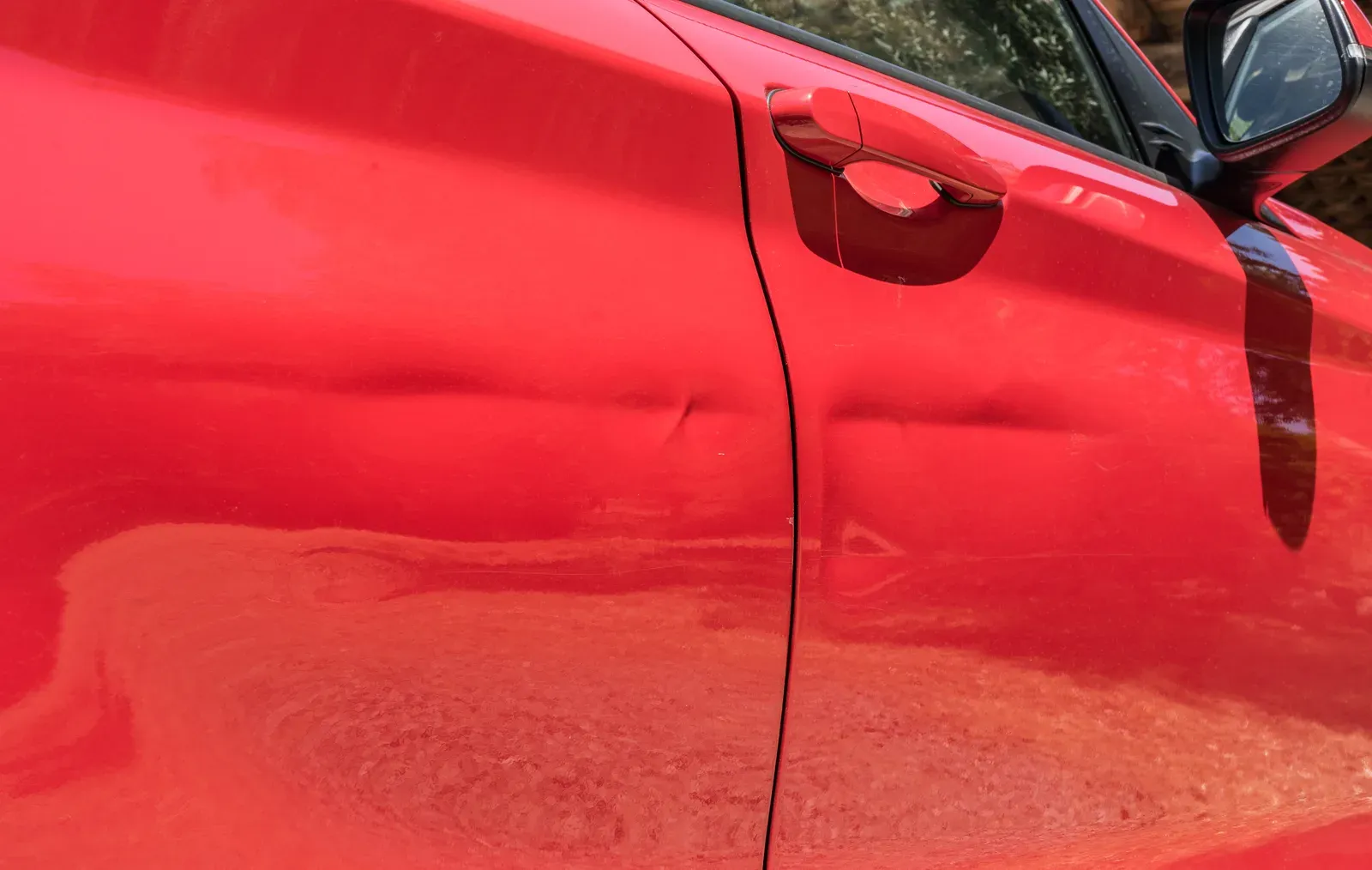
The usual pattern is a long horizontal band of transferred material — white or off-white from a painted steel frame, brown from a wood casing, grey from aluminum trim — sitting on top of paint that is scratched but not necessarily cut through. Underneath that band, at the point where the frame first caught, there is often a crease or a dent where the metal actually moved.
Wipe a corner of the band with a solvent-dampened cloth. Transfer that lifts off and leaves gloss underneath is the good scenario, and you may be looking at a polish plus one small repair rather than three panels of paint. Anywhere a nail catches, the colour is cut and that section is getting sprayed.
Two things get caught in this collision that people miss. Door handles and their surrounds take the hit because they stand proud of the panel, and the mouldings along the belt line pop their clips, which is why a door can look fine and then rattle for the rest of its life. Both belong on the estimate.
When the door was open: hinges, hems and the house itself
Reversing with a door open is its own version of this. The frame catches the door’s leading edge — a folded hem with paint laid over a seam — and dents it in a way that is slow to straighten without cracking the finish. Worse, the hit loads the hinges and the check strap sideways, a direction they were never designed to take, so afterwards the door may sit slightly proud at its rear edge or need a lift to latch. Getting the door back flush in its opening is hinge and alignment work before it is ever paint work, and it is the first thing we check.
The sequence of contact matters when you describe it. On most garage scrapes the mirror meets the frame first, folds or cracks, and then the door skin takes over as the car keeps moving — so there are usually two distinct damage sites, not one, and the second often hides behind the transferred paint a hand-span back from the mirror.
The house has its own casualty list. A bent aluminum capping on the frame, a torn weatherstrip or a split jamb is a home-maintenance or home-insurance question, not an auto-body one — the two policies do not offset each other, and each has its own deductible, so fixing a scraped jamb yourself while claiming the car is a perfectly normal split.
The geometry behind all this is built into the housing stock. The single-car garages on postwar North York and Scarborough bungalows were framed for much narrower cars, and a current SUV clears the opening by a few centimetres per side. The newer double garages in Thornhill and Markham subdivisions are wide overall but often split by a centre post, which is exactly where mirror caps and door edges go.
A one-car scrape is an at-fault claim, so run the numbers first
A garage-frame scrape is a single-vehicle at-fault incident. There is no other driver, DCPD does not come into it, and if you claim, it runs through your collision coverage with your deductible and gets recorded as at-fault. That is the part drivers usually have not thought about when they call.
So the arithmetic is straightforward. Get the written estimate and set it against the deductible plus whatever an at-fault claim is likely to do at renewal, which is a question worth putting directly to your insurance company. Plenty of people in this situation pay out of pocket and never open a file at all.
If the damage is bad enough to claim, we handle the file with your insurance company, including the supplement when hidden damage turns up as the door trim comes off. If the mirror carried a blind-spot sensor or a camera, recalibration may be required once the assembly is replaced, and it goes on the estimate before the car comes in rather than after.
Questions people ask
Will polishing take a garage scrape out?
It removes transferred paint and it will lift marks that live only in the clear coat. It does nothing for a scratch that has cut the colour, and it cannot lift a crease. Try a solvent wipe on a small section to see which one you are dealing with before investing in a machine polish.
The door was open when I reversed and the edge is bent — is that a different repair?
Yes. A door edge is a folded hem, and a bent one is straightened slowly so the paint over the seam does not crack. The hit also strains the hinges and check strap, so the door is checked for flush fit and latch effort before any refinishing starts — alignment first, paint second.
My mirror still works. Does it still need replacing?
Not automatically. If the housing is sound, the glass is tight and the fold action feels normal, a new cap and a colour match on it is often all that is needed. A cracked internal hinge will let go later, usually in a car wash, so that one is worth replacing while the vehicle is here.
Can I drive with the mirror folded in until the part arrives?
On the passenger side, usually yes for careful local driving, provided the interior mirror gives you an adequate view to the rear. A damaged driver-side mirror is a different matter — plan the trip here and little else. Tape a loose assembly flat to the door first so it cannot swing and dent the skin.
Does my home insurance cover the car or the frame?
The building, not the vehicle. A damaged jamb, capping or weatherstrip is a question for your home policy; the car runs through your auto policy or your own pocket. The two claims are separate, each with its own deductible, and many owners repair the frame themselves and deal only with the car.