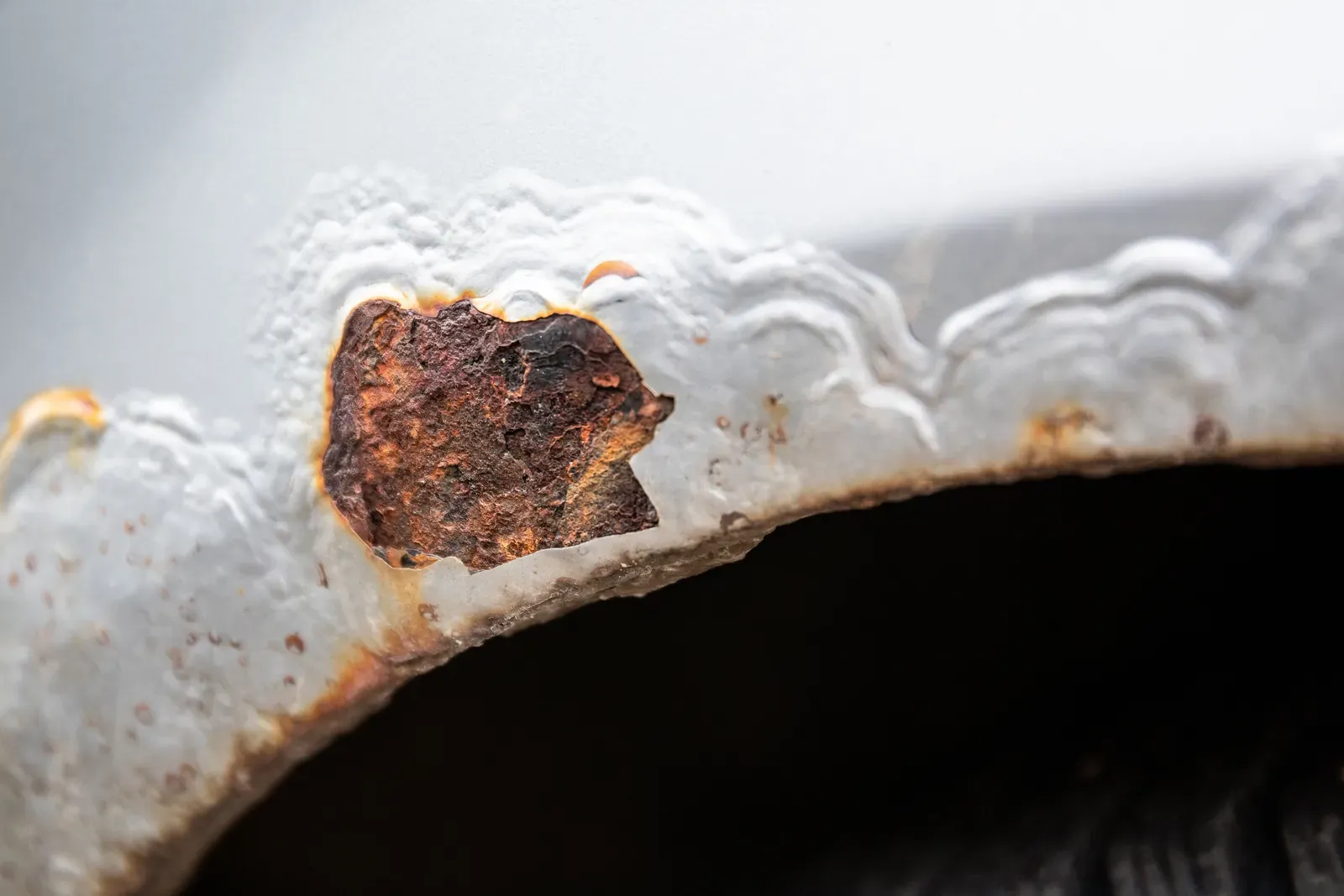
What to check the day you notice it
Push on the blister with a thumb, gently. Sound paint over sound metal stays rigid. A bubble that gives, flexes or breaks open under light pressure is telling you the steel behind it has already thinned or perforated, and that the paint is the only thing left holding the shape.
Then look where you cannot easily see. Turn the wheel to full lock and shine a light up behind the arch liner. That is where the damage actually lives — salt slurry sits in the gap between the liner and the metal lip, stays damp for days at a time, and eats outward from the inside. What shows on the outside is the last stage, not the first.
Check the rest of the car while you are down there. Rust does not appear at random; it appears where the design traps moisture. If one arch has bubbled, the other is usually not far behind, and the doglegs behind the rear wheels, the bottom lip of the doors, the tailgate seam and the area around the fuel filler all deserve a look with a flashlight.
One thing not to do is sand the bubble and brush touch-up over it. Sealing rust in the dark under fresh paint does not stop it. It hides the problem for a season, and it comes back wider than it was.
Why arches go first
A wheel arch is the worst place on a vehicle by design. The tire throws everything the road has — brine, grit, sand, meltwater — straight into it, at speed, all winter long. The arch lip is a folded seam with two layers of steel pressed together, and capillary action pulls salt water into that seam and holds it there. Then a stone chip breaks the coating on the outer surface and gives it a second way in.
Corrosion needs metal, oxygen and an electrolyte. Road salt supplies the last of those and keeps working well below freezing, which is exactly why Ontario uses it and exactly why cars here rot in ways cars in dry provinces do not. It accelerates through the freeze–thaw weeks of February to April, when the underside spends more time wet and above zero than frozen solid.
By the time it bubbles through the paint, the metal has usually been going for two or three seasons. A blister you could cover with a fingertip commonly maps to a rotted area several times larger once the paint is stripped off it. That is not a sales line; it is the ordinary geometry of rust working outward from behind.
A lasting arch repair starts by cutting past the visible rust
A repair that lasts starts by removing everything that is not sound metal. The liner comes out, the area is stripped back well past the visible damage, and the true extent is judged on bare steel where it can finally be seen. Anything perforated or paper-thin gets cut out.
Then new metal goes in. A patch is shaped to the curve of the arch, welded in, and the welds are ground back and sealed. The inside face — the part nobody will ever look at — is primed and treated as well, and the cavity behind gets a wax injection, because a patch that is perfect outside and bare inside is a repair with an expiry date on it.
Only then does it become a paint job: epoxy primer, filler used sparingly to level the seam, sealer, colour and clear, blended into the door or the quarter so the work has no edge to find. The lifetime warranty on our paint and refinish work is a straightforward thing to offer over cut-and-welded steel, and an impossible thing to offer over filler laid on rust.
A lesser alternative exists too. On an older vehicle where the goal is a few more winters, grinding back, treating and refinishing without cutting will buy time — less time, for less money — and we say plainly which of the two you are getting.
No claim, so the decision is yours
Corrosion is excluded from every Ontario auto policy. It is wear rather than a sudden accidental loss, and there is no version of a comprehensive or collision claim that pays to fix rust. The only coverage that ever applies is a manufacturer’s perforation warranty on a newer vehicle, and those run out long before most arches start to blister.
So the decision is a plain one about the car. How many winters do you intend to keep it, what is it worth, and is the rest of it sound? A vehicle you plan to drive for another five years is worth cutting and welding properly. One you are selling in the spring may only need enough to present honestly, and it helps to know that a used-vehicle safety inspection cares about structural corrosion and brake lines, not about a cosmetic blister on an arch lip.
Timing is the other half of it. Rust work wants dry, warmer months, and doing it in April or September rather than January is both easier and better for the finish. Book it before the salt goes down, not after, and treat the underside afterwards so the same seam does not start over.
Send photos of the arch — straight on, at an angle, and one taken up inside behind the liner — and the written estimate will say which of those two paths your vehicle is on.
Questions people ask
Can you just sand the bubbles and repaint the arch?
You can, and it looks right for a while. Paint does not stop corrosion already sitting in the seam behind the panel, so it returns, usually within a couple of winters and usually larger. If the metal is still solid, a strip-and-refinish is legitimate. If a thumb press moves it, it needs cutting.
My car is eight years old — does the factory perforation warranty still help?
Probably not for long. Perforation warranties cover rust that ate through from the inside on a relatively new vehicle, and their year and distance limits are ones most bubbling arches have already outlived — check the booklet before assuming. Ontario auto policies exclude corrosion entirely, so arch work is paid for directly.
Should I fix an arch on a car I am about to sell?
It depends what a buyer will see. Visible rust on an arch is one of the most effective ways to lose money on a private sale, because buyers read it as neglect and assume there is worse underneath. If you are trading it in, the calculation is different and often not worth doing.
How long does an arch repair take?
A cut-and-weld repair with proper sealing and refinishing is usually the better part of a week per side, because welding, sealing, priming and painting each want their own time and the cure cannot be hurried. A strip-and-refinish without cutting is shorter. The estimate tells you which one applies.