The definition, in one sentence
Blending is the technique of carrying a freshly mixed colour partway into an adjacent undamaged panel, thinning the coverage as it goes, so that new and old paint overlap across a wide fade rather than meeting at a border — and the eye, which is excellent at finding edges and poor at detecting slow gradients, never locks onto it. For the plain-language version of what blending is and why a perfect mix still needs one, the answer page on panel blending covers it; this guide is about how the operation is laid out, priced and executed.
How far into the next panel the colour goes
A blend is not a whole second paint job and not a light dusting at the gap either. In practice the colour travels roughly the nearer third to half of the adjacent panel, feathered out over about a hand-span, with the strongest new material sitting closest to the repair and the lightest farthest from it.
The clear coat is different: it goes over the adjacent panel edge to edge, every time. Clear cannot simply stop in open surface — a dry edge mid-panel leaves a line that shows within a season. A blending solvent can melt a small clear edge into the old finish, and that spot-repair technique may hold up in the right circumstances, but it has limits of its own, which is why a proper blend clears the whole panel and lets the fade live in the colour beneath it.
The layout is planned before anything is masked, because it determines what comes off the car — a mirror, a door handle, a moulding, sometimes a weatherstrip — so the fade never has to end at a tape line.
- A repaired front fender usually blends into the front door
- A repaired door blends into the door beside it, or into the quarter panel
- A quarter panel may blend into the roof, which is the hardest surface to hide a transition on
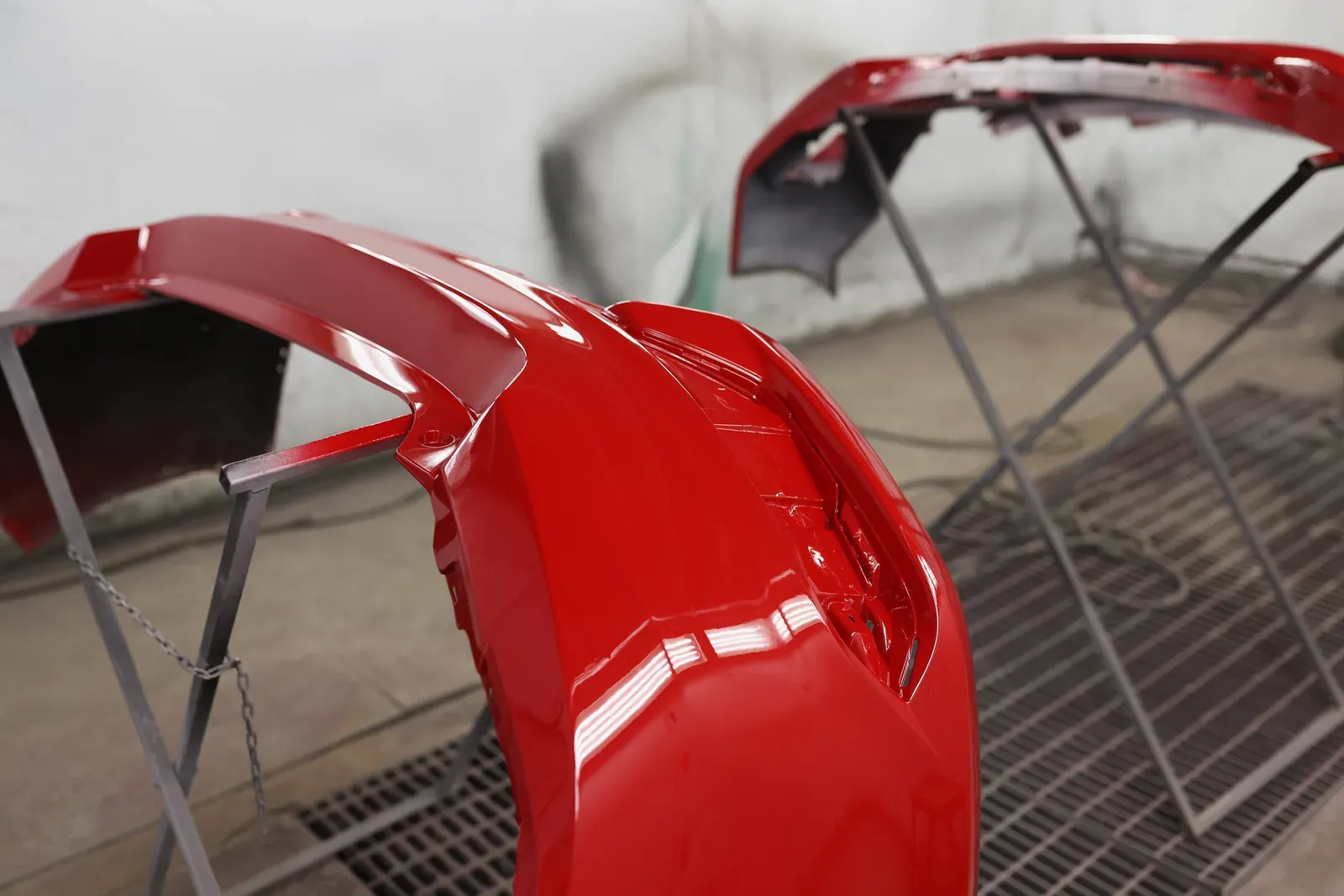
- A bumper cover is usually painted complete as a part; on a metallic or pearl the adjacent fender is often blended so the plastic’s slightly different texture does not read as a colour step
- A hood is normally refinished whole, because there is nowhere on it for a blend to end
What the blend line on your estimate pays for
When an estimate lists refinish time for a panel with no damage on it, that is the blend, and the estimating convention is specific: it is written at a fraction of that panel’s full refinish time. The shorthand buys a defined list of work — the panel scuffed and prepared, its hardware removed or masked, colour carried partway across, and clear applied over every inch of it.
It is not padding — a shop that trims the blend to keep a number lean is the shop whose repair you can spot from the driveway — and our estimator writes it into the first estimate rather than adding it later as a supplement, so nobody is surprised and the claim does not stall mid-repair.
Old paint beside new: the reverse blend
Sometimes the adjacent panel is the problem. On a vehicle where the neighbouring paint has aged hard — a ten-year-old hood beside a new fender, a sun-bleached quarter — fading fresh, correct colour into tired paint can make the tired paint look worse, because the fade points a spotlight at the difference.
One answer is to work the transition in the other direction: tune the mix toward the aged panel rather than the master formula, and lay the fade into a wet bed of blending base so the new material melts toward the old rather than sitting on top of it. It is a judgment made at the spray-out stage, with the card held against the faded panel rather than the repaired one.
And where the neighbour is heavily faded, peeling or carrying its own damage, the better answer is usually to refinish both panels properly rather than fade good paint into a finish that is on its way out. That choice belongs on the estimate, not in the booth.
When blending is not the answer
Solid, non-metallic colours — plain white, plain black, many fleet colours — can often be butt-matched at a panel edge, because there is no flake orientation to go wrong. If the formula is right, new meets old at the gap and nothing shows. That saves a panel of labour and the estimate should reflect it.
Three-stage pearls go the other way, and they bring their own tool: the let-down card. The painter sprays the ground coat across a test card, then applies the translucent pearl mid-coat in steps — one coat on the first band, two on the next, up to four — clears the card, and holds it against the vehicle to see which band matches. That count of mid-coats is then repeated exactly on the panel, which is why a pearl blend takes more cards and more booth time than the same repair in a plain metallic. Matte and satin factory finishes are a category of their own, since they cannot be polished and a blend has to be executed perfectly the first time.
Checking the work at pickup
Judge a blend outdoors, never under the fluorescent tubes of a shop bay, and never at arm’s length. Stand three or four steps back and look along the side of the vehicle so your eye travels across the repaired panel, over the join and onto the untouched one. Then walk the length of the car slowly. If a transition exists visually, it announces itself as your viewing angle changes, which is precisely the movement a static photograph cannot reproduce.
Check the shaded side as well as the sunlit side. Metallic finishes behave differently in direct light and in shadow, and a fade that is slightly heavy will show under an overcast sky sooner than under a July sun. Open the doors too, since jambs and shut faces are refinished on some repairs and left original on others depending on where the damage ended.
If something reads wrong to you, say so at the counter rather than at home a week later. Colour and blend work is easier to address while the vehicle is still in the shop’s hands, and the paint warranty here covers the refinish work regardless.
Questions people ask
Does blending mean you are painting undamaged parts of my car?
Yes, deliberately and only as far as the fade requires. The adjacent panel is prepared and cleared completely, with colour carried partway across. It is done to make the repair invisible, and refinish work on that panel carries the same warranty as the repaired one.
Can you blend without removing the door handle or mirror?
Sometimes, but it is rarely worth it. Masking around a handle leaves a hard tape line right where the fade should be smoothest. Removing the part takes minutes and lets colour run under and past the edge the way factory paint does.
Will I be able to see the blend if I look for it?
Under strong light at a shallow angle, on a difficult metallic, someone who knows exactly where to look occasionally can. From any normal viewing distance, in daylight, it should read as one continuous panel. That is the standard we work to.
What is the let-down card the painter mentioned for my pearl white?
It is a test panel for three-stage colours. The ground coat goes on, then the pearl mid-coat is sprayed in increasing steps across the card and cleared. Held against your paint, one band matches, and that number of mid-coats is repeated on the car — it settles the one variable no formula can: how many passes of pearl your finish carries.