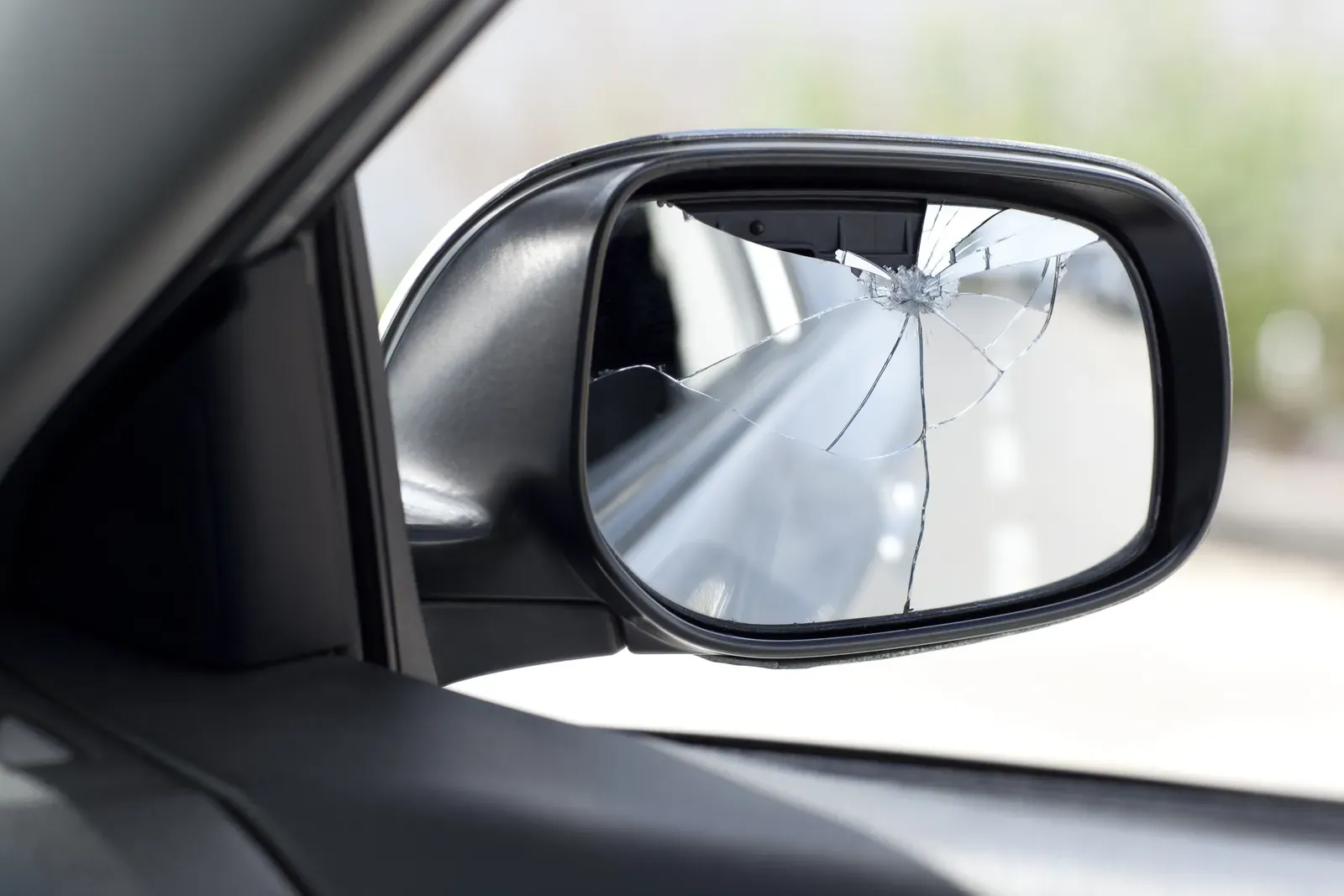
At the roadside, before you drive off
Collect everything. The glass, the painted cap, the black backing, the small clips — all of it goes in a bag, and all of it matters, because a mirror comes apart into separate pieces and the ones that survived can shorten the order. If the assembly is hanging by its wiring loom, tape it flat against the door instead of letting it swing; a mirror on a cable will beat a fresh set of dents into the door skin in a single trip home.
Check whether the door itself took anything. A mirror knocked off cleanly leaves a bare mounting triangle and maybe a torn gasket. A mirror hit hard enough to tear its base out usually creases the sail panel or the door skin behind it, and that is body work rather than a part swap.
Then the practical question: can you drive it? You need to be able to see behind you, and a vehicle with no driver-side mirror and no usable rear view is not one to take onto the DVP at rush hour. A passenger-side mirror gone is manageable for a careful trip across town. A driver-side mirror gone is not.
One last thing worth doing before you leave the spot: look up and down the street for the other half of the story. A cap sitting in the gutter, a streak of your colour along a parked van, a doorbell camera on the house beside you — any of those can turn an unidentified hit into an identified one, and that changes which part of your policy the repair goes through.
A mirror is five parts, not one
It looks like a single object bolted to a door. It is not. There is the mounting base, the housing, the painted cap, and the glass on its backing plate, and inside that housing, depending on the vehicle, a heating element, a power adjustment motor, a power-folding motor, a turn-signal lamp, a puddle light, a blind-spot radar module and sometimes a camera feeding a surround-view display.
That is why the first job is identifying the exact variant your car left the factory with, from the build data rather than from a catalogue picture. Two identical-looking mirrors on the same model can differ by whether the glass is auto-dimming or whether there is a camera in the underside, and ordering the wrong one costs everyone a week.
Sometimes the news is good. A mirror that folded and cracked only its cap needs a cap, not an assembly. A mirror whose glass popped off its backing can take new glass on its own. We look for the smallest correct repair before we go looking for a part number.
Matching the cap and putting the door right
Replacement caps arrive primed or in a generic black, so on any vehicle with a body-colour mirror the cap gets sprayed here. It is a small part with a lot of curve, which makes it one of the fussier things to match: the colour is mixed to your paint code, sprayed on a card, checked against the door in daylight, adjusted, then applied and cleared so the gloss and the texture agree with the panel it sits beside.
If the door skin creased when the mirror was torn away, that gets straightened before anything is bolted back on. A dent behind a mirror base sits in an awkward place — the sail area is small, stiff and tight to the window frame — so it is often glue-pulled from the outside instead of pushed from behind.
Where there was a blind-spot module or a camera in the mirror, recalibration may be required once the new assembly is fitted. It is not automatic on every vehicle and we do not pretend otherwise, but we check what yours asks for and put it on the estimate rather than handing you a warning light at pickup.
Deductible, hit-and-run, and when it is worth a claim
A mirror on a base model with manual glass is one of the few repairs that genuinely sits below most deductibles, and paying directly is normally the sensible route. A power-folding, heated, signal-equipped mirror with a radar module inside it is a different order of part, and that one can be worth claiming.
How it gets claimed depends on what happened. Clipped by a passing vehicle whose driver stopped: that is a collision between two vehicles, DCPD applies when you are not at fault, and your own insurance company handles the vehicle damage. Clipped by a vehicle that kept going, or found broken in the morning on a narrow street off the Danforth: that is a hit-and-run, and it usually runs through collision coverage with your deductible unless the other driver is identified. Report it to police, and to your insurance company promptly.
The garbage-day version deserves its own mention, because it is common on older residential streets where cars park tight to the curb and a truck needs the full lane. If the vehicle is identified, that is an ordinary claim. If it is not, you are back on your own coverage. Either way, photograph the door and the mounting base as well as the broken mirror, so the estimate covers the whole of what happened.
Questions people ask
Can I use an aftermarket mirror to save money?
Sometimes, and on a simple manual or basic power mirror it is a reasonable choice. Where there is a radar module, a camera or auto-dimming glass, aftermarket quality varies enough that we push for the original part. No Ontario law forces either option, and if your insurance company writes for like-kind-and-quality you can request the original and pay the difference.
Is it illegal to drive with a missing side mirror?
You are required to have an adequate view to the rear. A vehicle with a working interior mirror and an intact passenger-side mirror generally satisfies that; a missing driver-side mirror on a car with a blocked rear view does not. Beyond the rules, merging onto the 404 with a blind left side is not a risk worth taking.
Why does the cap need spraying here instead of arriving in my colour?
Because a pre-painted cap is mixed to the factory code, and a code knows nothing about the summers your car has spent outside. Caps arrive primed or in black plastic; we spray yours against the door it will sit beside, so the cap does not read as a newer shade of the same colour.
How long does a mirror replacement take?
Once the correct part is in hand, fitting is short, and the wait is almost entirely the part and the paint. Caps need spraying and curing before they go on. If the door needs straightening as well, plan on a few days rather than an afternoon.