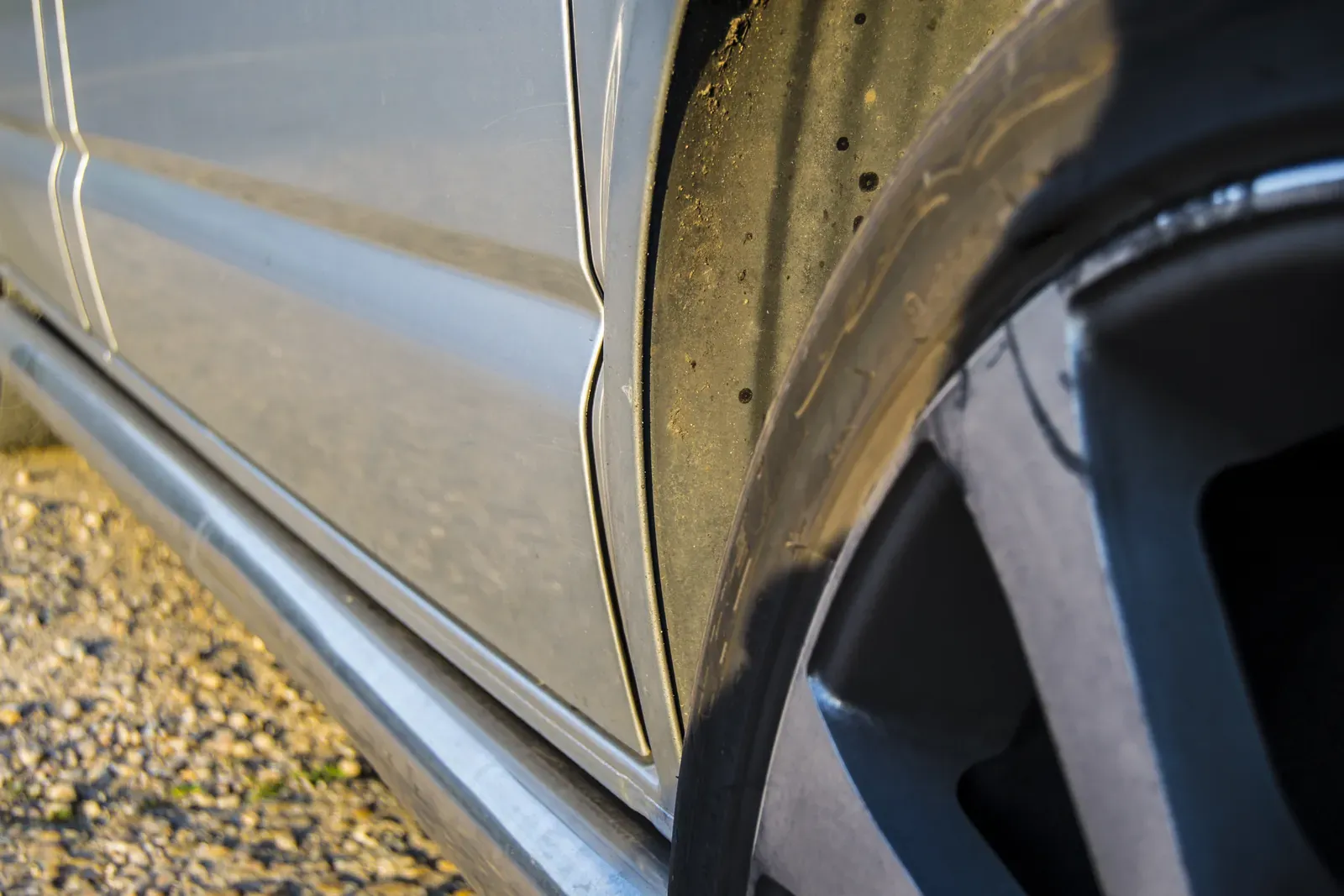
Look under the lip before you drive off
Curb strikes read worse from the ground than they do from the driver’s seat. Park somewhere flat, crouch at the corner you caught, and look up under the bumper. That lower lip is where the plastic takes the load, and it is where cracks start.
Wipe the area with a wet cloth first. A good share of what looks like a gouge is transfer — concrete dust, paint off a painted curb, rubber from a wheel stop. Whatever is still there after the cloth is the real damage.
Then check the fit. Follow the gap between the cover and the fender on both sides of the car. If one side sits proud, or the cover has sagged toward the tire, a mounting tab has already let go behind the paint even when the front face looks tidy.
- Shoot the whole corner from about two metres back, then the crack up close, then the wheel and tire on that side.
- Check the rim for a fresh bright line — if the tire touched hard, the wheel took part of the hit too.
- Glance underneath for a drip of coolant or oil before you move the car.
- If the cover is hanging, tape it up and away from the tire rather than letting it flex all the way home.
What a curb usually turns out to have done
A modern front end is three layers: a painted flexible cover, a foam or honeycomb absorber behind it, and a reinforcement bar bolted to the frame rails. At the speed you take a parking curb, that bar almost never moves. The cover and its brackets absorb the entire event.
The most common result is a scuff that has cut through the clear coat into the colour, with a stress crack running out of one of the mounting holes. Next most common is a snapped tab — a small plastic ear behind the headlight or wheel-arch liner that clips the cover in place. With the tab gone the cover still looks attached, and then it starts to droop during the first warm week.
Less common, still worth checking: a fog-light bezel cracked out of its frame, a parking sensor pushed off its retaining ring so it now aims at the pavement, a wheel-arch liner torn loose and rubbing, or a bent lower valance that catches air and hums above eighty on the 401.
If the rim picked up a mark, say so when you send the photos. A curb hit hard enough to jar a wheel earns a steering and alignment check, especially if the car has started pulling or the steering wheel no longer sits straight on a level road.
What we do with a cracked cover
The cover comes off the car. There is no honest way to judge a crack from the painted side — the back of the panel shows how far it has travelled and whether the plastic stretched or simply split.
When the tabs and mounting flanges are intact, we repair. That means grinding a V into the crack from both faces, welding the plastic back together with a matching rod, laying reinforcing mesh into the back, then filling, priming and blocking the front until a straightedge sits flat across it.
Refinishing is where a bumper repair passes or fails. Bumper plastic accepts colour differently from the steel fender beside it, so we spray a test card, tune the mix, and blend into the neighbouring panel instead of stopping at the seam. The match gets checked outside in daylight, not under shop lights.
Where the mounting structure is destroyed, we replace the cover rather than pretend a repair will hold, and we argue for the original-equipment part whenever a sensor bracket or radar mount is moulded into it — those brackets are what the sensor aims by. If the car has front sensors or a camera behind the grille, recalibration may be required once everything is back together.
Claim it, or just pay for it
A curb is a single-vehicle collision. There is no other driver, so there is no not-at-fault route and no DCPD involved. It goes on your own collision coverage with your deductible applied, or you pay for the work directly.
That turns it into arithmetic you can do at the counter. We write down what the repair actually takes; you weigh it against your deductible and against what a chargeable claim does to your renewal. For one cracked cover, paying directly is often the quieter answer. For a corner that also took out the headlight, the wheel and a sensor, the claim usually earns its keep.
Leased cars get a third column. Return standards do not care whose fault it was, and a cracked cover handed back at lease end is charged at rates nobody negotiates with you.
Either way, get it in writing before you decide. Send photos of the corner from your phone and the estimate lays out both routes on one page, so you can choose from your kitchen table.
Questions people ask
What decides whether a cracked cover gets repaired or replaced?
Plastic covers are repairable more often than people expect. The deciding factor is not the crack itself but the mounting structure around it — tabs, flanges and bracket bosses. If those are whole, a welded and reinforced repair holds and refinishes invisibly. If they are shattered, the cover no longer has anything to hang from, and replacement is the right call.
Will the repaired spot crack again in the cold?
A repair done from both faces — welded through, meshed at the back, then filled and blocked at the front — flexes with the rest of the panel through a Toronto winter. Repairs that fail are usually filler-only patches with nothing structural behind them. Ask any shop whether they weld the back of the cover or only skim the front.
Do I have to tell my insurance company about a curb strike I plan to pay for myself?
There is no other driver and no third party to report to, but the standard policy still expects prompt notice of any incident you might later claim for. A quick call costs nothing and keeps the option open if hidden damage turns up once the cover comes off. Keep the estimate, the invoice and the photos you took on the day either way.
The crack is underneath where nobody can see it. Can I leave it?
You can, but plan on it growing. Flexible plastic transmits every speed bump and cold snap to the ends of a crack, and what starts under the lip works its way up into the painted face where it becomes a much larger refinish. Repairing it while it is still hidden is the cheaper version of the same job.