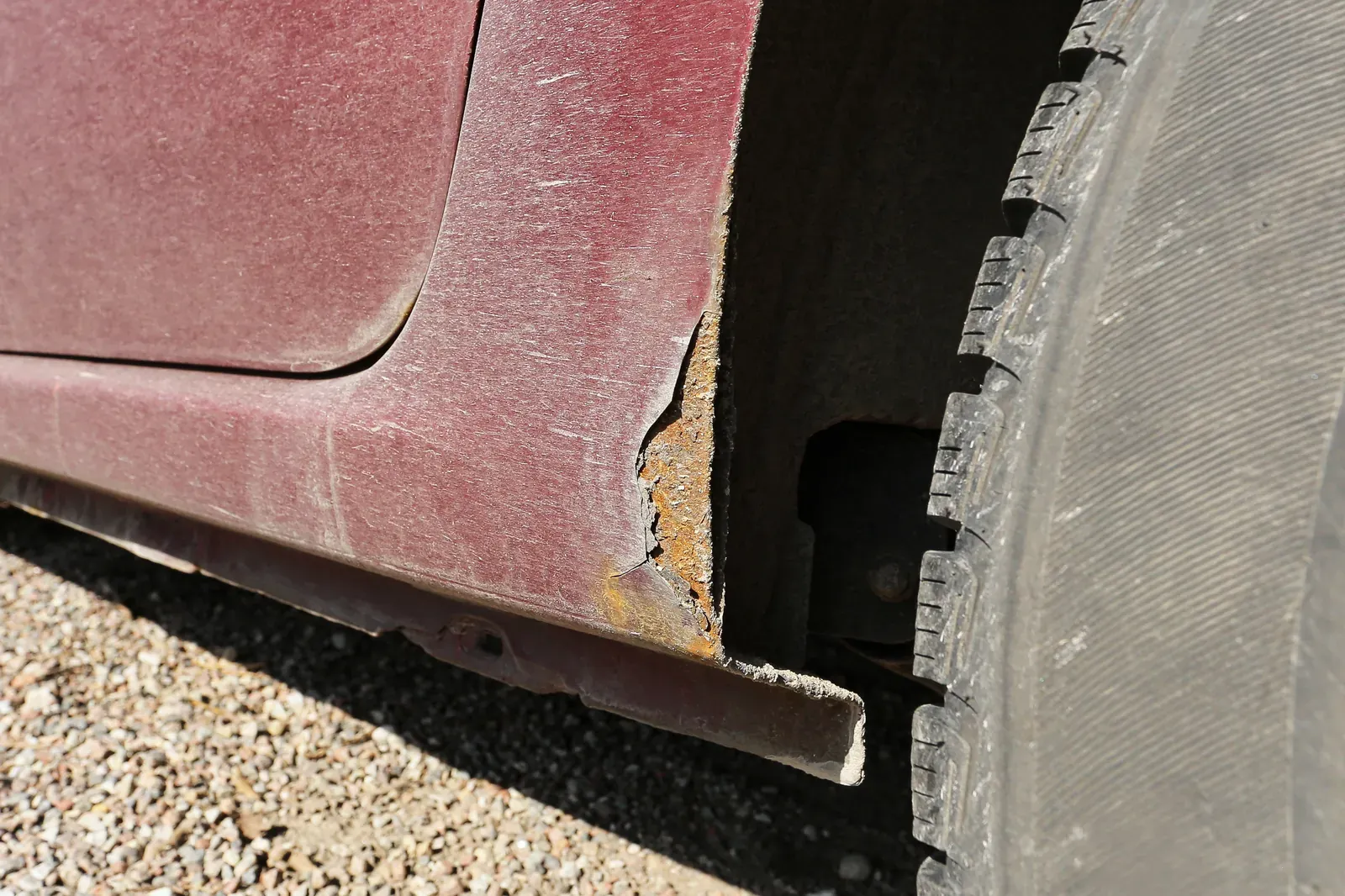
Find the real edge of the rot
Open the front door and look down at the sill. The rocker is the long box section running under the doors from the front wheel to the rear, and the first clear look at it comes from that angle with the door out of the way. Lift the sill trim if it comes away easily, and check where the outer skin meets the floor pan, because that seam is where the trouble normally starts.
Now tap along it. A knuckle or a screwdriver handle, front to back, listening as you go. Sound steel rings. Metal that has thinned from the inside gives a dull, flat note, and the stretch that sounds wrong is almost always longer than the stretch that looks wrong. Put a piece of tape at each end of the dull section so you can see its true size.
Two more checks. Find the jacking points, usually a reinforced notch under the pinch weld, and see whether the metal there is still solid, because that is what a jack loads and what a hoist arm grips. Then look for the drain holes along the bottom edge — on a car that has done ten winters here they are commonly packed solid with grit, which means the inside has been holding water through every thaw.
What ten winters of brine does to a rocker
Road salt does not need a hole to get in. Brine mist thrown up by the front tire coats the whole underside, works into the seam between the rocker skin and the floor, and sits there in the dark. Every freeze–thaw cycle wets it again. Over enough seasons the steel loses its thickness from the inside out, and the first visible sign is a row of blisters low on the panel, or a strip of paint that lifts away in a sheet the moment it is poked.
What is underneath is structure, not decoration. The outer rocker skin is cosmetic on most vehicles, but behind it sit an inner rocker and reinforcements that form part of the body’s side rail. They carry crash loads into the floor, they anchor seat belt hardware on some models, and they take the full weight of the vehicle at the jack points. That is the difference between an arch, which is a panel, and a rocker, which is part of how the car holds together.
Doglegs go at the same time. The dogleg is the short piece of quarter panel that curls forward at the bottom of the rear wheel arch to meet the rocker; it catches everything the rear tire throws, and on a salted vehicle it is often gone before the rocker itself. The bottoms of the doors join in, because doors have drains too and drains block.
Cutting back to sound metal
There is no shortcut version of this that lasts. The vehicle goes on the hoist, sill trim and any plastic cladding come off, and the affected area is stripped until the boundary between good steel and bad steel is actually visible. That boundary is where cutting starts, and it is normally further along than the tape you put down in the driveway.
Rotted outer skin is cut away. If the inner rocker is affected too, that gets dealt with first, with a patch shaped and welded in, because there is no sense putting new skin over compromised structure. New outer metal is then formed, or a replacement rocker skin is trimmed to fit, welded in place, and the welds dressed back flat.
The finishing is what decides whether you see this again. Seam sealer goes on the way the factory applied it, so water cannot stand in the new join. The inside of the cavity gets a wax injection through the drains. The outside is epoxy primed, levelled, sealed, sprayed and blended into the door and quarter above it, and the underside gets a coating that will take stone impact without chipping off.
On some vehicles the outer rocker is bonded rather than spot welded, and the manufacturer’s method matters. We follow it rather than improvising, because a structural panel attached the wrong way is a safety problem that will not show itself until the day it counts.
Nobody insures rust, so the maths is about the car
There is no claim here. Corrosion is excluded right across the board, and no way of describing it as sudden changes that; a policy pays for accidents, and salt is not an accident. Rocker work is paid for directly, which makes the estimate a decision document rather than a formality.
What tips the decision is usually structure and inspection. A vehicle that needs a Safety Standards Certificate to be licensed in someone else’s name will not pass with structural corrosion at the jack points or near suspension mounting areas, so if you are selling privately the work stops being optional. If you are keeping the car, the question is whether the engine, transmission, suspension and the other rocker justify the metalwork.
The wrong answer is the cheap patch: fibreglass, filler and paint laid over metal that is still rotting behind it. It looks solved for a summer, it fails an honest inspection, and it makes the eventual real repair bigger because all of that has to come off first. If the budget does not stretch to a proper repair this year, treating and sealing the area to slow it down is a better interim step than covering it up.
Book the work for the dry months if you can. Spring and early autumn are the window: the salt is off the roads, the underside can be cleaned and dried properly, and new sealer and coating go onto a surface that is genuinely dry. Send photos along the sill and up under the car, and the estimate will say whether you are looking at a patch, a full outer skin or inner-rocker work as well.
Questions people ask
Why does a rotted rocker matter more than a rusty arch?
Because the outer skin hides structure. An arch is a panel; the inner rocker carries crash loads into the floor and is what a jack or hoist lifts against. Once rot reaches the inner section the vehicle is weak exactly where it needs to be strong, and an inspection for a Safety Standards Certificate treats structural corrosion accordingly.
Can you weld in a patch instead of a whole rocker?
Often, yes, when the rot is confined to one section rather than the full length. A properly shaped, welded and sealed patch surrounded by sound metal is a real repair. What does not work is welding a patch to thin metal at its edges, which simply moves the failure a few centimetres along.
Will the repaired area rust again?
Not the way it did, provided the inside is treated. Most repeat failures come from work that was welded and painted on the outside only, leaving bare steel in a cavity that fills with brine every winter. Seam sealer, cavity wax and a stone-resistant underside coating are the parts that make it last.
Should I rust-proof the car after the repair?
It is worth doing, and worth doing on the whole underside rather than only the repaired section. An annual oil-based treatment creeps into seams and displaces moisture, which is precisely the mechanism that killed the rocker in the first place. Have it done in autumn, before the salt trucks start.