The first ten minutes after the bang
A hard pothole strike sounds worse than most collisions and feels like the car hit a step. Get off the road at the next safe spot — a side street or a plaza entrance, not the shoulder of the DVP — and start with the tire you hit on. You are looking for a bubble or a bulge in the sidewall, a cut, or a rim lip that has been rolled or flattened. A sidewall bulge is a broken carcass inside the tire, and it can come apart later at speed with no further warning.
Next, get back in and drive slowly in a straight line on a flat surface. Does the steering wheel sit centred? Does the car pull? Is there a new vibration through the wheel at forty or through the seat at ninety? A wheel that is now off-centre by a few degrees points at a bent tie rod or a shifted alignment, and a vibration that arrives only at speed usually points at the rim.
Photograph the hole if you can do it without standing in traffic, along with the street name and the direction you were travelling. If you intend to claim against the road authority later, that photograph and the date are most of the file. Then check the front air dam and the under-tray, because a car that bottomed out in a deep hole often leaves part of its plastics in it.
What usually turns out to be bent
The wheel takes it first. Alloy rims fold at the lip where the tire bead sits, and a flat spot the width of a thumb is enough to leak air slowly and shake the car at highway speed. Steel wheels dent instead of cracking, which is why they survive this city better. Behind the wheel, the parts that bend in order of frequency are the outer tie rod end, the lower control arm and its bushing, and the strut itself, which can take a set that no alignment will correct.
The give-away for a bent tie rod is exactly the symptom you noticed in the first ten minutes: the steering wheel no longer sits square when the car goes straight. The give-away for a bent strut is an alignment technician who cannot bring camber back into range on one corner no matter what is adjusted. A control arm bushing that has torn shows up as a clunk over expansion joints, and it usually arrives a few days after the pothole rather than immediately.
On the body side, deep holes crack the lower valance, tear the under-tray from its clips, and occasionally push the front bumper cover down at the corners. Cars with low front ends collect all of that at once. If the hole was deep enough to strike the subframe, the car needs measuring rather than eyeballing, because a subframe that has moved a few millimetres changes every alignment number on the printout.
Where and when this happens in the GTA
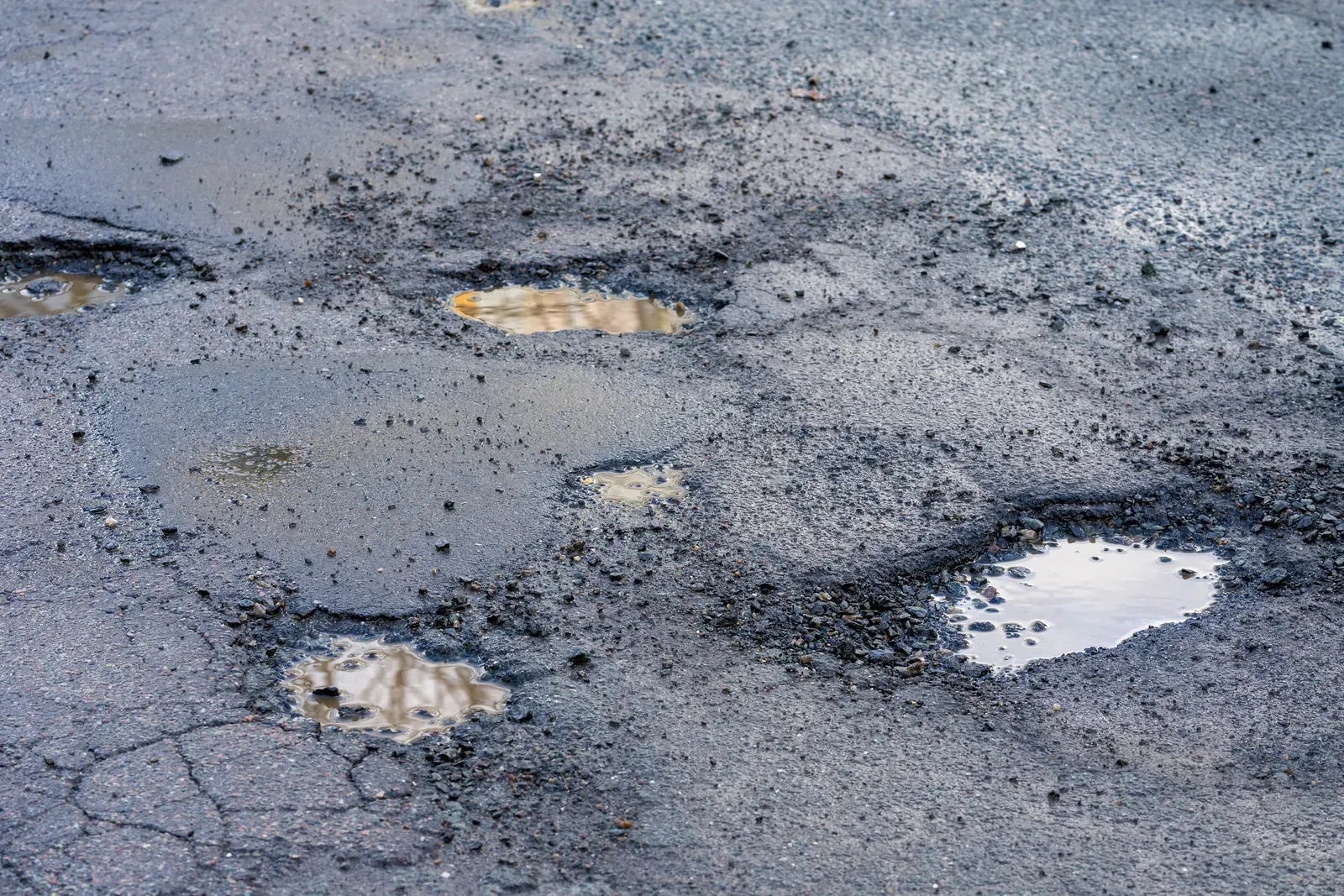
Pothole season here runs from roughly February through April, and it is a freeze-thaw problem rather than a cold problem. Water gets into a crack, freezes overnight, expands, and lifts the asphalt; the next afternoon it melts, traffic pounds the loosened surface, and by the following week there is a hole with a square edge that hits like a curb. The worst of it appears after a run of days that swing above and below zero.
The places that produce our spring work are predictable: Don Mills Road south of Eglinton where the pavement is patched over patches, the ramps at Leslie and Sheppard, the DVP northbound near York Mills after a thaw, Steeles across the top of the city, and the curb lanes of arterials where meltwater sits because the catch basins are still iced over. Curb lanes are worse than centre lanes for exactly that reason.
The practical defence is boring and it works: more following distance in March, so you see the hole rather than the brake lights of the car that just hit it, and slower through standing water because a puddle in early spring is not necessarily a puddle.
What we do, and what we send elsewhere
Send photos of the wheel, the tire sidewall and anything hanging off the front of the car, and say plainly what the steering is doing — our estimator writes the estimate from exactly that. Body-side work — cracked valances, torn liners, scraped bumper corners, a wheel-arch lip that got folded — is straightforward. Where the car needs measuring, it goes on the bench and the numbers come off the manufacturer’s specifications rather than off a tape measure.
We are honest about the boundary. A bent tie rod, a strut and a fresh alignment are mechanical work, and if the car needs a suspension shop rather than a body shop we say so instead of quoting it. What we do not do is repair a panel and hand back a car that still tracks crooked. Where the strike shifted structure, the measuring comes first, because everything else is guesswork until the numbers are in range.
If the car is not safe to drive on that tire, we help arrange the tow. Where the vehicle goes is your decision — that is true of every tow in Ontario, no matter who called it.
Your policy, the road authority, or the tire plan: three places to look
There are two routes and they rarely both work. Against your own policy, pothole damage is a single-vehicle collision claim: your collision coverage, your deductible, recorded as at-fault even though nobody hit you. Against the road authority, it is a claim in negligence, and it usually turns on whether the authority knew about that hole and had a reasonable chance to fix it. Those claims are slow, they demand your photographs and the exact location, and they are refused more often than they are paid.
Tires and rims are also worth checking against any road-hazard coverage sold with the tires themselves, which sits outside your auto policy entirely and does not touch your record. Between the deductible, the claim history and the size of the repair, a single bent rim is usually a wallet job and a bent strut plus a control arm plus a wheel usually is not.
Questions people ask
Is a bubble in the sidewall safe to drive on?
No. A bulge means the internal cords have broken and only the rubber is holding the shape. It can fail without warning, and it fails fastest when the tire is hot and loaded, which is to say on the highway. Put the spare on or have the car moved.
The car pulls to one side now. Is that just alignment?
Alignment is the symptom, not always the cause. A wheel can be knocked out of specification by the impact alone and adjust back in, but a bent tie rod, a collapsed bushing or a bent strut will not come into range no matter how the adjustments are turned. A proper alignment check tells you which of the two you have.
Does insurance cover pothole damage in Ontario?
Collision coverage does, with your deductible, and it is logged as an at-fault single-vehicle claim. There is no separate pothole coverage on a standard policy. Whether it is worth using depends entirely on how the repair compares with the deductible.
Can a bent alloy wheel be straightened?
Sometimes, by specialists who heat and press the lip back. It works for a mild fold on the inboard side. It is not appropriate for a cracked rim or for a wheel bent on the outer face, and any wheel that has been straightened should be checked for runout before the tire is remounted.