Getting clear of the merge
A merge sideswipe is loud, brief and rarely dangerous, and the risk starts afterwards. The acceleration lane at Highway 7 is short, traffic is arriving in the right lane at highway speed, and two cars stopped side by side at the end of a ramp are exactly what nobody behind them expects. If both vehicles roll, wave the other driver forward and keep going until there is real shoulder past the gore point, or come off at the next exit and do all of this in a lot.
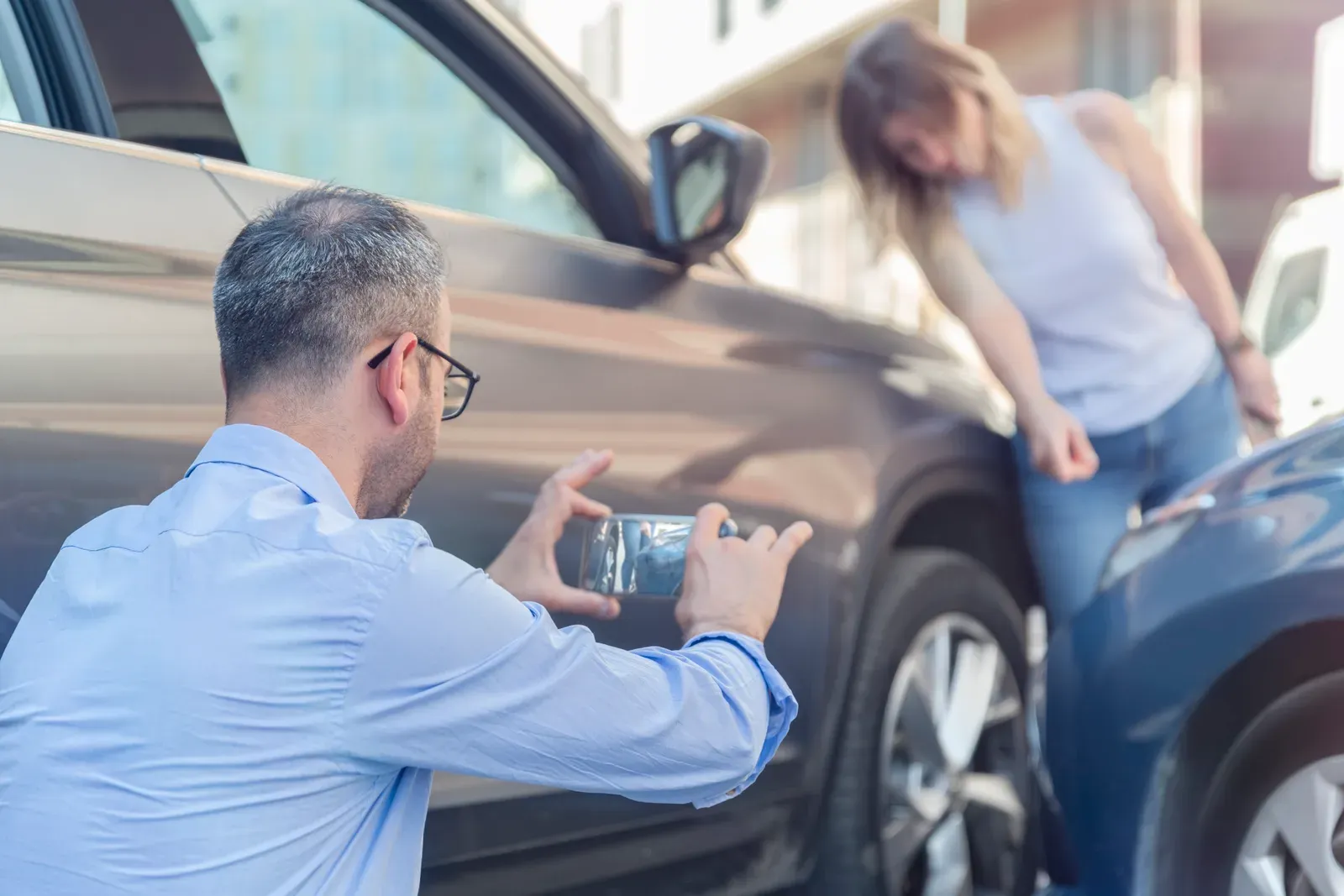
The photographs matter more here than in most collisions, because a sideswipe has no obvious geometry to reconstruct afterwards. Shoot both cars from the front, the rear and each side. Get the scrape close enough to show which way the marks run, and get the other car’s corresponding damage in the same detail, because paint transfer sits on the panel that was struck and tells the story about who arrived where. Then the plates, the pink slips, and a wide shot with the ramp and the sign in it.
Nobody is usually hurt in these, and the cars usually drive, so this ends at a Collision Reporting Centre rather than at the roadside. Go if the combined damage looks past the provincial reporting threshold — with a scrape crossing several panels on two cars, it commonly does. Give your account plainly and let the photographs carry the argument.
A scrape that crosses three panels
Sideswipes are wide rather than deep. A typical one runs from the front fender, across both doors, and dies out on the quarter panel, catching the mirror, both door handles and the rocker moulding on the way through. That is four or five separate parts and three or four painted panels from a contact that lasted under a second, which is why the estimate looks disproportionate to the drama.
Under the scrape, the questions are about edges. Door skins take a shallow dent and hold it. The leading edge of a door is folded metal and creases rather than dents, and a door that no longer sits flush in its opening usually means the hinge area took load or the frame moved. Mirrors shear off cleanly. The rocker moulding pops its clips and cracks at the ends. Wheel-arch lips fold back against the tire and are easy to miss until the liner starts rubbing.
One thing worth checking on the spot: whether the doors open and close normally on the struck side. A door that catches on the striker or drops when you open it is a structural clue, not a trim complaint, and it moves this repair into a different category.
Why a sideswipe is really a paint job
Straightening the metal on a sideswipe is often the smaller half of the work. The larger half is making three or four adjacent panels look like they left the factory together. Colour is mixed from the code on your door jamb, then adjusted against a sprayed-out card held to your actual paint, which has spent years fading in sun and salt. On a metallic or a pearl, the flake orientation shifts with gun distance, air pressure and panel angle, so two panels sprayed to the same formula can still read differently in the sun.
That is what blending solves. Colour is faded out into the panels next to the repair rather than stopped at a door gap, and the clear coat is carried across the whole surface so there is no hard line anywhere. On a car where the scrape crosses a fender, two doors and a quarter, the blend usually has to extend past the damage in both directions, which is normal work and belongs on the estimate rather than being treated as an extra.
Refinish work carries a lifetime warranty here, and that only means anything because of what happens under the colour: correcting the metal properly, sealing what was opened, and taking the time on prep. Where a panel is beyond straightening, replacement gets you a better result than filling, and our estimator will say so rather than sell you the cheaper line.
Fault when both drivers were merging
Lane-change collisions are the ones where the two accounts differ most, because both drivers genuinely believe they were established in the lane. Ontario’s Fault Determination Rules deal with lane changes and merges by rule rather than by argument, and they can land it entirely on one driver or split it between both. A split is far more common on a merge than in a rear-end hit.
For the repair, DCPD carries the part of the damage you are not at fault for, and your own insurance company handles that file. Where fault is shared, part of the vehicle damage is covered under DCPD and the rest falls to your collision coverage with its deductible, which is why a fifty-fifty finding costs more than a not-at-fault one. Where the OPCF 49 endorsement was signed to save on premiums, neither half is there — it strips direct compensation, collision and all perils in one move, and signs away any recovery from the other driver as well, leaving comprehensive as the only physical-damage coverage on the car.
Two practical notes. First, the photographs you took on the shoulder are what an adjuster uses when the two statements disagree, so send them in early rather than waiting to be asked. Second, the shop is your choice regardless of how fault is decided — a preferred list is a suggestion, and the claim runs the same wherever the car is repaired.
The ramp at Highway 7, and the rest of the 404
The 404 was built as a commuter pipe and its merges reflect that. The Highway 7 ramps feed a wall of Markham traffic into a lane that also carries everything coming off the retail strips, and the acceleration lane runs out sooner than drivers coming from a stop expect. Southbound at Sheppard, the reverse problem: the lane you are in becomes the exit for the 401 and everyone tries to be somewhere else at the same moment. Steeles and Finch have their own versions, and 16th Avenue is where the northbound traffic bunches.
Markham is about fourteen kilometres from us, which is fourteen to twenty-two minutes down the 404 outside rush hour, and we are at the Sheppard exit at the bottom of it. Cars from the whole 404 corridor come here for that reason as much as any other — a sideswipe repair that needs several days of panel and paint work is easier to live with when dropping it off is one exit rather than a morning.
Questions people ask
We both say the other one changed lanes. How is that decided?
By the rules and the evidence, not by the argument on the shoulder. The direction of the scrape, where the paint transferred, and which part of each car made first contact usually settle it. Photographs taken before the vehicles moved are the strongest thing you can put in the file.
Will the repaired panels match the rest of the car?
That is what blending is for. Colour is faded into the surrounding panels rather than stopped at a gap, so there is no edge for the eye to catch. Matching a well-aged metallic is a skill rather than a formula, and it is the part of this trade that is hardest to fake.
Fault came back split. What does that mean for my repair?
The share you are not at fault for is handled under DCPD by your own insurance company, and the remainder goes to your collision coverage with its deductible. The repair itself proceeds either way. A split finding is common on merge collisions and it can be disputed with the insurance company if the evidence supports it.
My door does not close properly since the hit. Is that serious?
It can be. A door that catches, drops or needs a push has usually lost its alignment because the opening moved rather than because the door did, and that points at load carried into the structure. It should be measured before anyone judges the repair by the scrape on the outside.