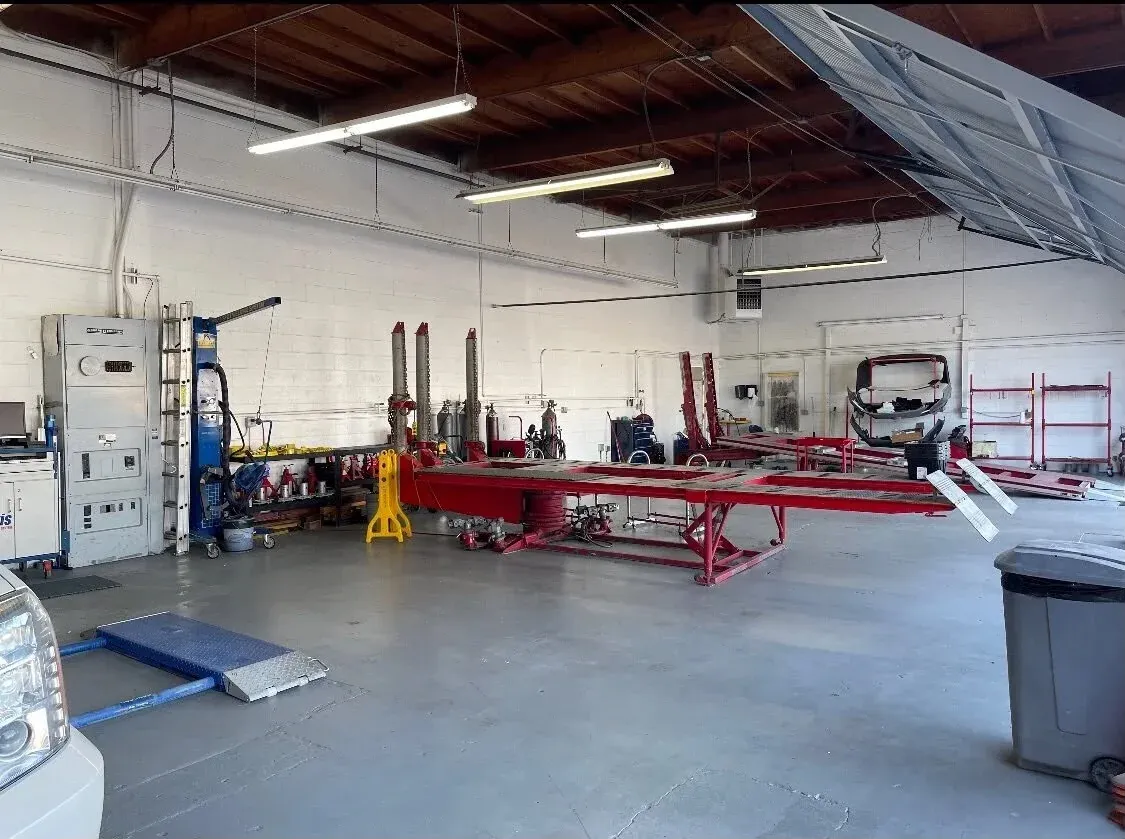
Frame damage today means the unibody has moved
Pickup trucks and a few large SUVs still have a ladder frame with the body bolted on top. Nearly everything else on the road, from a compact hatchback to a three-row crossover, is a unibody: the floor, the rails that run forward to hold the engine, the aprons alongside the strut towers, the pillars either side of the windshield and doors, and the rear rails under the trunk are all stamped steel and aluminum welded into one structure. There is no frame to speak of, so when a shop says “frame damage” on a unibody car, it means that structure has been pushed out of its designed shape.
The tell is often not visible. A front hit that crumpled the bumper and hood can also have shortened a rail by a few millimetres, or pushed a strut tower back and up. The panels get replaced and the car looks fine, but the suspension no longer sits where the engineers put it, the doors do not quite close, and the tires wear on one edge. That is why the diagnosis is done with measurement rather than by eye.
How we find it: measuring against factory data
Every manufacturer publishes the dimensions of its body as a set of reference points: holes, bolts and edges at known positions in three dimensions. A car suspected of structural damage is set on a frame bench or measuring system, and those points are measured and compared to the specification. A rail that is pushed back or a pillar leaning in shows up as a number, with a direction. The repair plan is written from that comparison, and the same measurement at the end of the job proves the car is back within tolerance.
This is the single most important step in a structural repair, and it is the step that gets skipped when a shop is in a hurry. A car pulled by eye until the hood closes may be a car with a rail still short on one side. Ask for the measurement printout on any repair that touched the structure. If there is not one, the shop guessed.
For drivers in North York, Scarborough and Markham who come in after a 401 or 404 hit, the measurement happens early, at the estimate stage, because it decides everything downstream: whether the car is repairable at all, which parts are needed, and what the insurance company is being asked to approve.
What can be pulled and what must be replaced
Some sections can be straightened. Mild steel in a floor or a lower rail can be pulled back to specification on the bench, with hydraulic force applied slowly against measured targets, and it keeps its strength. Other sections cannot. The high-strength and ultra-high-strength steels used in pillars, roof rails and many front rails lose their properties when they are heated or bent back, so the manufacturer’s procedure says they must be replaced, sometimes as a whole part and sometimes by sectioning at a specified line.
Replacement means cutting the damaged section out, fitting the new one, and joining it with the same kind of welds, rivets or adhesive the factory used, then restoring the corrosion protection inside the cavity. Aluminum structures have their own rules and cannot be worked with steel tools in the same bay. Following the procedure is what makes the repaired car crash the way it was designed to; the page on whether a repaired car is as safe as before explains the stakes.
- Lower rails and floor sections in mild steel: often pulled to specification.
- Front rails, aprons and strut towers: pulled or replaced depending on the steel grade and the extent of the damage.
- A-, B- and C-pillars and roof rails: usually replaced by sectioning, never heated.
- Aluminum rails and castings: replaced according to the manufacturer’s method.
Can it be fixed, and should it be
Most frame damage can be fixed. The question is whether it should be, and that is a cost question rather than a safety one. A structural repair done to procedure, with the right parts, is as sound as the original. What decides the car’s fate is the total on the estimate against the car’s value, which is the total loss decision explained on its own page. A modest rail pull on a valuable car is an easy yes. A full front structure replacement on a car worth little is where the insurance company writes it off.
A few cases genuinely should not be repaired: damage that reaches into areas the manufacturer says must not be sectioned, or a car that has already been repaired badly once and now has two problems layered together. We will say so at the teardown if that is what we find. Send the photos, and our estimator will look at where the damage sits before the car is even on the truck.
One practical point about timing. Structural parts on newer cars are sometimes on back-order, and a rail or an apron can take longer to arrive than the rest of the job takes to do. We order them the day the insurance company approves the estimate, and we tell you the honest range rather than a date we cannot keep.
Questions people ask
How can I tell if my car has frame damage?
Clues include doors that no longer line up, a hood or trunk that will not latch cleanly, uneven gaps, the car pulling to one side, and tire wear on one edge after a hit. Only measurement on a bench confirms it.
Is a car with frame damage automatically a write-off?
No. Whether it is repaired or written off depends on the repair cost plus salvage against the car’s value, not on the word “frame”. Plenty of structural repairs are approved every week.
Does frame straightening weaken the metal?
Not when the procedure is followed. Sections that can be pulled are pulled cold, to measured targets. Sections that would weaken are replaced instead, which is why the manufacturer’s repair method matters more than the equipment.
Will frame damage show on a history report?
The claim will show if one was filed. Whether it is labelled structural depends on what was reported. Either way, keep the measurement printouts: they show the next owner that the car was put back to specification.