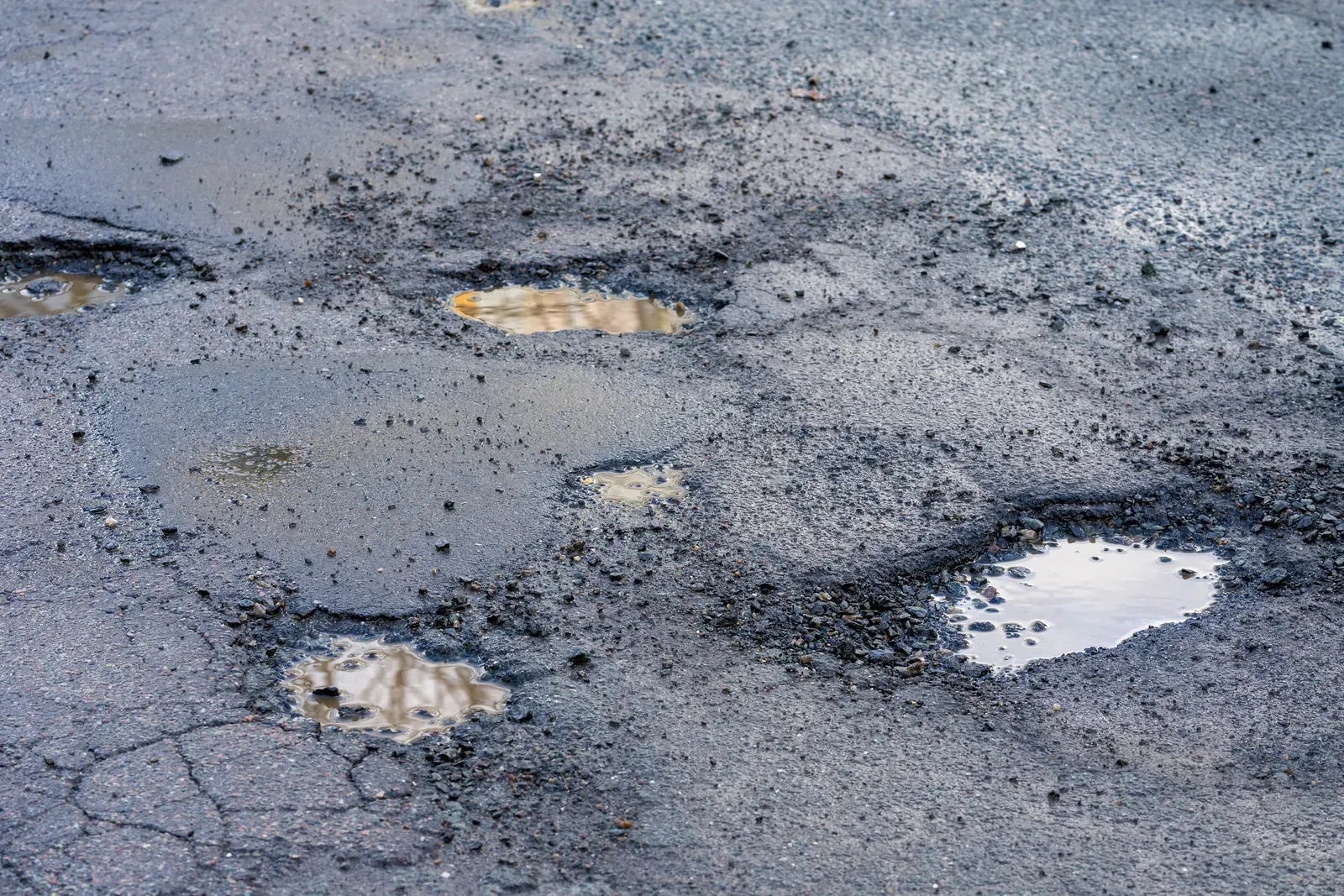
Why February to April is the worst of it
Potholes are made by water and temperature, not by traffic alone. Meltwater runs into a crack in the asphalt during a mild afternoon, freezes overnight and expands, and lifts the surface slightly. Repeat that a few dozen times through a GTA freeze–thaw stretch and a hairline crack becomes a cavity with a hard, square edge. The first heavy truck breaks the lid off it and now there is a hole.
That is why the same route you drove all winter turns hostile in late February. Ramps and merge lanes on the 404 and DVP, the bridge approaches, the worn lanes along Sheppard, Finch and Don Mills, and the patched sections of any plaza entrance all go at once, and rain or slush fills them so the depth is invisible until the wheel is already in.
The edge is what does the damage. A gently worn dip is nothing; a vertical rim of asphalt hit at speed acts like a chisel against the tire and rim.
The first ten minutes at the roadside
Do the boring things first, in order. Keep control of the car, signal, and find somewhere genuinely safe to stop — a plaza entrance or a side street, not a highway shoulder at rush hour if you can possibly avoid it. Then walk around the car with your hazards on and look properly rather than glancing.
- Tire: a bulge in the sidewall, a cut, a sudden softness. A sidewall bulge means the tire is finished, whatever it looks like otherwise.
- Rim: run a hand around the inner and outer lip. A flat spot, a lip that has folded, or a fresh gouge changes the seal against the tire.
- Front bumper and air dam: pothole hits crack the lower lip and pop the clips along the bottom edge, and the crack usually runs from a mounting point.
- Underneath: a hanging plastic undertray, a dangling splash shield, or fresh scrape marks on the exhaust.
- Fluid: any wet patch appearing under the car within a minute of stopping deserves a tow rather than a drive home.
What a pothole actually breaks
The damage from a single hit tends to spread across three systems, which is why an estimate can look bigger than the bang felt.
Wheels and tires take the first blow. Alloy rims bend rather than crack, and a bend of a couple of millimetres is enough to cause a steady vibration at highway speed and a slow leak that shows up as a low-pressure warning two days later.
The body damage is mostly at the front lower edge. Bumper covers are flexible plastic, but the lower valance is thin, cold plastic in February is brittle, and the fastener points are stress risers. Cracks radiate from them.
The third system is steering and suspension. A hard hit can shift toe or camber, damage a strut, or bend a control arm. The symptoms are a pull to one side, an off-centre steering wheel, a new clunk over bumps, or tires wearing unevenly a month later. That belongs on an alignment rack — and if a sensor or camera was disturbed at the front of the car, recalibration may be required after the parts go back on.
The photographs that decide the claim
A pothole claim is won or lost on evidence gathered within the hour, because the road authority may patch the hole within days and then nobody can prove what it looked like.
- The hole itself, from a safe position — one wide shot showing the lane and one close shot showing depth, ideally with something for scale beside it.
- Something that fixes the location: a street sign, an intersection, a building number, or a phone screenshot of the map pin.
- The damage on your car, wide and close, including the rim, the tire sidewall, and any cracked plastic.
- The date and time, which your phone records automatically as long as you do not crop it out.
- Anything showing conditions — standing water, slush, no cones or warning signs present.
Claiming against the road authority
Roads in the GTA belong to different owners: the city, the region, or the province depending on which stretch you were on. Each runs its own claims process, and the first step is always to identify the correct authority and file a written notice of the incident.
Two things are worth knowing before you start. The notice period is short — measured in days rather than months from the date of the incident — so file immediately even if you have not yet priced the damage. And these claims are not automatic compensation: the road authority can defend a claim by showing it met the maintenance standards for that road, meaning it inspected on schedule and repaired within the required timeframe once the defect was known. Where that defence holds, the claim is denied regardless of how real your damage is.
File anyway if the evidence is good. Keep a copy of everything, including the claim reference you are given, and keep the repair invoice when the work is done.
The insurance route, and when it makes more sense
Pothole damage falls under collision coverage rather than comprehensive, which means a deductible applies and the claim may be treated as at-fault since no other vehicle was involved. For a bent rim and a tire, that maths often lands on paying directly instead.
Where a claim earns its keep is the larger hit: a wheel, a tire, suspension parts, an alignment and a cracked bumper cover together. Get a written estimate first so you are deciding with a real number rather than a guess, and ask what the deductible does to it.
Either way, bring the car in and let the damage be looked at properly. Send photos of the wheel, the bumper and the underside, and the estimate can be written before you commit to a route.
Questions people ask
The car drives fine after the hit. Do I still need it checked?
If the steering is straight, there is no vibration and nothing is hanging underneath, driving is reasonable. Watch for three things over the following week: a pull to one side, a shimmy that appears above 80 km/h, and a tire that keeps losing pressure. Any of them means an alignment rack and a proper wheel inspection.
Who do I report the pothole to?
It depends on who owns the road — a municipal road, a regional road and a provincial highway each go to a different authority. Work out which stretch you were on, then file written notice with that authority right away, because the window for giving notice is short and missing it can end the claim before it is assessed.
Can a bent alloy wheel be repaired or does it need replacing?
A light bend on the inner lip can often be straightened by a wheel specialist. Cracks, a bend on the outer face where it will show, or damage to the bead seat usually mean replacement, because a wheel that will not hold a seal or that has been over-worked is not something to gamble on at highway speed.
Why do pothole cracks always seem to start at a screw hole in the bumper lip?
Fastener points are stress risers — the load of the hit concentrates where the plastic is pierced, and February-cold plastic is brittle on top of that. A short crack in open plastic welds and reinforces well from behind; one radiating through a mounting point is fighting the forces that hold the cover on, which is why it should be repaired while it is still short.