Before you leave the lot
The surface rows at Fairview fill up from the doors outward, so by mid-afternoon everyone is parked in the tight middle of the lot with a shopping bag in one hand and a door swinging on a spring hinge. That is the whole mechanism. You come back, there is a crescent-shaped mark at the height of somebody else’s door edge, and the car responsible may be gone or may be sitting right beside you with the driver still inside.
If the vehicle is still there and somebody is with it, talk first and exchange details second — names, plate, insurance company, phone number. If it is empty, photograph your damage with their car and plate in the same frame, then take a wide shot showing the row and any camera dome overhead. Write down the level and the row. Fairview has both open lots and a garage underneath, and security handles footage requests by location and time, so being vague costs you the recording.
Parking lots are private property, but Ontario’s fault rules still get applied to what happened in them, and an opened door striking a parked car is about as clear-cut as fault gets. What is missing is usually not the rule but the identity of the other driver, which is why the plate in the photo is worth more than any amount of description.
A flat push or a dragged crease: the two kinds of ding
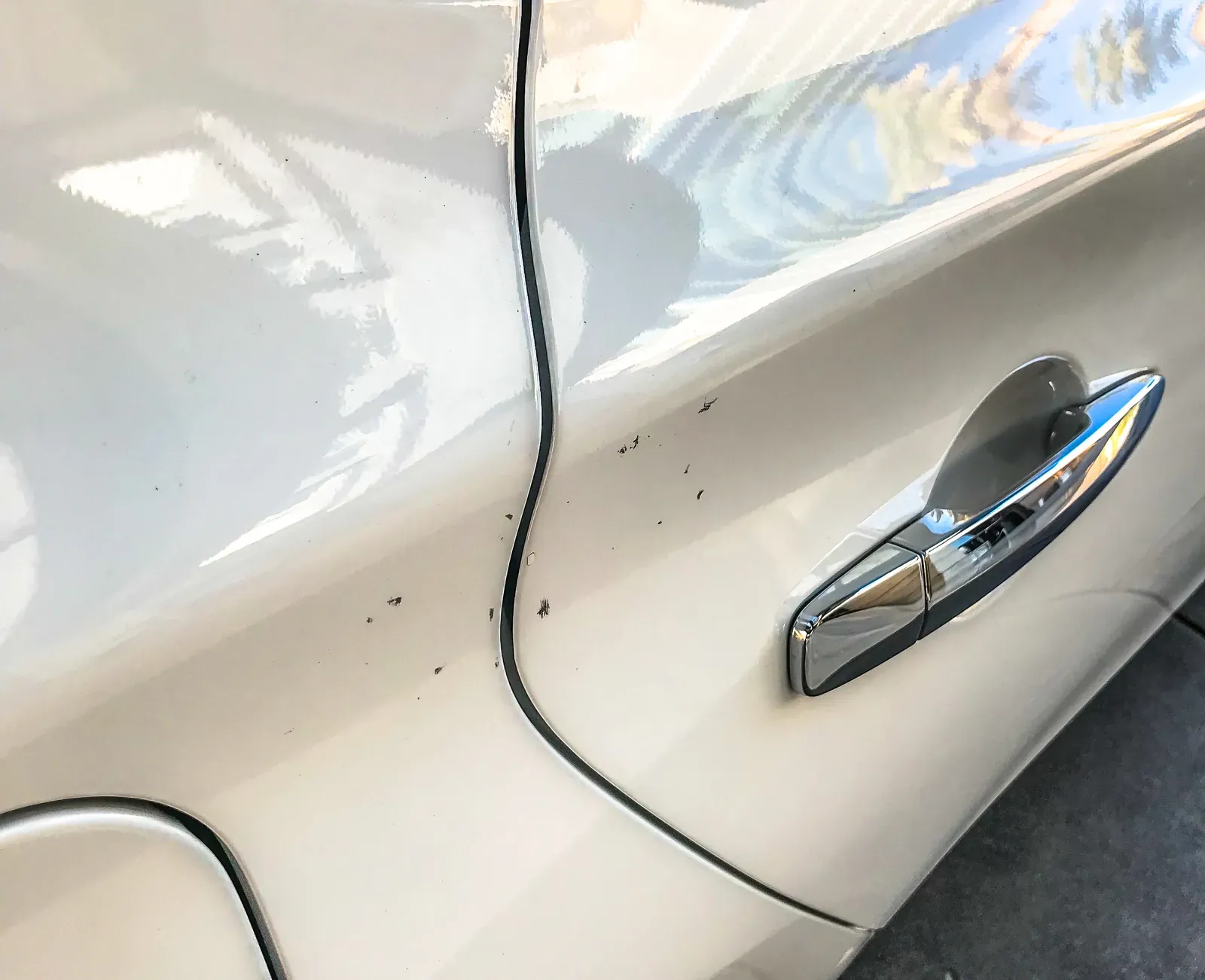
There are two kinds and they cost very different amounts. The first is a round or oval dent in the flat middle of a panel with the paint completely intact — the door edge landed flat and pushed the metal in. The second is a crease, where the edge caught at an angle and dragged, stretching the metal along a line and usually cracking or chipping the paint at the deepest point. From two metres away in a parking lot they look the same.
Location matters as much as type. A dent in the middle of a large flat door panel is the easiest thing in this trade to fix. A dent on a body line, on the crown of a fender, on the door’s folded edge, or within an inch of a seam has almost no room to move, because the panel is stiffest exactly there. Dings on the trailing edge of a door are among the most awkward jobs on a car despite being the smallest.
The material matters too. Steel panels have memory and want to return. Aluminum doors and hoods, which are now common on larger vehicles, do not spring back the same way and often need heat and a slower, more patient approach. It is worth knowing which one you have before anyone quotes you.
Dent removal, and when it stops being an option
When the paint is unbroken, dents can come out without any repainting at all. The metal is worked from behind through an access point, or pulled from the outside with a tab glued to the panel and released with heat, and the finish that comes back is the factory finish, because nothing was sprayed. It is the cheapest good outcome available and it keeps the original paint on the car, which matters more than people realise when the vehicle is eventually sold or handed back.
It stops being an option in three situations: the paint is cracked or chipped through to primer, the metal is stretched into a sharp crease rather than pushed in, or the back of the panel cannot be reached without cutting something that should not be cut. Then it becomes a conventional repair — the low spot is worked as far as it will go, filled thinly, primed and refinished, with colour blended into the panel beside it so the eye never lands on an edge.
A photo estimate settles which one you are looking at faster than a visit. Take it in daylight, square to the panel, with the reflection of something straight-edged running across the damage. That reflection is what shows the shape of the dent to somebody who is not standing next to the car.
Most single dings sit below the deductible; a lease changes that
For most single dings, the repair costs less than the deductible, which makes the claim question academic. Where it becomes real is the door that took two or three hits over a lease term, or the crease that runs half the length of a panel and needs paint. If the other driver was identified and insured, you are not at fault, and DCPD means your own insurance company handles the damage without fault attaching to you.
If the other driver left and cannot be identified, the file changes character. There is no other policy to look to, so the damage falls under your own collision coverage with your deductible, rated not-at-fault once a report is on file, and that is where a plate number in a photograph earns its keep. A police report or a report at a Collision Reporting Centre helps, and the mall’s footage helps more, but only if it is requested before the system overwrites it.
A quiet third option exists and is often the right one: fix it out of pocket and treat the estimate as information rather than as the first step of a claim. Even then, mention the incident to your insurance company — notice is not a claim, it is expected under the policy, and it keeps your options open if the repair turns out bigger than the photo suggested.
Why mall lots produce so many of these
Stall widths were set decades ago and vehicles have grown in every dimension since. A row that comfortably held sedans now holds crossovers with long doors and high beltlines, so the door edge of the vehicle beside you arrives at exactly the height of your door skin rather than below it. Wind helps: an open lot at Sheppard and Don Mills catches gusts across the flat, and a door taken by the wind lands with real force.
The rows nearest the entrances are the worst of it, and the ones at the far edge of the lot are the cheapest insurance anybody sells. If the car is on a lease, that walk is worth the two minutes, because door dings are the single most commonly charged item on a lease-return inspection and they are counted individually.
Questions people ask
How long does the mall keep its camera footage?
Retention varies by system and is not published, so treat it as short and ask the security office the same day if you can. Give the row, the level and a time window — a specific request is far more likely to be pulled than a vague one. If footage produces a plate, the file changes from an unidentified-driver claim on your own coverage to a not-at-fault claim under DCPD.
There is a hairline crack in the paint at the centre of the dent. Does that matter?
It usually closes off the no-paint route. Paintless repair works by flexing the metal back, and a finish that has already cracked flakes further as the panel moves. Once the paint is broken the job becomes a refinish whatever the size of the dent, which is why that tiny white line changes the estimate more than the dent around it.
The ding is right on a body line. Does that change anything?
It usually makes it harder. A body line is a fold, and folds are stiff, so the metal has far less room to move back. Those repairs take longer and sometimes come out to ninety-odd per cent rather than invisible. We tell you which one you are looking at before the work starts.
Do several small dings get repaired at once?
Yes, and it is usually the sensible way to do it. The setup is most of the labour on a small dent, so three on the same side of the car cost far less together than three separate visits. That is worth remembering in the month before a lease goes back.