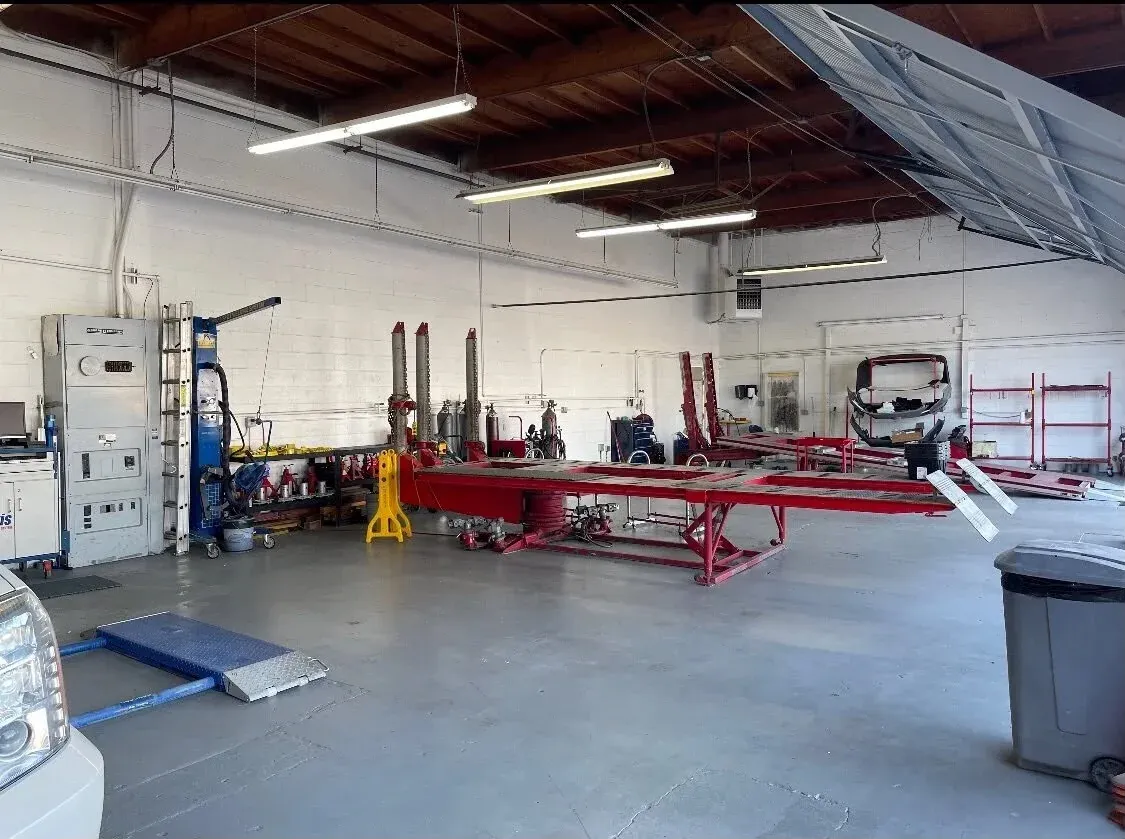
The write-off conversation, before the repair one
East York keeps its cars a long time, and a long-kept car has a low actual cash value. That matters the moment structure is involved, because the insurance company compares the repair cost to what the car is worth minus salvage, and there is no fixed Ontario percentage — it is a judgment, made by an adjuster who often has not seen the car. A hit that would be a routine repair on a three-year-old sedan can be a total loss on a fourteen-year-old one from a driveway off Cosburn, and the owner who wanted the car back is told it is gone.
That is why we measure first. Before anyone signs anything, the car goes on the bench and every reference point is compared to the manufacturer’s specification. The printout says exactly how far each point has moved, and it lets our estimator put a real repair figure in front of the adjuster instead of a guess. Sometimes it confirms the write-off, and we tell you so. Often it shows a pull that is well within repairable range, and the car comes home.
How the pull actually happens
Nearly every car in East York is a unibody: there is no separate frame, so the rails, the aprons, the strut towers and the rockers are all one welded shell, and damage to one moves the others. The car is clamped to the bench at its pinch welds, chains and towers are set up to pull against the direction of the impact, and the metal is brought back in stages while the measuring system tracks each point. The goal is not close; it is specification, so that the doors close, the wheels track and the crumple zones will fold the way the engineers intended the next time.
Where a rail is kinked past what a pull can safely restore, that section is cut at the factory seam and a new one welded in, and we ask your insurance company for the OEM section because this is precisely where safety is involved. After the pull, the car is measured again and the second printout goes beside the first. Then the panels go on, the paint is blended, and if the front took the hit, the sensors are recalibrated where required.
- Measured on the bench before the repair-or-write-off call
- Pulled in stages to specification, not to “close enough”
- Re-measured after, both printouts in your file
Where East York cars get bent this badly
It takes more than a lot bump. The parkway is the usual source — a stop-and-go rear-end at Wynford that pushed the trunk floor forward, or a lane change at the Don Mills ramp that folded a front corner into a barrier. The Leaside Bridge merge and the O’Connor ravine curves in winter produce the frontal ones: a car that slid into a guardrail at 40 km/h, cover split, wheel pushed back, and the apron behind it moved. A car like that often still drives. It should not drive to us; tell us where it is and we help arrange the tow, and you name the destination.
Structural repair is weeks rather than days — measurement, the pull, the section if one is needed, then body and paint. Rental through your coverage runs the length of it. If you are not at fault, DCPD means your own insurance company pays; if the car is financed, the lender is named on the claim, and we handle that paperwork too.
Questions people ask
The adjuster wants to write off my 2010 after a DVP rear-end. Can you stop that?
We can make sure the decision is based on a measurement rather than a photo. If the bench shows the damage is within repairable range and the repair cost sits under the car’s value, we put that figure in front of the adjuster and it often changes the call. If the numbers really do not work, we tell you that too, and you can choose to keep the car on a salvage title.
How do I know the car is really straight afterwards?
You see the two printouts — before and after — with each reference point against specification. Beyond that: the door and hood gaps are even, the car tracks straight on Don Mills Road with your hands off the wheel for a second, and the tires wear evenly over the next months. Those are the tells, and we show you the first two before you leave.
The car drives fine after the guardrail. Does it need the bench?
Driving fine is not the test. A front corner that moved the apron a centimetre will drive fine and then wear a tire, misalign a headlight and fail to crumple properly next time. If the cover split and the wheel is not centred in the arch, the car needs to be measured. It takes an hour and settles the question.