Parked for days, found on Friday
The dent on a Beaches car is rarely something the owner did. It is what the neighbourhood did to a car left in one place for most of a week. The angled parking on the side streets south of Queen sets every car at a slant, so the driver reversing out beside you swings a rear corner into your door before the wheel is straight. The laneway garages behind the older cottages were framed for something the width of a Model T, and a modern fender touches the jamb once or twice a year however careful the driver. Kew Gardens and the Woodbine lots fill with families on hot weekends, and a door opened by a child holding a boogie board lands on whatever is parked beside it.
What these share is that the metal moved and the paint did not. A slow push at parking speed stretches steel without cracking the finish over it, which makes it the right kind of dent to have. The wrong kind — a sharp crease, a dent across a body line, a chip at the centre — is rarer here, because almost nothing in the Beaches hits hard.
Pushing it out from behind
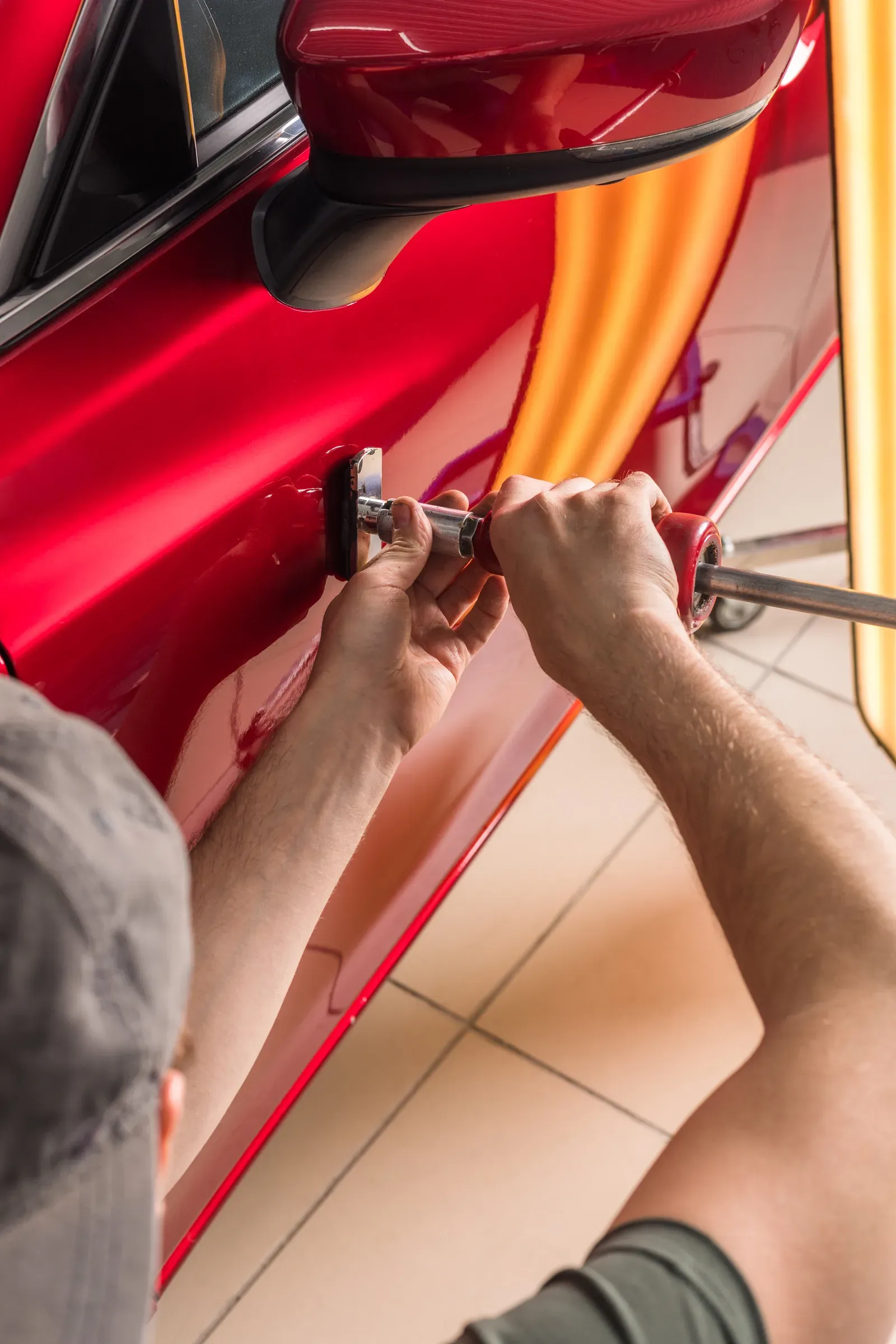
The panel is worked from the inside. With a trim piece off or a lamp out, the technician reaches a steel rod to the back of the dent and levers the metal outward in tiny steps, reading the reflection of a striped lamp on the outside to see what is still low. It is finished when the reflection runs straight. Nothing is sanded, filled or sprayed; the factory finish on that panel is the same finish it had when it left the plant, which is why this is the repair to want on a car that is leased, newish, or one you intend to keep.
The method has limits. Cracked paint cannot be pushed back together, a crease that folded the steel will not relax, and a dent hard against a panel edge leaves the rod nowhere to work. Those get the conventional repair — pulled near, skimmed, primed, refinished and blended — and the estimate names which one you are getting so there is nothing to argue about at the counter. Photograph the dent from a low angle with the sky reflected in the panel; the reflection outlines the dent and shows whether the paint has split.
- Paint whole and the dent shallow: worked from behind, home the same day
- Paint split or the steel folded: conventional fill and refinish
- A row of dings: one booking, one price for the set
One dent rarely clears the deductible; a row of them can
One dent on its own does not clear a collision deductible, and opening a claim for it buys an at-fault entry on your record in exchange for nothing, so our estimator will tell you to pay it directly. Two things move it into claim territory. A car back from a week at the curb with a row of dents down one side was hit by someone who drove off, which is a hit-and-run: it runs through your collision coverage, the deductible generally applies, but with a police report it is recorded as not-at-fault. And hail, which a summer thunderstorm can drop on a roof and hood by the dozen, sits under comprehensive coverage, with a lower deductible and no fault at all.
Whichever it is, the trip is the same. Lake Shore to the parkway in the morning, the car in the bay by ten, and for a single paintless dent we call the same afternoon. No rental, no second visit, and the door looks like it never met the side street.
Questions people ask
The dent is on the rear door right on the crease line. Can that still be done without paint?
Sometimes. A body line is where the steel is stiffest and the paint is most stretched, so a dent there is more likely to have cracked the finish. If the close photo shows the paint whole, we try paintless first and switch to a refinish only if the line will not come back true.
My lease ends in the spring and there are half a dozen dings from angled parking. Worth fixing?
Yes, and all at once. A lease inspector looks for repainted panels and finds none after paintless work, and six dings done in one sitting are priced as a batch rather than six jobs. Do it before the inspection rather than after the invoice arrives.
The tailgate corner caught the laneway garage jamb and it is aluminum. Does paintless work still apply?
Often, within limits. Aluminum is softer than steel but does not spring back the way steel does, so a broad, shallow dome usually pushes out cleanly, while a sharp crease is where the metal has hardened around the fold — that one goes to filler and refinish. Send a low-angle photo in daylight and our estimator will say which side yours is on.