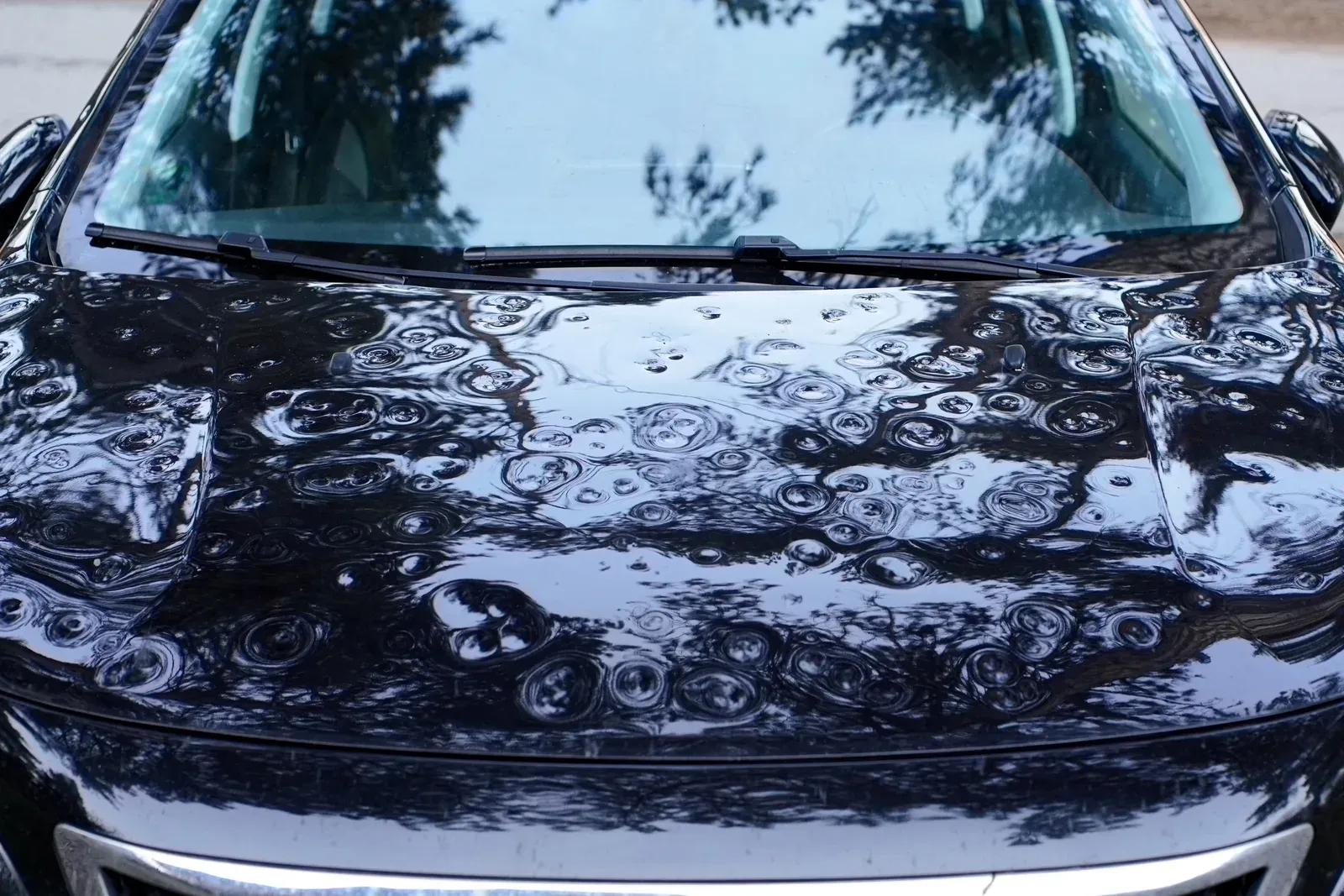
Count them in the right light, then write down the storm
Hail hides in flat light. Under an overcast sky or in a garage, a roof full of dents can look clean. Roll the car outside in early morning or late afternoon sun, crouch until your eye is nearly level with the panel, and the dimples appear as a field of soft shadows. A fluorescent strip does the same job indoors — the straight line of the tube breaks over every dent it crosses.
Photograph the roof, hood and trunk lid from that low angle rather than from above. Then write down what you know about the storm: the date, roughly what time, and where the car was parked. That detail matters because the claim gets matched to a weather event, and a file opened months later against a storm nobody can place moves a lot slower.
While you are there, check the glass and the seals. A stone big enough to dent a roof can crack a sunroof or star a windshield, and water finding its way inside is the one part of hail damage that gets worse while you wait.
What hail actually does to sheet metal
Hail lands on horizontal surfaces, so the roof, the hood, the trunk lid and the upper edges of the fenders take nearly all of it. The dents are shallow, round and numerous — often dozens on a single panel — and in most storms the paint is untouched. That last part is the good news, because paint is the expensive half of any body repair.
A few things change the picture. Aluminum hoods, common on newer vehicles, move differently from steel and can crease rather than dimple. Roof panels have bracing bonded underneath, so they cannot be reached from behind everywhere. A stone that lands on a body line or a panel edge leaves a sharp dent instead of a round one, and sharp dents take longer to work out than deep ones do. Mirror caps, roof rails and plastic trim simply crack.
A July cell that walks east out of Vaughan across Richmond Hill and into Markham can leave one street peppered and the next one dry. Cars parked at a GO lot all day take the full load; cars in a garage take none. If your vehicle sat outdoors north of Steeles on a bad afternoon, assume there is more damage than you counted on the first pass.
Paintless removal, and when a roof has to come off
The default repair for hail is paintless dent removal. A technician works from the underside of the panel with rods and shaped tips, pushing each dent up in small increments while watching a reflected line move across the surface. Where there is no access from behind, tabs are glued to the outside, the dent is pulled, and the residue is cleaned off. The factory finish is never disturbed, which is why a properly done hail repair is invisible and why it takes nothing off the paint’s life.
It is slow, careful work, priced by the number and size of dents rather than by the panel, so a hail estimate reads differently from a collision estimate. Expect a count per panel. Expect us to say which dents will come out completely and which will still read as faint at a low angle in strong sun.
Replacement enters the conversation when a roof has been stretched — dents dense and deep enough that the metal has nowhere left to go — or when the paint has cracked over a dent, which means refinishing anyway. On a vehicle with a sunroof, replacing a roof skin is a bigger job than it sounds, and we lay out both paths before anything is ordered.
Comprehensive, the deductible, and the week everyone calls at once
Hail is comprehensive damage. Nobody is at fault, it does not sit in your file as an at-fault loss, and your comprehensive deductible is what you pay. If you carry collision but dropped comprehensive to hold the premium down, hail is not covered at all, which is worth confirming before you make the call.
After a real storm, every shop and every adjuster in the affected corridor hears from the same few thousand drivers in the same week. Open the file early and send the photos with the storm date attached, so the claim number, the estimate and the repair date can all move together instead of one after another.
Whether to claim at all is a fair question when the damage is light. A handful of small dents on a hood can sit close to the deductible, and paying directly keeps the claim out of your history. A roof, hood and trunk lid full of them will not sit anywhere near it — that is a real repair, and the coverage exists for exactly this.
The one thing not to do is leave it for a season. Hail dents do not spread on their own, but a cracked sunroof seal or a chipped edge that starts to corrode does, and a claim tied to a storm two summers ago is far harder to place than one filed the same week.
Questions people ask
Does paintless dent removal work on every hail dent?
On most of them. Shallow round dents in a panel with access behind it come out cleanly. Dents sitting over a bonded roof brace, dents on a sharp body line, and any dent where the paint has cracked are the exceptions, and those get flagged on the estimate rather than discovered at pickup.
Will hail damage hurt what my car is worth?
Left alone, yes — a roof full of dimples is the first thing a buyer or an appraiser sees, and it reads as a vehicle that lived outside and was not looked after. Repaired paintlessly there is no refinished panel to disclose and nothing for a paint gauge to pick up.
Do I have to use the shop my insurance company suggests for hail?
No. In Ontario you choose where the work is done. A recommendation is only a recommendation, and after a big storm the recommended list is usually the busiest list. Tell your insurance company where the vehicle is going and the file follows it.
My car was hailed on while I was away — is it too late?
Not necessarily, but report it as soon as you find it. Your policy expects prompt notice, and the practical problem with waiting is showing which storm did it. Photograph the car, name the date range you were away, and let us document the damage pattern for the file.