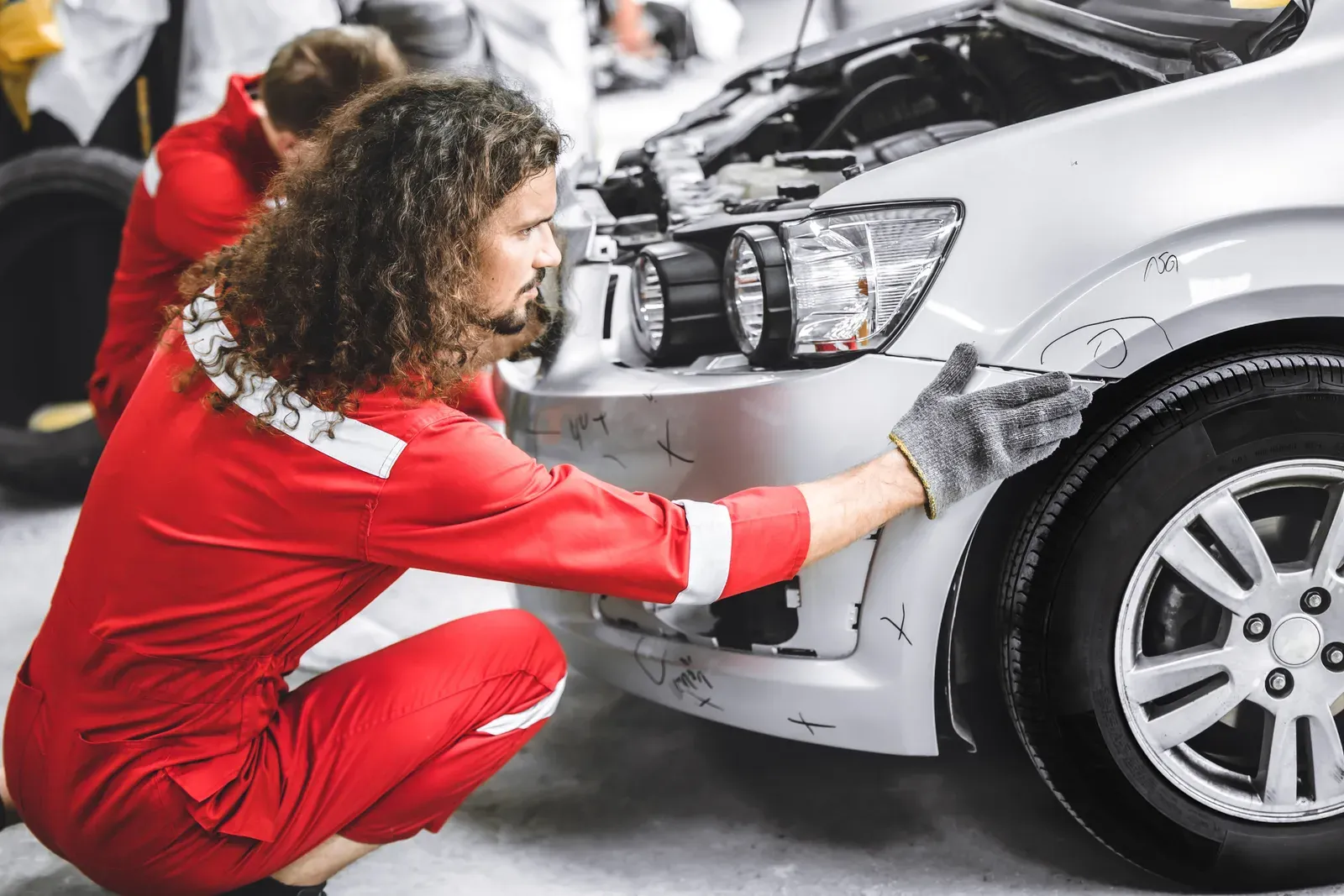
A Beaches car works differently from a suburban one. It belongs to a household that mostly walks, cycles or rides the 501, so it sits at the curb or in a laneway for days at a stretch, collecting the marks of a busy neighbourhood while nobody is watching: an angled-parking bump, a plow scrape, a door flung open by someone carrying a paddleboard. When the owner finally notices, the damage is a week old and there is no note. Our estimator looks at the photos, says whether this is a claim or a cash job, and if it is a claim, opens it and runs it with your insurance company — in English or Mandarin — while the car sits in our bay instead of on your street.
Lake Shore to the parkway, or Victoria Park to the 401
The run from the Beaches is longer than it looks on a map, because nothing runs straight between the lake and Sheppard. The quick way is west: Lake Shore Boulevard past Ashbridges Bay and the port lands, onto the northbound parkway where Lake Shore meets the Don, and up the valley — under Bloor, past the Bayview and Don Mills ramps, through the 401 interchange where the parkway changes its name to the 404 — to the Sheppard exit, a block from Fairview Mall. Twenty kilometres, about 22 to 34 minutes when the valley is moving, and more in the evening rush.
From the east end of the neighbourhood, Victoria Park is the other honest route: north to the 401, a short westbound hop to the 404, and off at Sheppard. It skips the valley entirely, which matters on a summer Sunday when Lake Shore is a parking lot from Woodbine Beach to the Don.
Getting home is three trains and a bus: Line 4 from Don Mills station, Line 1 south, Line 2 east to Woodbine and the 92 down the hill to Queen.
A car that is parked more than it is driven
Most Beaches households run one car and use it sparingly. The commute is the 501 or a bike along the Martin Goodman Trail, the dog gets walked on the Boardwalk, and the car sits — in an angled spot on a side street south of Queen, at the curb on Lee or Waverley, or in a laneway garage behind a cottage that became a house after the war. Those garages were framed for a Model T. A hatchback clears the jamb by a hand on each side, an SUV by less, and the shared laneway has a fence on one side and the neighbour’s mirror on the other.
A car used twice a week is a car that gets hit while nobody is looking. Every driver backing out of the angled spot beside yours is swinging a bumper toward your door. A cyclist leans a bike on the fender. A beach crowd opens doors into whatever is parked near Kew Gardens or the Woodbine lots. And because nobody touched the car on Tuesday, Wednesday or Thursday, the dent is found on Friday with no idea which day it happened, no witness and no note. That changes the claim question, and it is the first thing our estimator sorts out from your photos.
Two seasons, both hard on a parked car
Summer brings the city to the lake. On a hot Saturday the Woodbine Beach lots are full by late morning, Lake Shore crawls, and every side street from Coxwell to Neville Park fills with cars hunting for a space they are not allowed to take. The hits are small and constant: a corner scuffed by someone squeezing into a gap, a mirror folded the wrong way, a door dinged by a cooler. In July the jazz festival closes a stretch of Queen for a few evenings and pushes the strip’s cars onto side streets that were already full.
Winter is the opposite problem. The salt comes from the road and the damp comes from the lake. Fog drifts up the side streets on mild mornings, brine thrown off Lake Shore and Kingston Road settles on a car that is not going anywhere, and the plow leaves a windrow that holds the mix against the rockers until March. By spring a car that stood all winter on Silver Birch or Balsam has a white crust along the lower doors and, if it is older, the first bubble on a rear arch.
- A written estimate from your photos before the car leaves the curb
- Claim opened with your insurance company and run from our desk
- Tow coordinated when the car should not attempt the parkway
Services for The Beaches drivers
- Collision repairCollision repair for the Beaches — Lake Shore rear-ends at Woodbine, streetcar clips on Queen East.
- Auto body paintingAuto body painting for Beaches cars with a lake side and a street side — sun, fog and brine matched on a test card and blended so the new panel disappears.
- Dent repairDent repair for the Beaches — angled-parking bumps, laneway garage taps, doors opened by beach crowds.
- Scratch repairScratch repair for the Beaches — bikes leaned on fenders, wagons dragged past doors, keys on a summer side street.
- Bumper repairBumper repair for the Beaches — backing out of angled parking, side-street windrows, Woodbine Beach lot bumps.
- Frame straighteningFrame straightening for the Beaches — the write-off question on an older, low-kilometre car after a hard hit on Lake Shore, answered on the measuring bench.
- Rust repairRust repair for the Beaches — cars that never dry out between the lake fog and the road brine.
The Beaches questions
My car sat on Waverley for four days and now there is a crease in the rear door. I have no idea when it happened. Can I still claim it?
Yes. Damage from a driver who did not stop is a hit-and-run, and with a police report filed it is recorded as not-at-fault, though it runs through your collision coverage and the deductible usually applies. Whether it is worth filing depends on the repair against that deductible, so send the photos before you call anyone and our estimator will tell you which side of the line the door sits on.
I backed out of an angled spot on a side street and a streetcar caught my rear corner. Who is at fault?
Almost certainly you, under Ontario’s Fault Determination Rules — a vehicle leaving a parking space is expected to yield to everything already moving, and a streetcar cannot swerve. Your own collision coverage pays for your car, the TTC deals with theirs, and the claim is at-fault on your record. It is still worth doing properly. We open it, photograph the teardown and see the corner through.
The car is drivable but the hood is buckled from a Lake Shore rear-end. Do I really have to drive it 20 kilometres to you?
Only if it is safe. A buckled hood that latches is fine on surface streets; a hood that might lift, a wheel out of place or a headlight out is not, and the parkway is no place to find out. Send the photos first. If the answer is tow, we arrange it, you choose the destination, and the rental through your coverage is waiting the morning the car arrives.