Old car, low kilometres, hard hit
A car driven twice a week for fifteen years has low kilometres, a high sentimental value and a low actual cash value, and that is the combination that makes an adjuster reach for the word total. There is no statutory cut-off in Ontario. The insurance company compares what the repair will cost with what the car is worth minus its salvage value, and the first version of that comparison is usually made from photographs by someone who has not measured anything. On the older sedans and wagons that live in Beaches laneways the numbers are close more often than the owner expects. Measuring is what turns that opinion into a figure. Sometimes it confirms the write-off, we say so, and the salvage-title choice is yours. More often on a sound car it shows the rails a pull away from specification, and that page goes to the adjuster with a repair figure attached.
Everything around the repair is handled from our desk: the flatbed from Lake Shore or your street; the DCPD claim with your own insurance company when the other driver was to blame; the lender added to the claim on a financed car; and a rental through your coverage that lasts as long as the job does, which for structural work is measured in weeks.
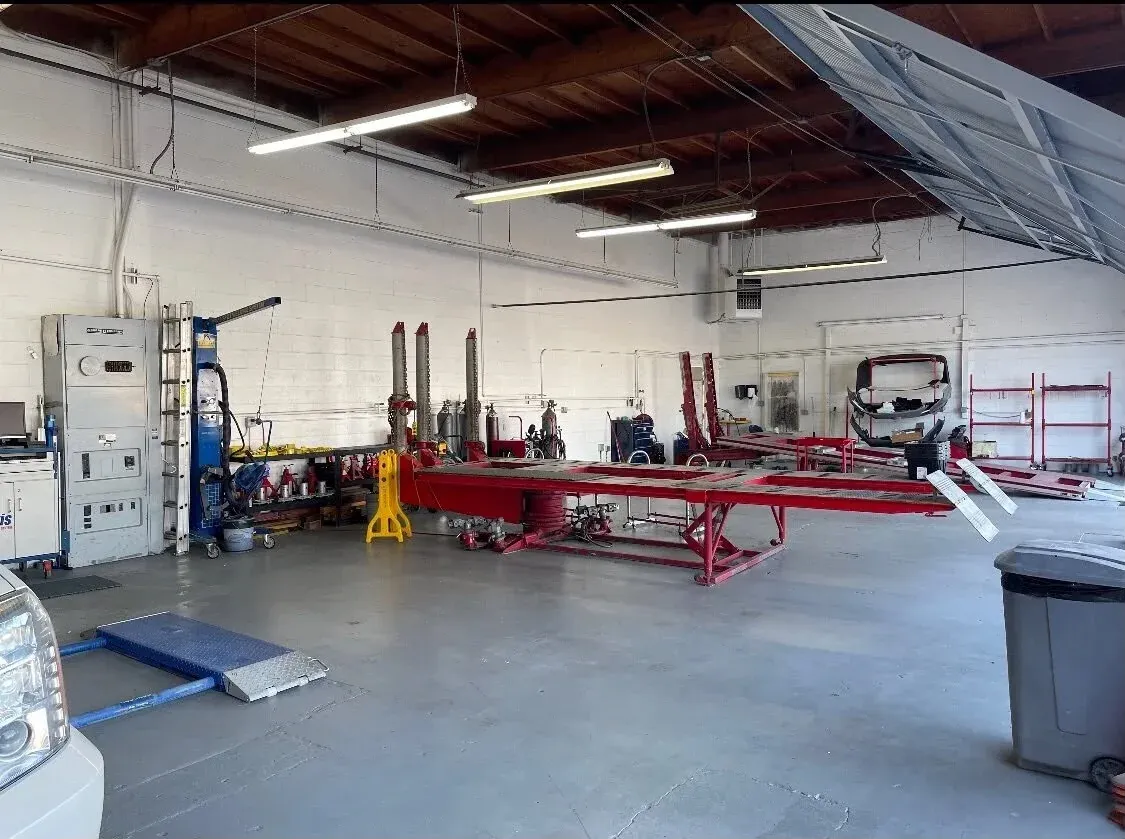
Held at the pinch welds, pulled back to the factory figures
Modern cars carry their strength in the shell. Rails, aprons, strut towers and rockers are spot-welded into one structure, so a hard hit on one corner is felt across it: a rail folds, the apron behind it shifts, and the door opening on that side changes shape by a few millimetres. On the bench the car is held at its pinch welds while a measuring system checks dozens of reference points against the manufacturer’s figures and prints how far each has moved. The pull works against that printout — towers and chains set opposite the direction of the hit, the metal brought back in stages, the figures re-read after each stage until they sit on specification. Where a rail has kinked rather than bowed, pulling would only work-harden the fold, so the damaged length is removed at the factory joint and a new section welded in, and for that piece we ask your insurance company for OEM steel and put the reason on the estimate.
A second measurement closes the job, and you get both sets of figures. Panels, paint and blending follow, and a front hit means the radar and camera may need recalibration before the car leaves.
- Measured before anyone decides repair or write-off
- Pulled in stages against the printout, not by eye
- OEM sections where a rail has kinked past pulling
What bends a Beaches car
Not the neighbourhood, which is too slow for it. The structural hits happen where the Beaches meets the fast roads: Lake Shore at Woodbine or Coxwell, where a rear-end at commuter speed pushes the trunk floor forward and skews the rear rails; the Kingston Road hills along the top of the neighbourhood, where the first black ice of the year puts a car into the curb with a wheel driven back into the apron; the parkway ramp off Lake Shore, where a merge that goes wrong ends against the barrier. The streetcar is the other: a left turn across the tracks in front of a 501 is a corner hit at a weight no car is built to argue with.
You can spot it from the curb. Sight down the side of the car and check the wheel against its arch; run a finger along the hood and door gaps; open and close the door on the hit side. If anything has shifted, the car needs measuring, and it should get there on a flatbed rather than under its own power.
Questions people ask
The adjuster totalled my sixteen-year-old wagon from photos after the Kingston Road curb. Is that the end of it?
A photo-based total is an opinion, and the bench turns it into a measurement. Ask your insurance company to hold the settlement until the car has been measured; if the rails are inside repairable range and the cost comes in under the value, the adjuster gets that printout and the decision is remade on real numbers. If the measurements go the other way, you hear it from us plainly, and the salvage-title option is yours.
The car tracks straight after the Lake Shore rear-end but the trunk lid does not line up anymore. Structural?
It can be. The trunk opening is framed by the rear rails and the floor, so a lid that no longer sits flush is telling you one of those moved. Straight steering only speaks for the front. Photograph the trunk gaps left and right and the rear bumper from behind, and we will say whether the bench is needed.
How long does this take and will I have a car?
Plan on weeks. The measurement is quick; the pull, any sectioning, then body and paint each take their turn, and a back-ordered rail can add more. If you were not at fault, or you carry OPCF 20 loss-of-use, the rental is covered, and we have it ready the morning the flatbed arrives.