Yes, if the paint is intact and the metal is not creased
A dent can be repaired without repainting when two things are true. The paint over it must be unbroken, with no chips, cracks or scuffed-through clear coat, and the metal must have moved without folding. Modern paint is flexible enough to follow a panel through a shallow dent and back out again. What it cannot survive is a sharp crease, because a crease stretches the metal and fractures the finish along the fold.
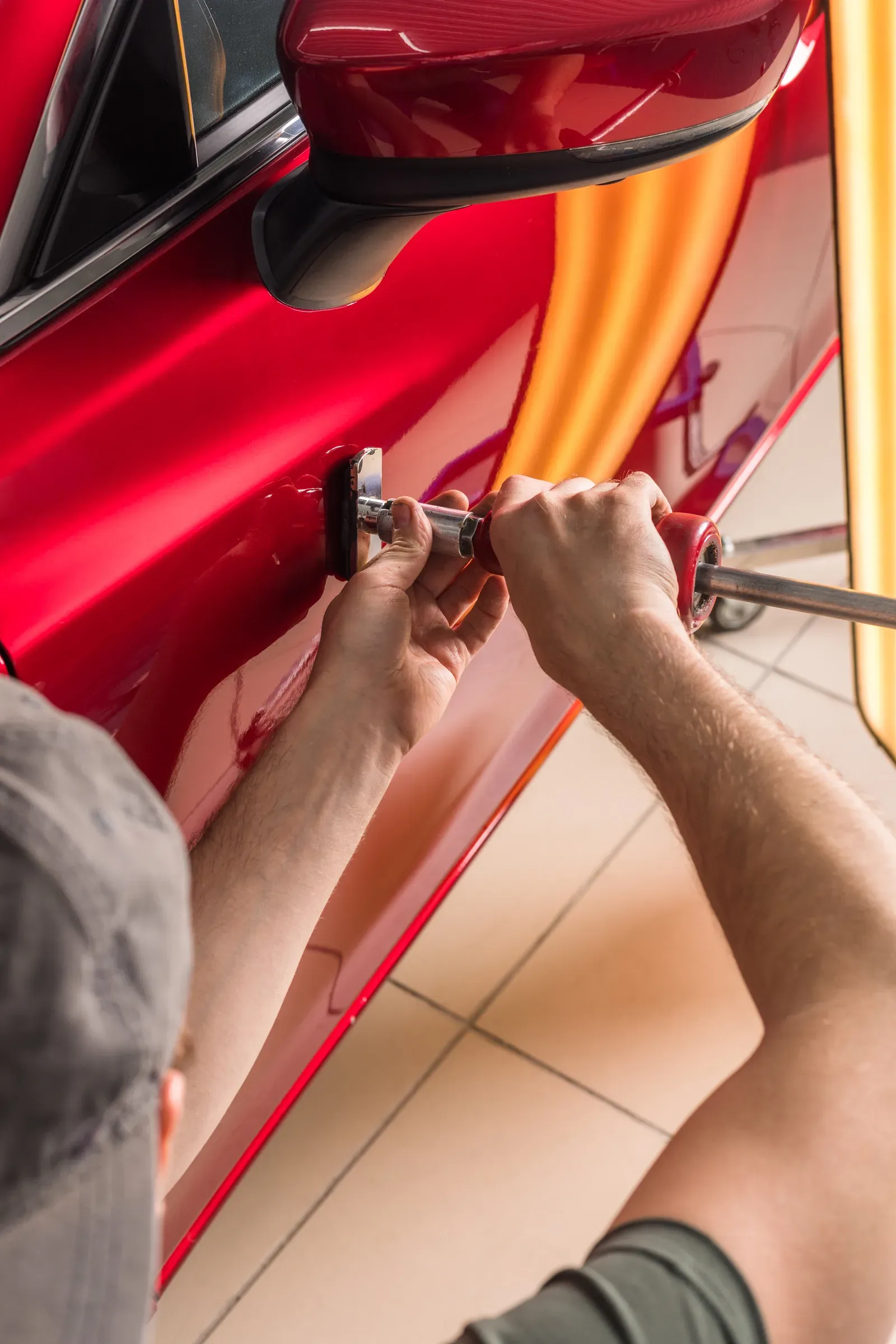
When those two conditions hold, the repair is paintless dent removal, or PDR. The technician reaches the back of the panel with steel rods and works the metal back to its original shape a fraction at a time, reading the reflection in a striped light board to see where the low spots remain. On panels with no rear access, a glue tab is pulled from the outside instead. No filler, no primer, no paint. The finish that came from the assembly plant is still there when the car leaves.
This is our first choice for any dent that qualifies, and it is usually the cheapest route as well. Photograph it straight on and again from a shallow angle so the reflections show the shape, and our estimator can tell you the same day whether your dent is a candidate.
The dents that respond best
The ideal PDR dent is round, shallow and sitting in the middle of a flat or gently curved steel panel. Door dings from a neighbouring car in the Fairview Mall lot are the classic case. Hail dents on a roof or hood are another, which is why hail repair is mostly paintless work. Dents from a knee, an elbow, a soccer ball or a shopping cart usually fit the description too.
Size matters less than people expect. A large soft dent across a door skin can come out beautifully because the metal moved gently over a wide area. A tiny dent with a sharp point in its centre can be worse, because the point has stretched the steel. What the technician is judging is how far the metal has been pushed past its elastic limit, not the diameter of the mark.
Panel material matters too. Steel returns to shape willingly. Aluminum, which is common on hoods and some doors and tailgates, is softer than steel but has almost no spring: it holds a memory of the dent and work-hardens as it is pushed, so it takes longer and does not always come all the way back. It is still often possible, but the quote will reflect the extra time.
When a dent will need paint no matter what
Some dents rule themselves out immediately. Cracked or chipped paint anywhere on the dent means the finish has already failed, and pushing the metal straight leaves a bare spot that will rust. A crease with a visible line down the middle has stretched metal along that line, and even a perfect push leaves a ridge you can see in the right light. Dents on a body line, the crisp styling crease that runs along a door or fender, are the hardest of all, because the line has to be rebuilt as well as the surface.
Location can also decide it. A dent on the edge of a panel, right at a door opening or a hood seam, has no room behind it to work from and the metal there is doubled over and rigid. Dents that sit on top of a brace or a reinforcement inside the panel are similar. Some of these still come out partway and then get finished with a thin skim of filler and paint, which is a smaller job than replacing the panel.
When paint is needed, the panel is prepared, primed, painted and cleared in the booth, and the colour is blended into the neighbouring panels so there is no visible edge. The page on whether new paint matches the old explains how that blend is done. It is a proper repair and we warranty the finish for life, but it is more work, more time and more cost than PDR, which is exactly why we start by asking whether PDR is possible.
Why keeping the factory paint matters
Factory paint is applied to a bare body in a controlled plant, baked at temperatures a finished car could never tolerate, and it is the reference every refinish is measured against. A skilled repaint matches it, but it does not become it. On a newer car, on a lease return, or on a car you plan to sell, an untouched original finish is worth protecting when the choice exists.
There is a practical side too. A paintless repair is usually done in hours, with no cure time and no need for a rental. You can often wait for it. That is a different afternoon from a painted repair, which needs the car for several days.
- Paint unbroken and metal not creased: paintless repair, factory finish kept.
- Paint chipped or metal creased: conventional repair with refinishing and blending.
- On a sharp body line or a panel edge: usually paint, occasionally a partial PDR first.
- Aluminum panel: paintless is possible but slower, and the quote says so.
Questions people ask
Will a paintless repair leave any trace of the dent?
On a good candidate, no. Under a bright light at the right angle a trained eye can occasionally spot a faint texture where a large dent was, but the paint is original and the panel reads straight. We show you the panel under the light board before you leave.
Can a dent that was already repaired badly be fixed without paint?
Usually not. If someone has already pushed it and left high spots, or if filler has been applied, the panel needs to be worked conventionally. If the previous attempt was paintless and simply incomplete, it can sometimes be finished.
Does the paint have to be original for PDR to work?
No. A repainted panel can be worked the same way, provided the repaint was done properly and has cured. Very thick or poorly adhered paint is more likely to crack during the push, and the technician will say so up front.
How long does a paintless dent repair take?
Most single dents take a few hours, and hail repairs across a whole roof and hood take longer. Because there is no paint to cure, the car goes home the same day in nearly every case.