Set the expectation before you spend anything
Rust-proofing slows a process; it does not cancel one. Every product on the market works the same way in principle — keep salt, water and oxygen away from bare steel — and every one of them fails at the same place, which is wherever the coating is thin, missing, or applied over corrosion that was already active.
That leads to the single most useful rule here: treatment is worth most on a car that is still clean, and worth least as a rescue. A three-year-old vehicle sprayed every autumn is a genuinely different car at year ten. A twelve-year-old car with bubbling arches gets a cosmetic delay at best, and possibly a coating sealing moisture against metal that was already losing.
It is also worth asking what you are protecting. Body panels are one target; brake and fuel lines, subframes and suspension mounting points are the ones that eventually decide whether a car stays on the road.
Annual oil spray, the drippy kind
This is the thin, creeping oil applied once a year, usually in the autumn. It is sprayed under pressure into the underbody and, more importantly, inside the box sections — rockers, doors, tailgates, rails — through existing holes and small drilled access points.
Its advantages come straight from being a liquid. It creeps into seams that no spray gun could ever aim at, it displaces the moisture already sitting there, and because it never fully hardens it keeps re-covering itself when a stone strikes. A chip in a hard coating stays a chip; a nick in an oil film closes.
The trade-offs are honest ones. It drips for a few days onto your driveway, it collects dust on the lower body, some of it washes off over the winter, and it has to be repeated every single year or the benefit fades. Skip two seasons and you are back to an untreated car with an oily film on it.
Drip-less and rubberized undercoating
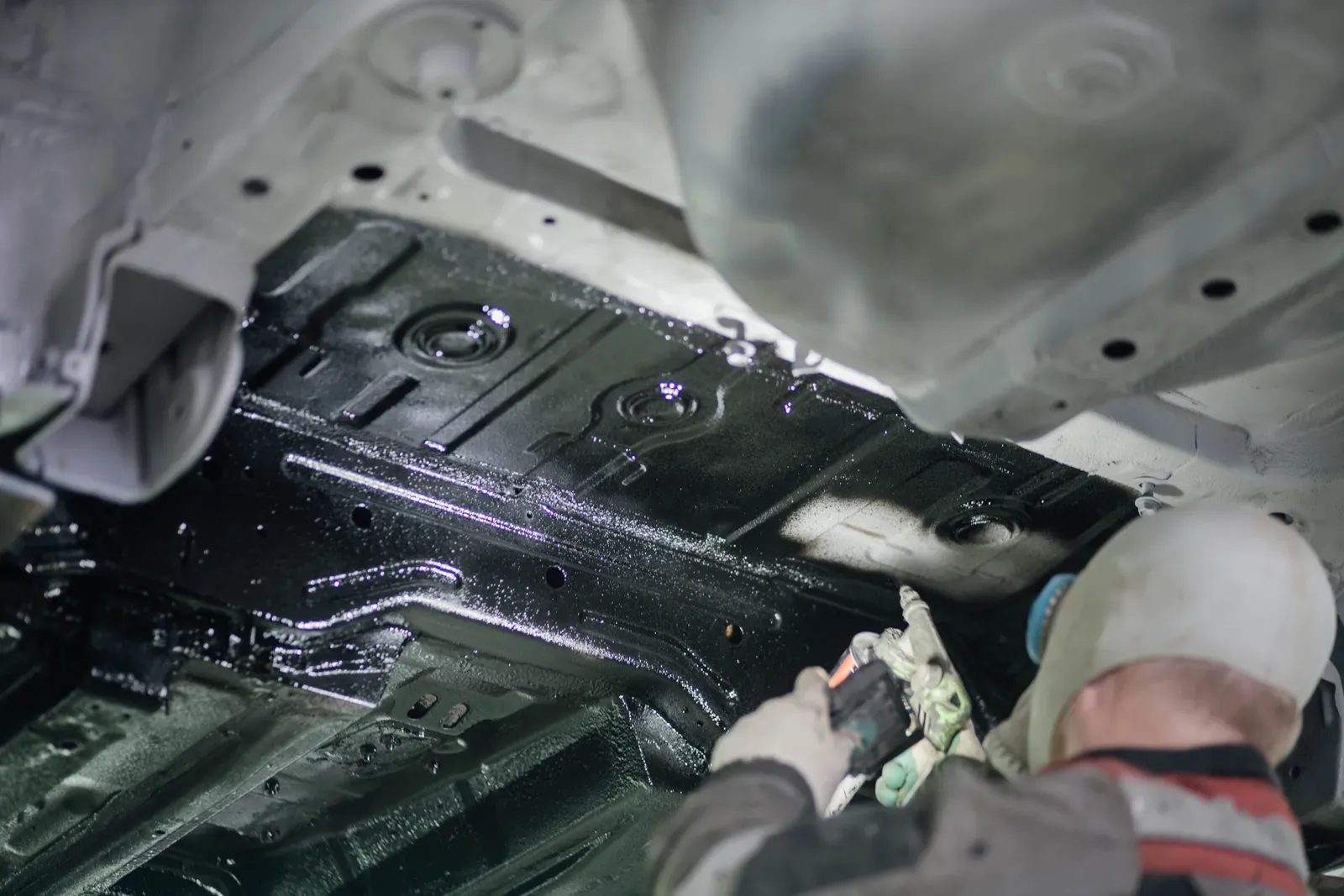
These are the thicker products: a waxy drip-less film, or the harder rubberized coating sprayed over the floor pan and inner arches. They are tidier, they last longer between applications, and the rubberized versions cut road noise noticeably.
The risk is the flip side of that durability. A hard coating applied over a properly cleaned, dry, sound underbody is good protection. Applied over damp metal, existing scale, or a surface nobody bothered to prepare, it becomes a lid — salt water finds the pinhole, gets underneath, and now corrodes in the dark with a shell over it holding the moisture in place. That is the version people mean when they say undercoating ruined their car.
If you go this route, the prep is the product. Ask what the underbody is washed and dried with, whether existing corrosion is treated first, and how cavities are handled, because a body-panel coating that never gets inside a rocker leaves the highest-risk area untouched.
Electronic modules: say it plainly
These are the small boxes wired to the battery and grounded to the body, sold as electronic or cathodic protection. The theory borrows from a real technique used on ships, pipelines and other structures continuously immersed in an electrolyte.
A car is not immersed in anything. It is dry more often than it is wet, and the salt film on it is patchy rather than continuous, so the current has no reliable path to the places that rot. Independent testing has not supported the marketing claims, and there is no mechanism that credibly protects the inside of a rocker box you never coated.
We are not going to tell you it does nothing at all in every conceivable condition. We will tell you plainly that it is unproven on ordinary passenger vehicles, that the warranties attached to it usually depend on annual inspections you have to remember to attend, and that the same money spent on yearly oil would do more.
What the answer depends on
Rather than a product ranking, work through the car in front of you.
- Age and condition — clean and young is worth treating; already bubbling means fix the metal first and treat afterwards, in that order.
- How long you are keeping it — protection pays off over years, not months, so a lease you return in eighteen months rarely justifies it.
- Where it lives — a car parked outdoors and driven daily through slush is exposed differently than a weekend car in a heated garage, and a heated garage is not the win people expect, because it thaws the salt and keeps it wet.
- What the manufacturer says — some warranties have opinions about drilling and coatings, so check before someone puts holes in a new car.
- Whether anyone will inspect it — annual products only work when they are actually applied annually.
What we do to a panel we have repaired
Whatever you decide about aftermarket treatment, a repaired panel gets protected as part of the job rather than as an upsell. Bare metal is cleaned and treated, welds are dressed and sealed, and seam sealer is put back along every joint that had it from the factory, in the same shape, because that bead is doing a job.
Inside the panel, cavity wax goes into the box section through the drains and access holes so the surface we could not spray is not left as bare steel behind fresh paint. Then primer, colour and clear go on the outside and get blended into the neighbouring panels.
When you collect the car, ask what went inside the repair, not just what is on it. Any shop that has done the work properly will be happy to walk you around it and point at the drain holes.
Questions people ask
Is rust-proofing worth it on a brand-new car?
It is the best moment to start, because there is nothing to seal in. Modern galvanizing and factory coatings are far better than they used to be, so a new car will not dissolve without treatment — but the seams, folds and cavity interiors are still the weak points, and annual oil reaches exactly those places.
Will oil spray damage brakes, rubber or wiring?
A competent applicator masks brake rotors, pads and exhaust components and keeps oil off them. Modern formulations are made to sit against rubber and wiring harnesses without attacking them. The complaints that come up are almost always about a hurried application rather than the product itself, which is a good reason to ask how long the job takes.
Can I rust-proof a car that already has bubbling paint?
You can treat it, but understand what you are buying. Coating over active corrosion slows the surface and does nothing about the metal already going underneath. Where a panel is only stained, sand it back and repaint it first; where it is perforated, cut and weld before anything gets sprayed, then protect the finished result.
Do you apply rust-proofing here?
Our work is the repair side — cutting out corroded metal, welding in new sections, sealing seams, treating the cavity behind the panel and refinishing it. For ongoing annual protection we will tell you what to look for in an applicator and what questions to ask about prep, without pretending one brand is magic.