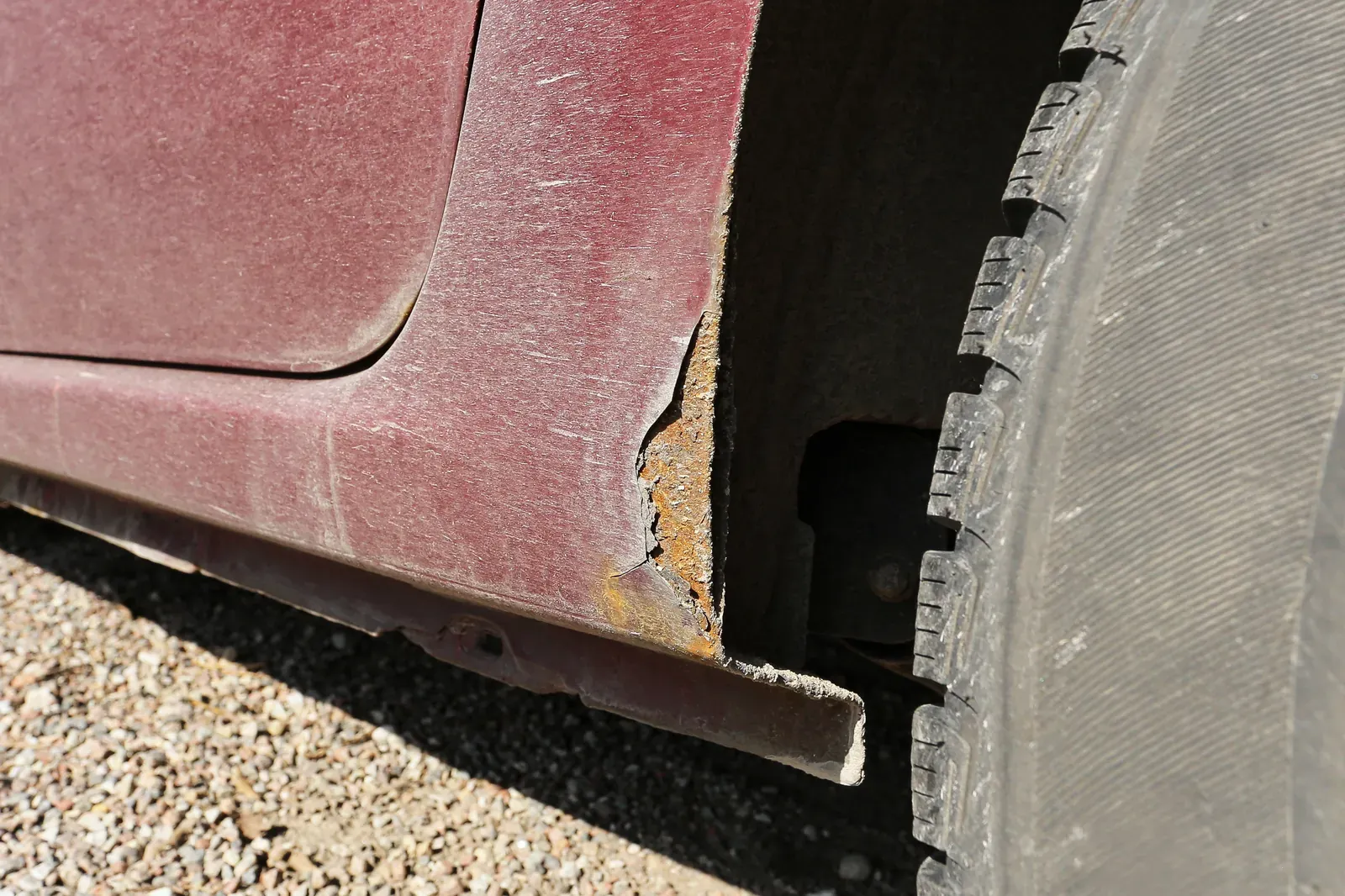
Why a rocker opened in January is a worse repair than the same rocker in July
Rust in Scarborough has a calendar. Brine goes down on McCowan, Kennedy, Lawrence and Kingston Road ahead of every storm from late November, and a car that drives those roads and parks on a driveway off Eglinton East carries it home in the seams of the rockers, inside the rear arches and along the bottom of the doors, where it sits wet until March. Freeze and thaw pump it deeper. Nothing shows for years, and then one April there are bubbles at the arch and a soft spot under the driver’s door.
The repair should happen in the warm months, and there is a reason beyond comfort. A rocker that is cut open in January is a fresh weld and a bare seam in the middle of the salt season, and brine gets into a new seam fast. Seam sealer and the cavity wax that goes inside the panel need warm weeks to cure fully before they meet brine. So: notice it in April, photograph it in May, repair it in summer, and have the underside coated before the trucks come back in November.
Where the rust sits on a fifteen-year-old Scarborough car, and when it is still worth the work
The car that brings rust to us is usually one somebody bought new and looked after — a 2008 sedan with every oil change on record, or a 2006 pickup that still hauls to the dump on Saturdays. The location tells the age. Trucks and SUVs from the 2000s rot at the rear arches, the rocker ends and the cab corners. Compacts from the same decade go at the door bottoms and behind the front wheels. Delivery vans go everywhere at once, because their undersides are never washed. Rust repair is not an insurance claim — corrosion is wear, not an incident — so the number is yours to weigh against what the car is worth to you.
Two things tip it toward repair. A rocker or a floor that has gone through is a structural item on a Safety Standards Certificate inspection, so a private sale needs it fixed properly. And an arch caught at the bubble stage is a small fraction of the same arch a winter later. Two things tip it the other way: rust that has reached the subframe mounts or the floor under the seats, or a car whose value would not cover doing the work properly. We look at the underside on a hoist and say which. What we will not do is sand the bubbles, fill the hole and paint over it; that repair is back in two winters.
Cutting past the last pitting, and what goes on the inside of the new steel
The rusted section is cut out past the last pitting, because pitted steel that looks solid is already thin. New steel is shaped and welded in, the welds are dressed flat, and the seams are sealed so brine has no way back in. Before the panel is closed, the inside is coated — the part a visible repair never shows and the one that decides how long it lasts. Then primer, refinish to your paint code and a blend into the panel beside it, with a lifetime warranty on the paint and refinish work.
Photos are enough for the estimate: each area low, in daylight, with the wheel turned so the arch shows. Rust work has few surprises, though a rocker sometimes runs further than the bubbles suggested, and we tell you the moment the metal is open. Drive in along Sheppard Avenue East or the 401 to the 404, and ask about an underbody coating for the same visit.
- Cut past the pitting, never sanded over and filled
- New steel welded in, seams sealed, cavity coated before closing
- Refinish blended into the neighbouring panel with a lifetime paint warranty
- Booked in the warm months so sealer and wax cure before the salt
Questions people ask
My van is never washed underneath. Is an underbody wash enough to slow this down?
It helps, and it is not a fix. A wash with an underbody spray every couple of weeks in salt season flushes brine off the floor and the inside of the arches, where it does the most damage. It cannot reach inside a closed rocker, and it does nothing for rust already under the paint. Wash it, and have the cavities coated before winter.
Rust on the cab corners of a 2006 pickup — is that the same job as a rocker?
Same method, different stakes. A pickup body sits on a separate ladder frame, so a rusted cab corner is a body panel rather than the structure — it lets water into the cab and it will fail cosmetically, but it does not carry the truck. The corner is cut out, a patch panel welded in, sealed and refinished. What we check alongside it is the frame, because on a truck that is where the safety question lives.
The bubbles are at the rear arch, right where the plastic liner clips in. Why there?
Because the liner holds salt against the steel. Brine and grit pack in behind the plastic, the clip holes give moisture a way into the seam, and the arch lip is a folded double layer that never dries. It is the first place a 2000s SUV rusts and the easiest to repair early: the lip is cut back, new steel folded in, and the seam sealed before the liner goes back on.
I want to keep my 2008 another five winters. What order should the rust be tackled in?
Safety first, then what spreads, then what shows. Rockers and floor go first because they are structural and they decide a safety inspection. Rear arches next, because arch rust runs into the quarter panel if left. Door bottoms and cosmetic bubbles last. Coat the inside of everything you open, and have the underside coated the same summer so the five winters are yours.