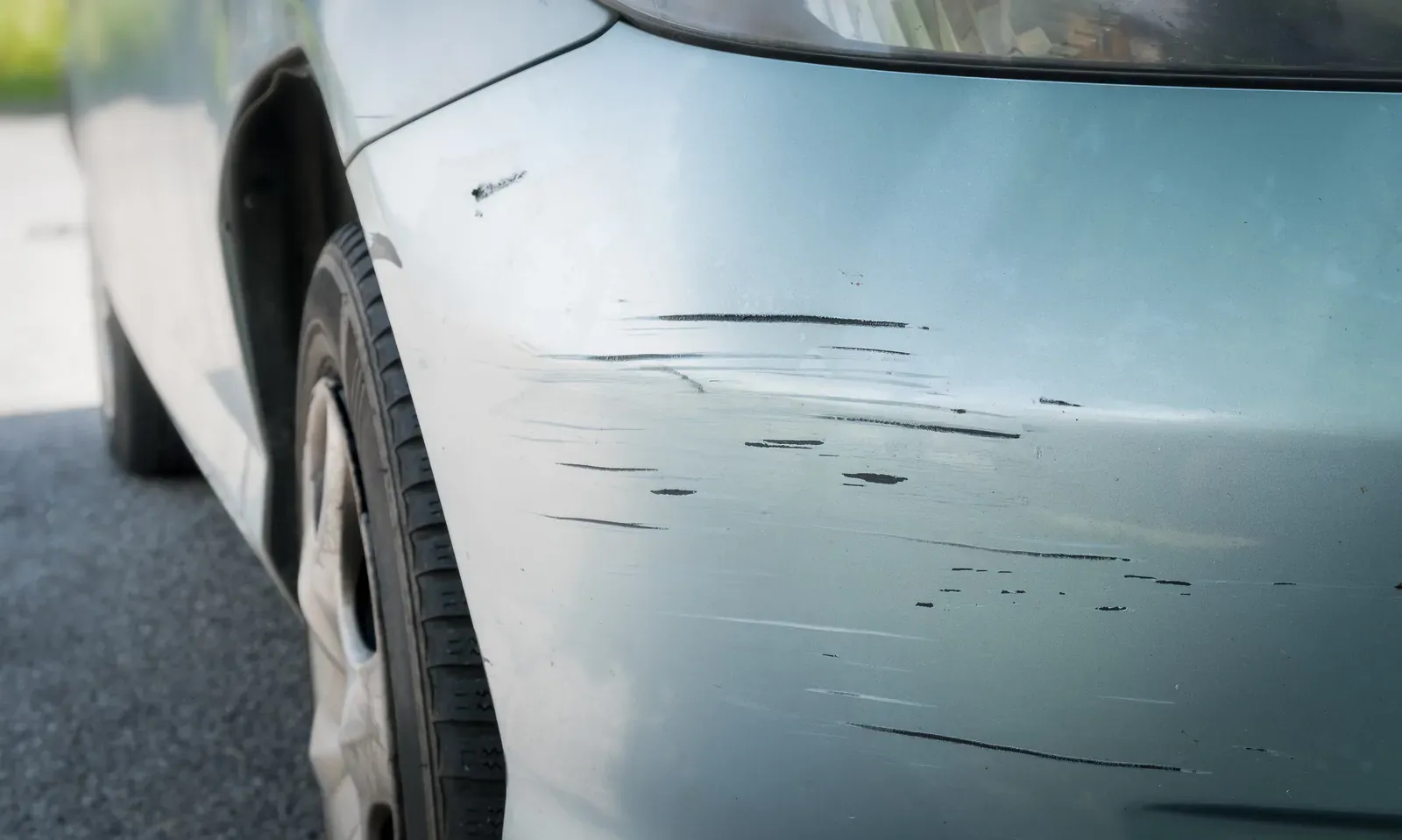
What to do in the first hour
Resist the compound. The instinct after finding a key line down a door is to buy a bottle of scratch remover and start rubbing, and on anything deeper than a clear-coat scuff that makes the job worse: the abrasive rounds off the edges of the groove, thins the clear around it, and turns a crisp line into a wide dull band that has to be sanded further before it can be sprayed.
Photograph it instead — in daylight, straight on, then at an angle so the depth reads. Do a slow lap of the whole vehicle before you decide what happened, because keying is rarely confined to one panel. A line that starts on a front fender usually carries across both doors and dies somewhere on the quarter, and there is often a second one on the other side.
Then gauge the depth. Draw the edge of a thumbnail slowly across the mark at right angles: if it glides over, the damage sits in the clear coat; if it snags, the colour is cut. Grey or white showing in the bottom of the line means it is into primer, and a bright metal streak means it went all the way through and will start to corrode.
If you intend to claim, report it. Keying is vandalism, not a collision, so it does not go through a Collision Reporting Centre — file the report online or at a police station and keep the incident number, which most comprehensive claims will ask for. That report is far easier to make the same day than a week later.
What the colour at the bottom of the line tells you
Automotive paint is built in layers: primer for adhesion and corrosion protection, a colour coat, and clear over top for gloss and ultraviolet protection. A key riding along a door at walking pace usually cuts the clear and the colour and stops at primer. A key held hard, or dragged over a body line where the panel stands proud, goes to metal.
What the line cut through sets the repair. Clear-coat-only damage can be machine polished — a compound cut followed by a finer polish, no paint at all, done in an afternoon. Once the colour is cut, polishing cannot bring it back, because there is nothing left to level down to. The panel gets sanded flat, sealed, resprayed in your colour and cleared.
Length matters less than people assume. A long scratch confined to one door is a one-panel repair. A short scratch that crosses from the fender onto the door is a two-panel repair, because paint has to stop at an edge and the colour on both sides of that edge has to agree.
Bare metal changes the urgency. Ontario roads are salted from November through March, and an exposed streak of steel will show rust creeping out from under the paint edge within a season. That is the one version of this where waiting costs real money.
Spot repair, blend, or the whole panel
Our estimator looks at the photos and sorts the repair into one of three buckets. Polish, if the clear survived. A spot repair, if the damage sits in the middle of a large panel with plenty of room around it. Or a full panel refinish, when the line runs the length of a door or crosses a body line where there is nowhere to hide a transition.
Whichever bucket it lands in, the colour starts from your vehicle’s paint code, then goes onto a test card and gets checked against the actual panel in proper light, because a code is a starting point and a nine-year-old fender that has lived outside is not the shade it was originally mixed as. Metallics and pearls are blended into the adjacent panel so the eye never finds an edge.
The finish is cleared over the repaired area and the blend, baked, then cut and polished so the texture agrees with the panels around it. A repair that is flat and glossy but smoother than the factory orange peel beside it is a repair you can spot from three metres away, and that detail is what separates a proper refinish from a quick one.
Our paint and refinish work carries a lifetime warranty, which is the honest answer to the question everyone asks about whether a resprayed panel will age differently from the rest of the car.
Comprehensive, the deductible, and whether to claim at all
Vandalism falls under comprehensive coverage, the same part of the policy that handles theft, fire and falling objects. No fault is assigned, because there is no other vehicle and no collision. Your comprehensive deductible applies, and you pay it once for the incident rather than once per panel — which matters, since a keying that crossed three panels is still one event.
That is the whole calculation. One scratched door can land close enough to the deductible that paying directly is the cleaner choice and keeps the claim out of your history. A full-length line down both sides of the vehicle is well past it, and the coverage is there for a reason.
What we can do either way is put a written estimate in front of you from your photos, so the decision gets made against a real number instead of a guess. If you claim, we run the file with your insurance company and you are not the one chasing approvals. If you pay directly, you tell us which panels to do and we do those.
Questions people ask
Can a keyed car be fixed without repainting?
Only if the key never got through the clear coat, which is uncommon on a deliberate scratch. Wet the door and watch the line before you spend money on polish: a mark that vanishes until the panel dries sits in the clear and may polish out; one that stays visible when wet is through the colour, and the panel has to be sprayed.
Should I report vandalism to police if I am not claiming?
It costs nothing and it keeps the option open. If you decide later that the repair is worth claiming, most insurance companies want an incident number for vandalism, and filing weeks after the fact is awkward. Reporting also puts the location on record if a lot or a street has a pattern.
Will a vandalism claim count as an at-fault accident?
It is not an at-fault loss — nobody hit anybody. It is still a claim on your record, and how any claim affects a renewal is between you and your insurance company, so put that question to them directly before you file. It is worth a phone call even for a repair you feel sure about.
How long does the car have to stay at the shop?
A polish is an afternoon. A single-panel refinish is usually a few days once the paint has cured and been polished back. Several panels down both sides is longer — you get a window when the estimate goes out, and we do not shorten it to make the booking sound better.