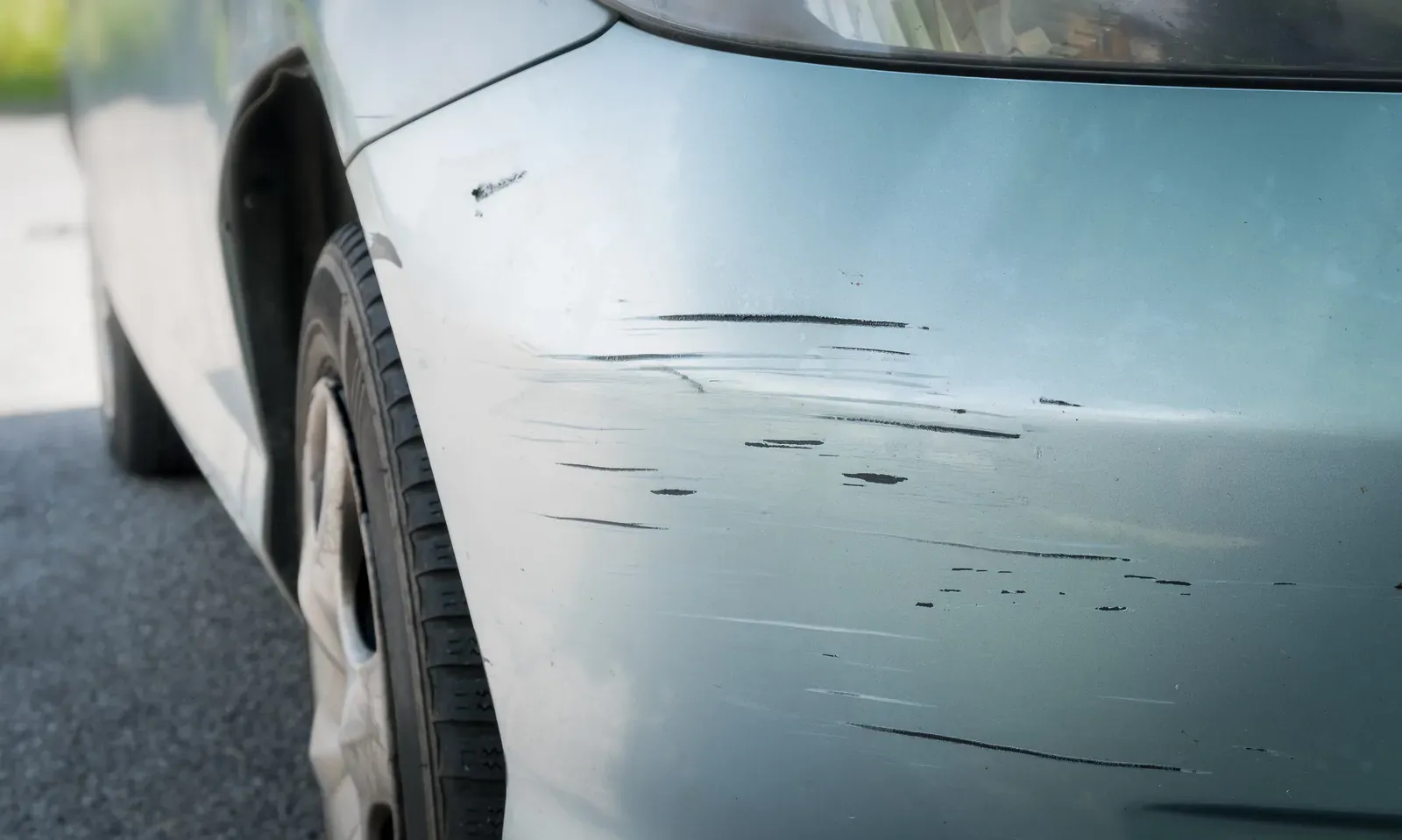
How to run the test properly
Wash the area first with soap and water and dry it. Half the scratches people bring in are not scratches at all but transferred paint or rubber sitting on top of the finish, and dirt in the groove exaggerates everything else. Then run a fingernail perpendicular across the mark, lightly, using the edge of the nail rather than the flat.
Do it in good light and from more than one direction. A scratch that disappears when you wet the surface with water is shallow, because water is temporarily filling the groove the way clear coat will — that is a useful second check and it costs nothing.
- Nail glides across, mark fades when wet — clear coat only
- Nail catches faintly, colour still visible in the groove — into the basecoat
- Groove reads grey, white or a body-colour undertone — through to primer
- Bright bare metal, or a dark line on aluminum — down to the substrate
What sits under your fingernail
A factory panel is built up in layers, each thinner than most people picture. On the steel there is an electrocoat applied by dipping the whole body shell, which is the primary corrosion barrier. Over that goes a primer surfacer that fills and provides adhesion. Then the basecoat, carrying every bit of the colour and flake. Then the clear coat on top.
The whole stack is thinner than a business card. That is why depth matters so much: the difference between a mark you can polish out and a mark that needs a booth is often a few microns, and that is exactly what the test is measuring.
The repair each depth needs
Clear-coat-only scratches are levelled, not filled. The surrounding clear is wet-sanded down to the bottom of the groove with progressively finer paper, then machine-compounded and polished back to gloss. There is no paint involved and no colour matching to worry about, which is why this is the fastest and least invasive repair on the board. It is limited by how much clear the panel has to give — a shallow mark, yes; a deep one, no.
Once the scratch is into the basecoat, polishing has nothing left to work with, because removing more clear just exposes more colour. The panel gets sanded, sealed, resprayed in colour and cleared, with the new material faded into the surrounding surface so the repair has no edge.
Through to primer means the same refinish process with a rebuild underneath: the edges of the scratch are feathered so the layers step gradually, primer is applied and block-sanded flat, and only then does colour go on. Skipping the feather is what causes a repaired scratch to reappear as a faint ridge months later.
Bare metal changes the priority. Now the job is corrosion protection first and appearance second — the exposed steel is cleaned, treated with an appropriate primer that bonds and seals, and any deformation around the gouge is straightened or filled before refinishing begins.
- Clear only — wet sand, compound, polish; no colour, no booth
- Into colour — sand, seal, respray colour and clear, blend into the panel
- Into primer — feather the edges, prime, block sand, then refinish
- To metal — clean and treat immediately, prime for corrosion, straighten, then refinish
Marks that are not really scratches
Transfer marks are the happiest diagnosis in the shop. When another vehicle, a bike pedal, a shopping cart or a garage door frame rubs your car, its paint or rubber often ends up sitting on top of your clear rather than cutting into it. A streak of another colour that your nail cannot catch usually comes off entirely with compound and a machine pad, sometimes with nothing more than a clay bar.
Bumper covers behave differently from steel panels. Plastic flexes, so a scuff on a corner is often a shallow abrasion across a wide area rather than a deep line, and it can be sanded and refinished without any structural work — as long as the plastic underneath is not cracked and the mounting tabs are intact.
And then there are wash marks: the fine, uniform swirl haze that spinning brushes leave across a whole panel. That is thousands of microscopic clear-coat scratches, not one, and it is corrected by machine polishing the entire surface rather than treating individual lines.
If you can see metal, do something today
Exposed steel in this climate does not wait. Between the salt on Sheppard from November to April and the humidity through August, a bare gouge can start orange-tinting within days, and rust that starts in a scratch spreads under the surrounding paint where you cannot see it. A scratch handled in week one is a refinish. The same scratch left for two winters can be a rust repair.
Do not fill it with a wax stick or a hardware-store touch-up bottle if you intend to have it done properly — those products leave a residue that has to be removed before any primer will bond, which adds work. Keep the area clean and dry, park inside if you can, and send photos so the depth can be assessed and the repair written before you commit to anything.
Three photos usually do it: one straight-on close-up, one along the panel at a shallow angle so the depth reads, and one from a few steps back so we can see which panels are involved.
Depth also drives the money conversation, which is worth having before anything is booked. A polish-only correction is a short visit with no colour work behind it. Anything that reaches primer or metal brings preparation, refinishing and blending into the job, and that difference is usually what decides whether a scratch is worth going through your insurance company or worth handling directly. Our estimator will tell you which side of that line your damage falls on from the photos, before you have to choose.
Questions people ask
Will a scratch remover from an auto parts store work?
On a clear-coat-only mark, a mild abrasive polish can genuinely reduce it, because that is the same principle a shop uses with better tools. On anything your nail catches, it does nothing useful — there is no clear left over the groove to level.
Can one deep scratch be fixed without painting the whole panel?
A spot repair is sometimes possible on a large panel where the damage sits well away from the edges. More often the refinish runs to the natural boundaries of the panel, because that is where a colour transition can be hidden properly.
Why do some repaired scratches reappear as a faint ridge months later?
Because the layers were not feathered before refinishing. When a deep scratch is painted over without stepping its edges back gradually, the buried edge telegraphs through the new material as the paint shrinks and cures. Feathering, priming and block-sanding flat before colour is what prevents it.
Does a scratch through to metal always mean rust later?
Not if it is sealed promptly. Steel needs oxygen and moisture, and a correctly primed and painted repair removes both. Left open through a GTA winter, though, rust is close to certain, and it will keep working under the edges of the paint.