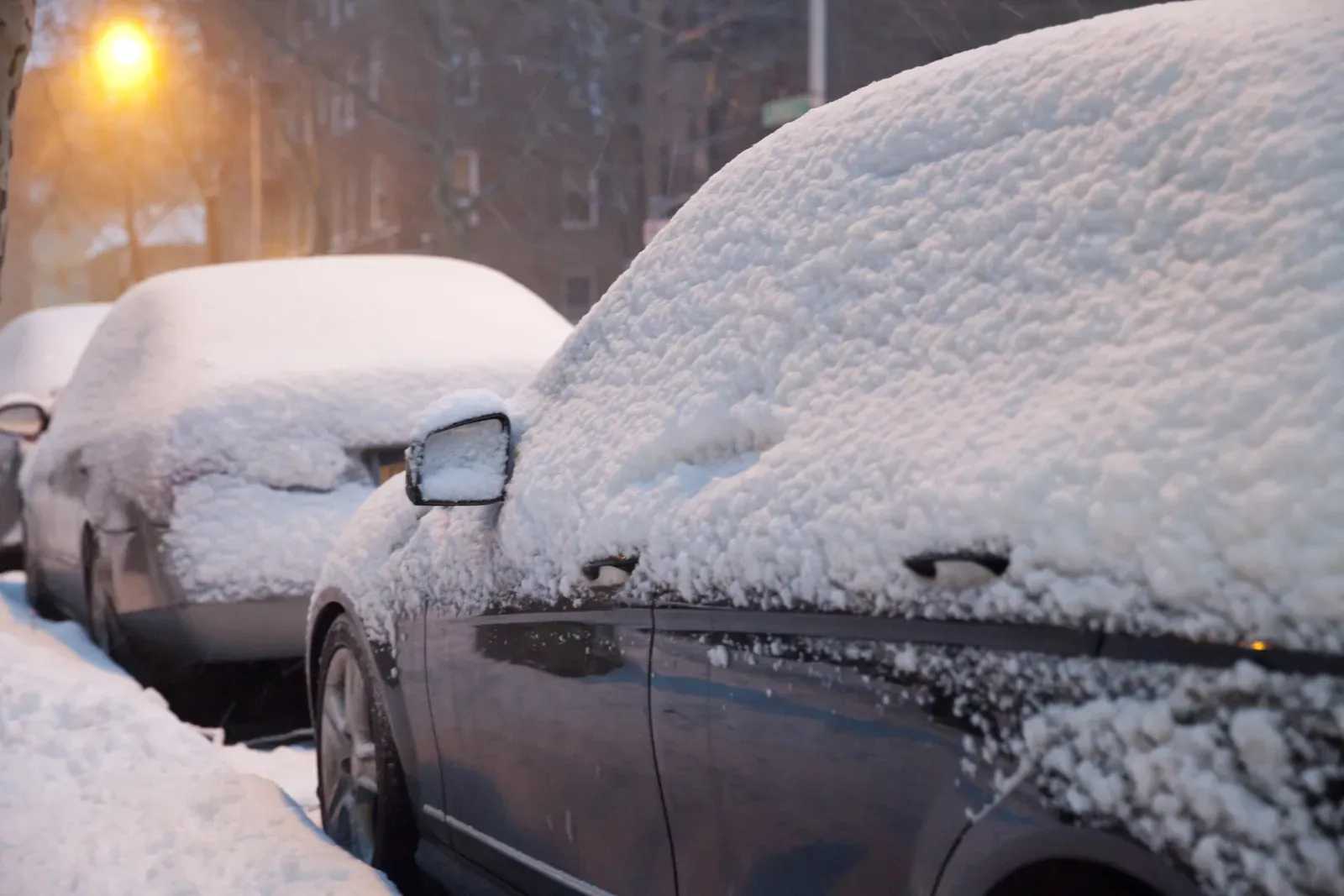
The morning it happens
You cleared the driveway at seven, the plow came through at seven-twenty, and now there is a ridge of grey compacted snow across the end of it that has already started to set. Everyone tries the same thing: a run at it. Sometimes the car climbs over and drops back down with nothing worse than a thump. Sometimes the front air dam catches, the plastic under-tray unclips, and you drag it down the street making a noise you will remember all day.
If the car stops halfway through, resist the second attempt. Back out along the tracks you made, take a shovel to the middle of the pile, and clear enough width that the wheels can carry the car through rather than the bumper. Then get down at the front and look: an under-tray hanging by two clips will fold under the wheels at the first turn, and a wheel-arch liner pulled loose will chew itself against the tire the whole way to work.
Take photos before the snow melts off the panel. Grit sitting in a fresh scuff shows exactly what happened, and if you decide later to claim, that beats trying to describe it in March. Then rinse the affected area, because the same windrow that scraped you also packed salt into the gap it opened.
What packed snow takes off a car
A windrow is not soft. Plow snow arrives mixed with sand, road salt and chunks of ice that have already been compacted once, and by mid-morning it has the consistency of wet concrete. The parts it finds are the ones hanging lowest: the front air dam under the bumper, the plastic valance and its clip line, the engine under-tray, the lower rocker moulding along the sill, and the front edge of the wheel-arch liner.
Above that line, the damage is usually cosmetic but ugly — dull grey scuffing along the rocker where the frozen crust dragged along the paint, scratches through the clear coat on the lower doglegs behind the front wheels, and a bumper corner sanded down by grit. Cars with side skirts or an aftermarket lip take the worst of it, because those parts sit lower than anything the factory engineers intended to meet snow.
The hidden version is a bumper cover that has been pushed backwards on its slides. The tabs let go, the cover looks fine, and then in April you notice the gap at the fender is wider on the driver’s side. That is the same failure a low-speed collision produces, arrived at through a snowbank instead.
Why a winter scuff is worse than a summer one
Paint is a sealed system. Once a scrape opens it to primer or to metal, the surface underneath starts collecting whatever the road throws at it, and in a GTA winter that is a brine of salt and grit that stays wet under snow for weeks. Rockers, wheel arches and the doglegs behind the front wheels are already the parts that rot first on cars around here, because they are the parts that stay soaked longest and get the least attention.
That is why a scuff in February is worth sealing in February rather than in May. It does not have to be the full repair — a scrape that will eventually need paint can be cleaned, treated and sealed to keep water out until the weather makes a proper job easier. What you want to avoid is three months of salt sitting in an open scratch on a lower panel, which is how a paint job turns into a rust repair.
The other winter habit worth keeping: rinse the underside of the car at a wash that offers it, especially after a thaw when the salt on the road is at its most concentrated. It does more for the sills than anything else you can do for the same money.
Clips and trays come back cheap; paint waits for the booth
Send photos of the front, the rocker and anything hanging down. The estimate typically separates into two piles: fasteners and plastics, which are quick, and paintwork, which needs booth time. Clips, under-trays and liners are cheap parts that cost more in labour than in material, and they are worth doing properly, because a re-secured tray with two zip ties will find the next windrow the same way.
Rocker and lower-panel refinishing has its own trick. Those areas usually wear a textured chip-guard coating rather than smooth colour, so the repair gets re-textured to match before it is sprayed, and then colour is faded up into the door. Get that step wrong and the panel reads as glossy where the rest of the car is grained. Seam sealer along any joint we open goes back before paint, not after.
Winter scheduling is honest here: booth time is in demand from December through March, curing takes longer when parts come in cold, and drying between stages is slower. We give you a range rather than a promise, and we tell you if waiting a few weeks costs you nothing.
Whether to claim it
Driving into a snowbank is a single-vehicle event. It goes against collision coverage, it is treated as at-fault, and the deductible applies. For a torn under-tray and a scuffed rocker, that maths almost always favours paying directly. For a car that has taken the front bumper off its mounts and needs a cover, a valance, liners and refinishing across three panels, it can go the other way.
Either way, the decision belongs to you and it should be made with the estimate in hand. If you do open a claim, notify the insurance company promptly rather than waiting for spring; the standard policy sets an expectation of notice within a week of the incident, and a claim reported in April about a January snowbank invites questions nobody enjoys answering.
Questions people ask
The plastic under the front bumper is dragging. Can I zip-tie it and drive?
As a way to get home, yes. As a repair, no. Those trays route air over the engine and away from the front wheels, and a torn one flapping at highway speed usually takes its remaining clips and part of the bumper skin with it. The clips themselves are inexpensive parts.
Should I fix a winter scrape now or wait until spring?
It depends where it is. High on a door with the paint intact, spring is fine. Low on a rocker or an arch with primer or metal showing, get it sealed now — those are the panels that rust in this city, and an open scratch spends the whole winter holding brine against bare steel.
Will a scuffed rocker actually rust before I get to it?
Not in a week, but the clock starts. Surface rust can appear within days on exposed steel in a wet winter, and once it creeps under the surrounding paint the repair area grows. Catching it while it is still a scratch keeps the job small.
Can paint be sprayed properly in the middle of winter?
Yes, in a heated booth with controlled airflow. What winter changes is the schedule around the booth — cold parts need to come up to temperature, prep takes longer, and the whole shop is busier because of everything else the season produces. That shows up as a longer range, not a worse finish.