Dock rub on a Progress Avenue van is a different job from a keyed door
A cube van that backs onto a loading dock along Progress or Ellesmere three times a day carries its history on the rear doors: black rubber transfer, a band of scuffing at dock-bumper height, and, where the rubber has picked up grit, a set of fine parallel scratches through the clear. Most of it polishes out. What does not is the season’s worth of grit that has gone through the colour, and on a white van the grey primer showing through is the tell. Taxis bring the same in a different place — a lower door or a rocker scraped along every curb between the Town Centre and the Bluffs.
For a working vehicle the question is not only what the repair is but when the vehicle can be earning again. We book it so that a polish happens while the driver waits, and so that a refinish goes into the booth the morning the van arrives, with the materials already on the bench. Turnaround is usually a day for polish and a few days for paint; a rear door that has to be repaired through the colour is the longer end of that.
What light, water and a detailer’s polish tell you before we do
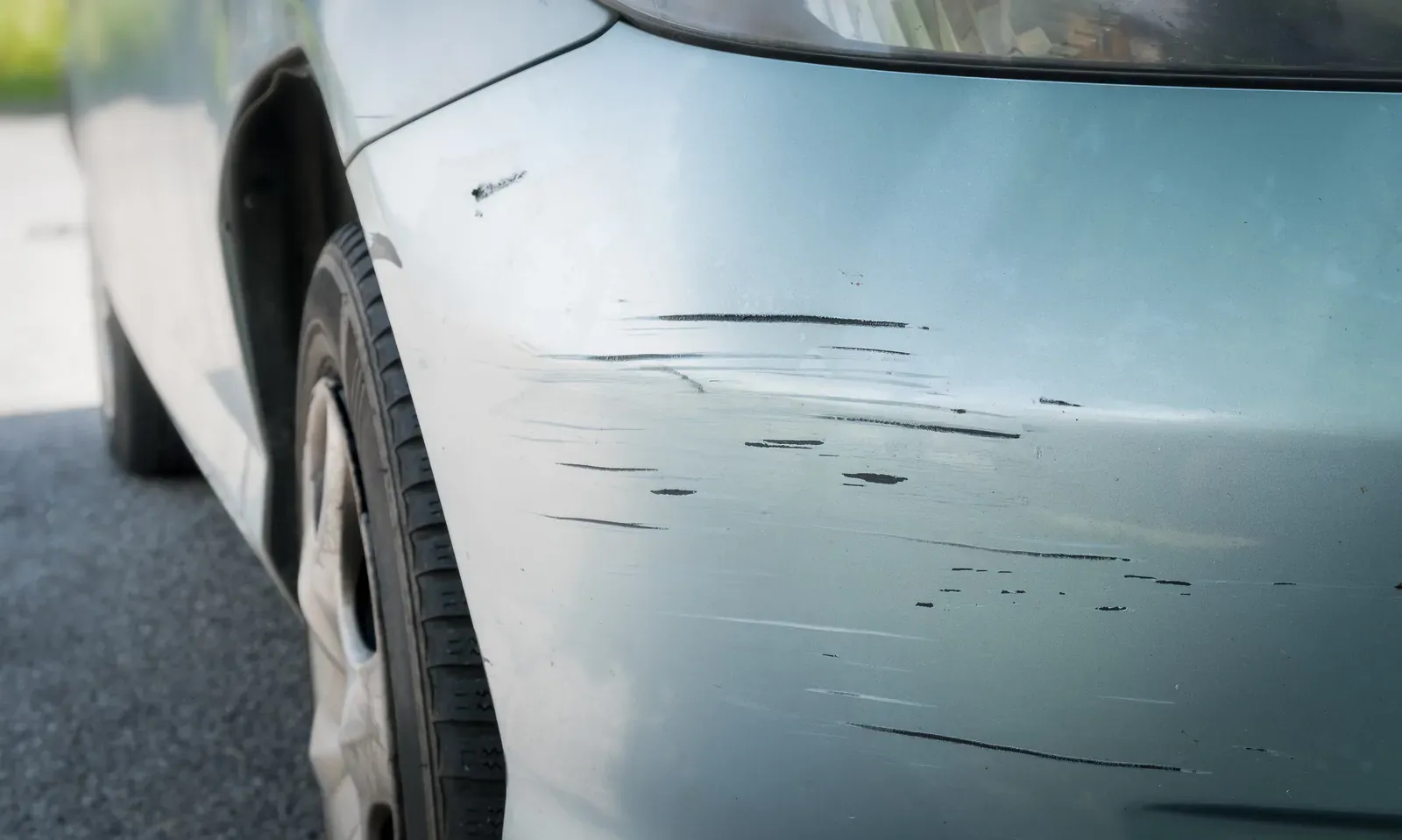
You can read the depth of a scratch without a shop. Wet it: if the line disappears while the panel is wet and returns as it dries, the scratch is in the clear coat, and a polish will take it out. Look at it against the sky: a clear-coat scratch is a bright hairline; a scratch into the colour is dull and the same colour as the car; a scratch that shows white or grey has reached the primer; one that shows bright silver or brown has reached the steel. If a detailer has already tried a polish and the line faded but stayed, it is through the clear and into the colour, and polishing harder only thins the clear around it.
Colour-depth scratches are touched, levelled and blended, and the panel polished so the repair disappears. Primer-depth and metal-depth scratches mean a refinish, blended into the panel beside it, and on a car that has sat through a Scarborough winter with bare steel exposed we check the edges for rust before we quote, because it is often there. Where the scratch sits matters too: a flat door blends easily, while a line across a fender crease or the corner of a bumper cover is two surfaces at two angles. On a bumper the cover is painted complete as a part, and on a metallic the adjacent fender is blended so the plastic does not read as a step.
- Clear-coat scratches polished, often while you wait
- Colour-depth scratches touched, levelled and blended along their length
- Primer or metal scratches refinished, with the edge checked for rust
- Any panel we refinish carries the lifetime paint warranty
Hedges off Midland, the Town Centre lot, and which scratches are a comprehensive claim
The rest of Scarborough’s scratches come from home and from the lot. A cedar hedge grown out over a driveway off Midland leaves a long shallow line down a rear quarter that is mostly clear coat until it reaches the arch. A fence post at the mouth of a mutual driveway catches the same corner every time. The Scarborough Town Centre lot leaves the marks nobody admits to: a cart, a bicycle pedal, a key.
The deliberate ones are a claim question. A key line is vandalism, which falls under comprehensive coverage with your normal deductible and no fault against you. It is reported to police online or at a station rather than at a Collision Reporting Centre, because no other vehicle was involved. A single door often prices near the deductible and a key line across three panels usually does not, so we write both figures before you call your insurance company.
Questions people ask
Dock rub on the rear doors of my van — is it worth refinishing, or is a cover plate the honest answer?
If the van keeps backing onto the same dock, a refinish is a fresh surface for the same rubber to grind, and a bolt-on protector plate or a strip of heavy film at dock height costs less and takes the abuse. Refinish first if the scratches have reached primer, because bare steel rusts, then protect it. If the van is coming off the route or going up for sale, refinish alone is fine.
What coverage does a keyed door at a Markham Road plaza fall under?
Comprehensive. Vandalism is not a collision, so it carries no fault and does not touch your collision coverage; you pay the comprehensive deductible and your insurance company pays the rest. Report it to police online or at a station and keep the report number for the adjuster.
A key line runs the whole driver’s side but does not catch a nail. Is that three panels repainted?
Rarely. A line that does not catch is in the clear coat, however long it is, and it is polished along its length. Length adds time in the bay; only depth changes the kind of repair. Three panels are refinished only where the line has gone through the colour, or where there are so many marks that polishing would thin the clear too far.
The taxi works nights. Can a clear-coat polish be done first thing in the morning without the car staying?
Yes. Polishing is measured in hours, and if the scratches are clear-coat only we book the first slot of the morning and you wait for it. Anything that needs the booth stays for a controlled cure, and we tell you the real number of days when the estimate goes out.