Seaton’s grey dust is why a car wash in north Pickering can add scratches instead of removing them
North of Taunton, Pickering is still a construction site. Seaton’s new streets and the collector roads that feed them carry dump trucks and concrete mixers all day, and what they leave behind is a fine grey dust of cement and crushed stone that settles on every car in Duffin Heights and the new blocks off Brock Road. Wipe it with a dry cloth, or run the car through a wash whose brushes have already been through fifty dusty cars, and the dust becomes an abrasive: a haze of fine circular scratches across the hood and roof that shows in sunlight and vanishes in shade. Add the gravel that comes off a truck bed on Whitevale Road and the front of the hood picks up chips that go through to primer. The haze polishes out; the chips do not.
The older neighbourhoods scratch cars differently. Amberlea and Dunbarton have driveways built narrower than the cars now parked on them, and a hedge, a downspout or the garage frame rubs the same spot on a mirror cap or a rear door every morning until the clear is gone in a band. The Bayly GO lot is where the deliberate scratch happens — a key dragged along a door or a quarter on a car that sits unattended ten hours a day, five days a week. And from June to September the angled stalls at the Nautical Village produce a specific mark: a curved scrape across a rear quarter at hitch height, left by a boat trailer on a backing turn.
What raking light shows about a scratch decides whether it is polished or painted
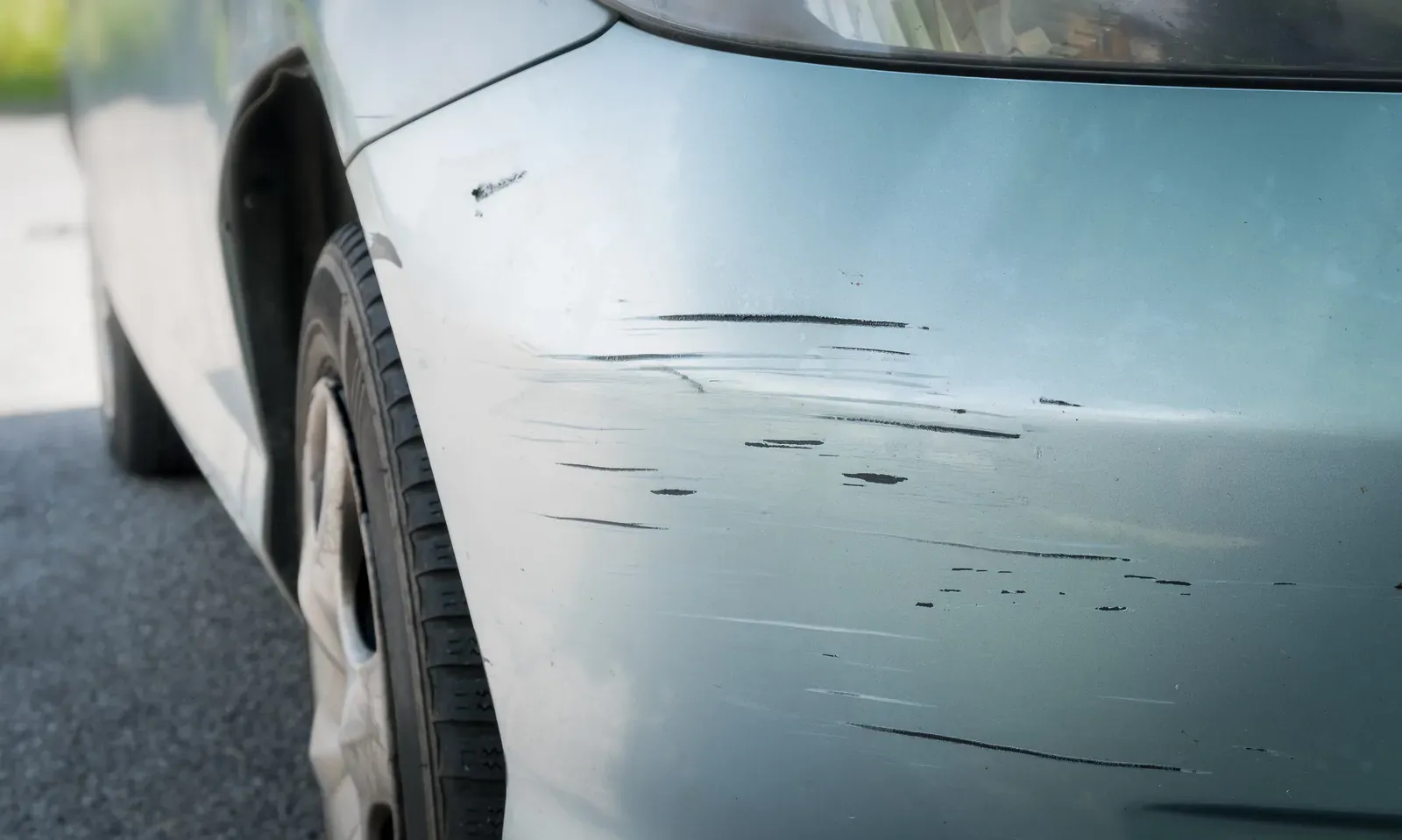
Photograph the scratch with the sun or a lamp raking across it rather than shining straight on, and the depth shows in the reflection. A mark that reads as a bright hairline and vanishes when the panel is wet is in the clear coat; it is polished in stages, with the remaining clear checked so nothing is burned through. A mark that stays dull when wet and is the same colour as the car has gone through the clear into the base coat; that section is sanded, refinished and blended into the surrounding panel. Grey or white at the bottom means primer, and bright silver or brown means bare steel — that panel is prepped, primed and painted, and it should not wait for winter, because salt finds bare metal before you do. If you would rather feel it than photograph it, a fingernail drawn across the mark catches on anything through the clear and glides over anything still in it.
A key line down a door and a quarter is handled as both panels together, with the blend running into the fender at one end and the bumper corner at the other. The Seaton dust haze is the easy case: a machine polish across the whole hood and roof, done in a morning, with no paint involved. Chips across the front of the hood are the opposite: touched individually when there are a handful, and done as one refinish with a blend into the fenders when they are dense, since a hood wearing thirty dabs of touch-up draws the eye faster than the chips ever did.
A keyed door at the GO lot is a comprehensive claim; a hitch arc at the bay is a collision claim
Which coverage a Pickering scratch falls under depends on what made it. A key is vandalism: a comprehensive claim with your normal deductible and no fault, reported to police online or at a station rather than at a Collision Reporting Centre, because no other vehicle was involved. A trailer hitch is part of a vehicle, so a hitch arc from a driver who left is a collision claim under your own collision coverage, rated not at fault, and it needs a reporting centre report. A hedge, a garage frame or construction dust is nobody’s fault but the calendar’s, and those are out-of-pocket jobs. We price the work both ways so the estimate sits beside your deductible before you call anyone, and the paint on any panel we refinish is covered for life.
- Depth read from a raking-light photo before you drive the 401
- Clear-coat hazing from construction dust polished across the whole panel in a morning
- Key lines across two panels refinished together and blended at both ends
- Comprehensive, collision or out of pocket — sorted by what made the mark
Questions people ask
Our new house in Seaton is surrounded by construction and the hood is full of chips. Do I claim, chase the builder, or pay?
Pay, usually, and only after the trucks are gone. Chasing the builder rarely goes anywhere, because the gravel came off a truck on a public road rather than off the site, and a comprehensive claim for road chips costs you the deductible and a claim on the record for what is often a single-panel refinish. Wait until the street is finished, then have the hood refinished once; a hood done while the mixers are still running is chipped again by spring. A single deep chip is worth sealing now so the steel under it does not rust.
Why does the touch-up I dabbed on the hood still show, and did it do any good?
It did the important job: it sealed the bare steel against salt, so the chip will not become a rust bloom by spring. It shows because touch-up paint goes on thick to fill the hole, sits proud of the surface, then shrinks as its solvent leaves, so it ends up as a small dome with a ring around it that catches light. It has no clear coat over it either, so on a metallic it reads darker than the panel. As a seal it is worth doing; as a repair it never disappears, and once the chips multiply the hood is better served by a single refinish.
The scratch runs across the door and onto the plastic bumper corner. Is the bumper done differently?
Yes. The door is refinished and blended into the fender or quarter beside it. The bumper cover is painted complete as a part rather than spot-blended, and on a metallic or pearl the panel next to it gets a blend of its own so the cover’s slightly different plastic texture never reads as a change in colour. A cover that is only scratched, with no crack and no broken tabs, is sanded, primed with a flexible primer and painted; replacement is for covers that are split or no longer hold their shape.