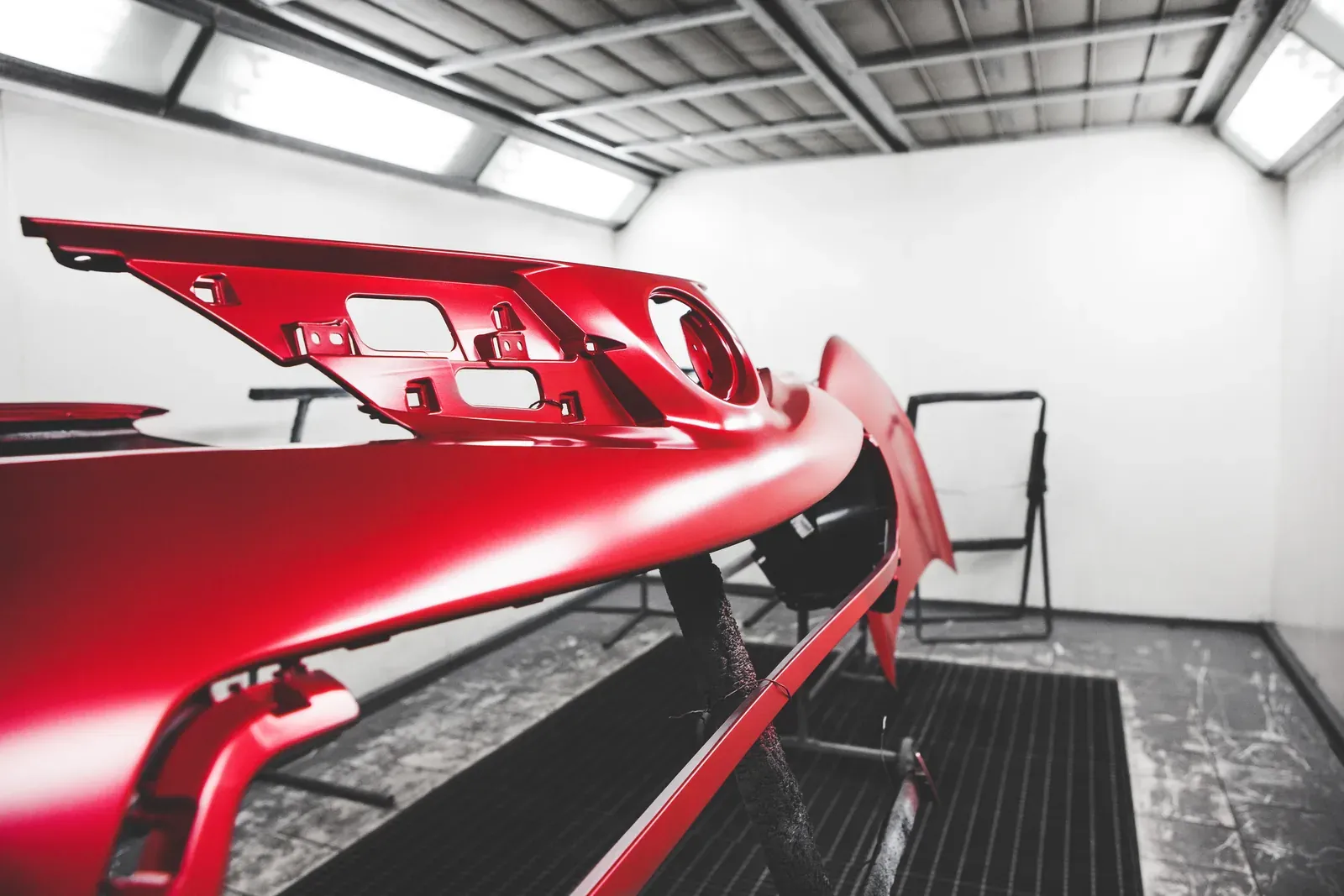
The lower valance is the part of a Pickering bumper that meets the windrow first
The piece that gets hurt most on a Pickering bumper is the one nobody names. Under the painted cover, at the bottom of the front bumper, is the lower valance — a strip of black or body-colour plastic that closes the gap to the road and often carries the fog lamps or the air dam. It sits a hand above the pavement, and in Amberlea, Rosebank and the streets off Liverpool Road the plow leaves a windrow across every driveway mouth that freezes overnight into a ridge at exactly that height. The first pass through it on a cold morning bends the valance; the second cracks it at a clip; by March the clips have let go along one side and the strip hangs low enough to catch the Bayly Street potholes.
Seen from underneath, a windrow crack is easy to read. It starts at a clip tower on the underside, runs forward toward the face of the bumper, and the plastic on either side is scuffed white where the ice dragged it. If the crack has stayed in the valance, that part alone is replaced or welded and the cover above it is untouched. If it has run up into the cover’s lower edge, or the impact pushed the corner in far enough to snap the tab behind the wheel liner, the cover is coming off, and then the question is whether it is welded from behind or replaced.
At Port Union the tap pushes the rear sensor through its mount, and the beep afterward is the tell
The rear bumper story is the westbound slowdown at Port Union, where the lanes stop without warning and the car behind arrives a half-second late. At 10 or 15 km/h the cover flexes, pops back and looks scuffed. What has happened behind it is different. A rear parking sensor sits in a plastic ring bonded to the inside of the cover; when the cover is pushed in, the sensor is driven back through that ring and left hanging by its wire, or sits crooked in a mount that has cracked. The foam absorber behind the cover is crushed where the hit landed, and when the car behind carried a hitch, the steel bar has a dent that pulls its brackets out of line.
The sign is the beep. A sensor that has been pushed through its mount reads the ground or the cover itself and chirps the moment reverse is selected, or shows a blank segment on the display. That is the fix, and it is why we ask for a photo of the sensors from behind if the cover can be reached. A cover with a cracked sensor ring is usually replaced rather than repaired, because a repaired ring rarely holds the sensor at the angle it was designed for; where the sensors mount to the cover we prefer an OEM cover, since a ring a few millimetres out gives false readings. After the repair the parking and blind-spot systems may require recalibration, and we say so before the estimate is approved rather than at pickup. Colour follows the same rule on every bumper: the cover is painted complete as a part, and on a metallic or pearl the quarter or fender beside it is blended so the plastic does not read as a step.
A GO-garage corner scuff is usually paid for directly; a Port Union hit is usually a DCPD claim
The Pickering GO garage and the rows nearest the Town Centre doors produce the third pattern: a corner scuffed on a concrete column or a wheel stop, paint gone to the plastic but nothing cracked and nothing behind it touched. That is a sand-and-refinish, and the number often lands near a deductible, so most drivers pay for it directly and keep a claim off the record. The Port Union hit is different. With an absorber, a sensor ring and possibly the bar on the estimate it is a claim, and when the other driver is identified and insured in Ontario your own insurance company pays for your car under DCPD, with fault set under the Fault Determination Rules. A windrow at your own driveway is a collision claim on your own policy with the deductible, and we put the estimate beside that deductible before you decide.
Send four photos: the whole corner from a few steps back, the damage close, the underside of the cover, and the sensors from behind if you can see them. The cover or the valance is ordered from those, and the drop-off is booked for the day it lands, so a Pickering driver makes one trip in and one trip home.
- Valance cracks read from the underside and replaced alone when the cover is untouched
- Sensor rings and absorbers checked behind every Port Union cover
- Colour on the cover as a whole part, with the quarter beside it blended on silver and pearl
- Recalibration flagged before approval when the car may require it
Questions people ask
The lower valance is hanging on one side after a windrow. Is it safe to drive it down the 401 like that?
Not at highway speed. A valance that has let go on one side is held by the remaining clips, and the air under a car at 100 km/h pulls it down and back until it folds under the wheel or lets go into the lane behind. Zip-tie it up through the clip holes for the drive, or take it off, and send the photos; a valance alone is a small job, and catching it before the cover tears keeps it that way.
I scuffed the corner on a column in the GO garage. Why is the estimate a whole cover and not a touch-up?
Because a bumper cover is usually painted as a complete part. Colour cannot be faded into the middle of textured plastic the way it can into a steel door, so a spot repair on a corner tends to show as a patch; the cover comes off, is sanded, primed with a flexible primer and painted whole, and on a metallic or a pearl the fender beside it is blended so the plastic does not read as a colour step. The scuff is the small part of the job; the paint is the price of a cover that matches from every angle.
The plow left the windrow that cracked my valance. Can I claim it against the City?
The windrow itself is ordinary plowing, and a claim against the City for it is not something to count on. On your own policy it is a collision claim with your deductible and no other driver, which for a single-vehicle hit is usually rated against you because there is nobody else to assign it to. For a valance alone the repair often sits near the deductible, so paying directly is the common choice. Send the underside photo and we put the two numbers side by side.