The trailer-ball dent in a tailgate is the Pickering special, and it is a three-way decision
From May to October the lots at the Nautical Village and Millennium Square are full of boat trailers, and a trailer ball sits at exactly the height of an SUV’s tailgate. The dent it leaves is round, deep at the centre and shallow at the edges, usually on the flattest part of the tailgate below the badge. The rest of the year the same dent comes from the Pickering GO lot on Bayly, where a pickup with a receiver hitch backs into the stall behind yours, and from the Kingston Road plazas, where a cart rolls downhill into a rear door.
A tailgate dent is a three-way call. If the paint is unbroken and the dent is on open metal, it is pushed out from behind through the inner panel’s access holes and the factory finish stays. If the ball caught the character line that runs across most tailgates, the metal along that line has stretched, and the crease is worked as far as it will go, skimmed with filler and refinished with the colour blended into the quarter panels. If the outer skin has creased hard in two directions, or the tailgate is aluminum and has cracked at the crease, a new skin or a new tailgate is the cheaper repair, and on a newer SUV the camera and the handle module move across to it. Photos taken at an angle, so the reflection crosses the dent, tell us which of the three you have.
Bayly GO-lot door dings come out without paint; the ones on a door crease often do not
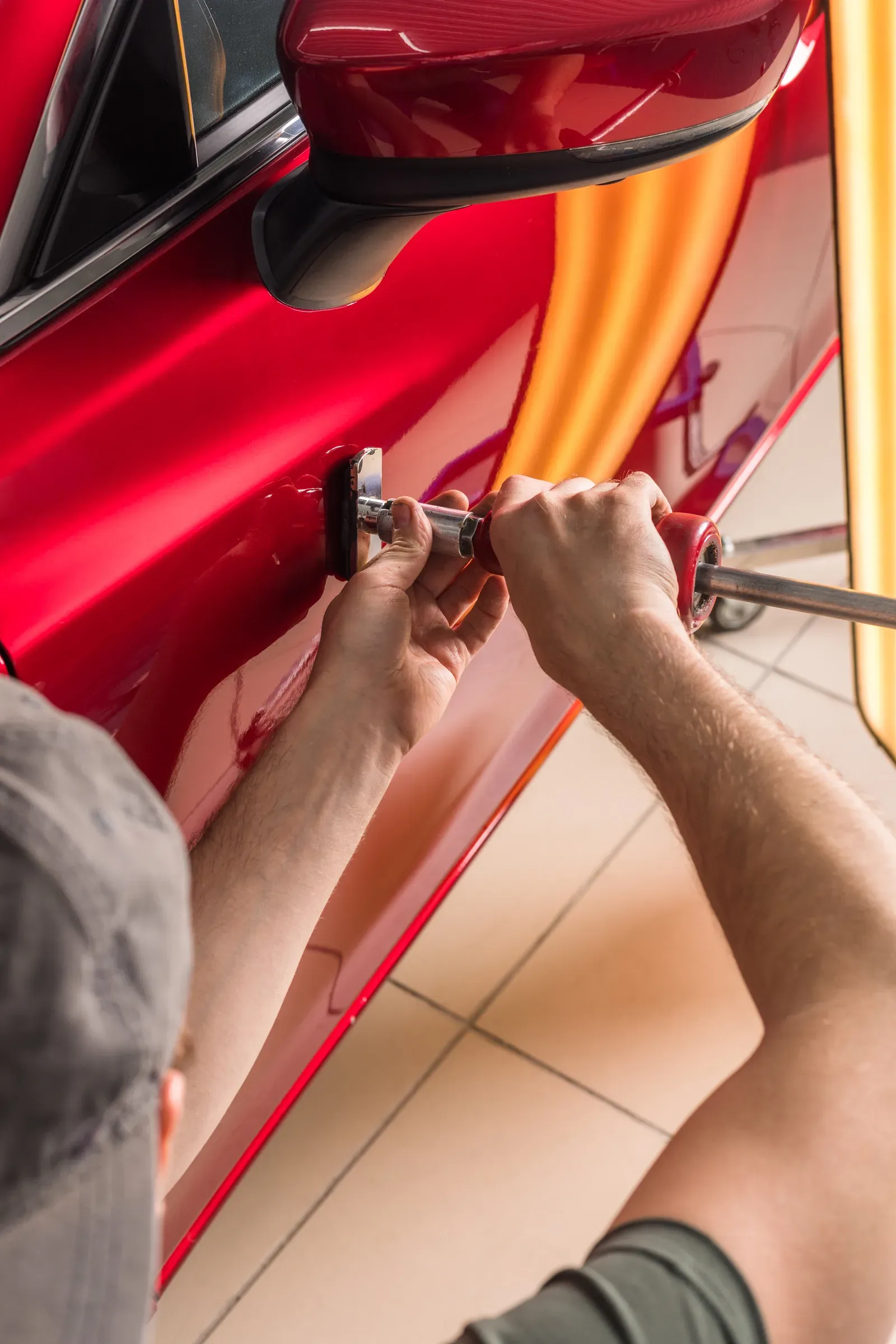
The everyday dent is smaller. The GO lot on Bayly fills before seven with commuters parking tight to make the train and the pedestrian bridge over the 401, and by six in the evening someone is opening a door in a hurry beside yours. Those dings land on the widest part of a front door and come out cleanly: the panel is reached through the window opening, the metal is worked back under a striped lamp until the reflection runs straight, and nothing is painted. The Pickering Town Centre rows near the Kingston Road entrances give the same result on rear doors and quarters.
A ding that lands on the crease of a door is different, because the crease is where the stamping stretched the steel hardest, and metal stretched a second time does not settle back flat. Shallow ones can still be worked; deep ones leave a soft spot that shows in a strong reflection, and the better result is a small skim and a blended refinish of the lower door. We say which from the photos, because the wrong guess costs a Pickering driver a morning on the 401.
When a summer storm dimples the hood, the claim runs from your photos before the car moves
Some summers a thunderstorm drops hail on part of Pickering and leaves a hood, roof and trunk lid full of shallow dimples. Hail is a comprehensive claim with no fault against you and your comprehensive deductible, and it is the one dent job where filing almost always makes sense, because there are dozens of dents rather than one. Photograph the panels in flat light, early or late in the day, so the dimples show, and send them with the door-jamb label. We open the claim, the adjuster reviews the photos — some insurance companies send an appraiser to see the car at the shop instead — and the work is booked once approval is in. Most hail comes out from behind, one dimple at a time, with the factory paint kept. A single lot ding is the opposite arithmetic: the repair is often close to your deductible, and paying directly keeps a claim off the record.
- Tailgate dents judged as push-out, skim-and-blend or new skin from angled photos
- GO-lot and Town Centre door dings worked from behind with no paint
- Hail claims opened from photos and booked once the adjuster has approved them
- Deductible put beside the estimate before any single-dent claim is filed
Questions people ask
A trailer at Millennium Square backed into my tailgate and the driver left. Is that a comprehensive claim?
No — it is collision. A trailer on a vehicle is a vehicle, so a hit by one that leaves is claimed under your own collision or all-perils coverage with the deductible, rated not at fault, and it needs a report at the nearest Collision Reporting Centre, generally within 24 hours. Comprehensive is for hail, theft, glass, animals and vandalism. Photograph the dent, the stall and the marks at ball height, and ask the marina office whether a camera covers the row.
Does a pushed-out dent come back, or sink again in the heat?
When the paint was intact and the dent sat on open metal, the steel has been returned to the shape it was stamped in and there is nothing under it to shrink or crack, so it stays put through summers on the driveway. The limit is stretched metal: a dent on a body line, or one that was pushed sharp, can be brought close but may leave a low spot that shows in a strong reflection, and we say so before choosing that route.
The neighbour’s hail claim got a new hood and mine got the dents pushed out. Why the difference?
Hoods are decided one panel at a time by how many dents there are and where they sit. Dimples on open metal come out from behind; dents on the hood’s edges, over the inner bracing where there is no access, or so dense that the metal would be worked thin, mean a new hood, and an aluminum hood that has cracked at a dent is replaced too. Two cars in the same storm can land on different sides of that line, and the photos and a look on the hoist decide it, not the neighbour’s file.