A deer on Whitevale Road is a comprehensive claim that still needs the bench
North of Taunton, Pickering turns into concession roads quickly. Whitevale Road, the sideline roads through Brougham, Brock Road toward Claremont and the roads around Greenwood carry deer at dusk for most of the year, and a deer at 80 km/h takes the hood, the grille and the radiator support, and often the tip of the upper rail on the side it hit. The claim quirk is that none of it is a collision in insurance terms: an animal strike sits under comprehensive coverage with no fault against you and your comprehensive deductible, and your collision record is untouched. The repair does not know that. A support pushed back a few centimetres has moved the rail it bolts to, and the rail is structure.
The 401 supplies the conventional version. A rear-end at highway speed in the Port Union slowdown drives the rear rails forward and ripples the trunk floor; a car pushed into the barrier at the Whites Road merge takes a front rail back and out of square. Seaton adds the odd one: a low-speed contact with a dump truck or a mixer, which outweighs a family SUV several times over, is a structural hit on the smaller vehicle even at walking pace.
Measured before any pull, pulled in stages, measured again — and both sheets stay in your file
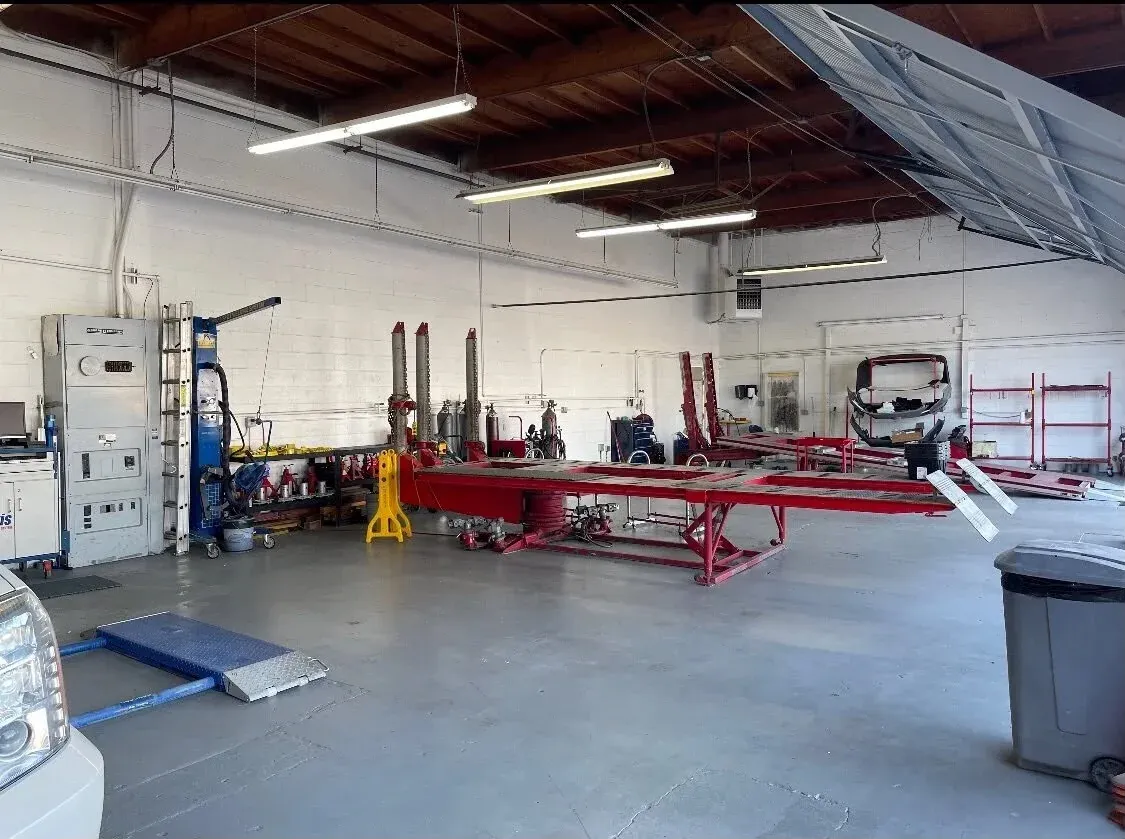
Almost everything on a Pickering driveway is unibody, so the shell itself is the frame: rails, aprons, pillars and floor welded into one structure with a set of factory reference points and known distances between them. On the bench the car is anchored, those points are measured against the manufacturer’s data, and the printout says which rail or tower has moved and by how much. Then hydraulic towers pull it back in the reverse order it was pushed, in stages, with a re-measure after each pull, because metal pulled past specification is worse than metal left short.
Some sections are not pulled at all. High-strength steels in newer cars lose their properties if they are heated and pulled, and the manufacturer defines where they are sectioned and how the new piece is joined; we use OEM sections there and the specified joining method. Aluminum structures on some trucks and EVs are softer than steel, do not spring back, and crack if worked twice, so they are replaced rather than persuaded. Afterward the suspension is aligned, and any radar or camera on a bracket that moved may require recalibration. The before-and-after sheets go to your adjuster and stay in your file, which is what answers a buyer’s question if you sell the car later.
Why we say “total loss” early to a driver who is 27 kilometres away
Some of these cars do not come back, and a Pickering driver should hear that before the drive rather than after it. Ontario has no fixed percentage that makes a car a write-off; your insurance company compares the actual cash value with the repair cost plus what the damaged car would bring as salvage, and a deer strike on a twelve-year-old sedan often lands on the wrong side of that line. The measurement sheet is the repair number, so we produce it first and send it to you and the adjuster together. If the numbers go against the car, you can accept the value, argue it with comparable listings and service receipts, or keep the car at a reduced payout and have it repaired here, with the branding and the structural inspection that follow explained beforehand.
Where the car is worth repairing, the job is the long kind — structure first, then panels and paint — and the logistics matter more than on any other repair. The flatbed is arranged from the shoulder, from a Pickering tow yard or from a reporting centre lot to Sheppard and Don Mills, beside Fairview Mall; the rental through your coverage runs from the day the car arrives; and the claim and every supplement are handled from our office. You come down the 401 once, to collect a car that has been measured and road-tested.
- Animal strikes handled as comprehensive claims, with the structure measured all the same
- Reference points measured against factory data before and after every pull
- High-strength and aluminum sections replaced along factory cut lines instead of heated and pulled
- Total-loss arithmetic shared before you make the drive
Questions people ask
A deer on Brock Road north of Taunton folded the hood and the grille. Is that on my collision record?
No. An animal strike is a comprehensive claim: no fault, your comprehensive deductible, and your collision history is untouched. What it can still be is structural, because the radiator support sits in front of the rails and moves them when it is pushed back. Photograph the front from both corners and from underneath if you safely can, and our estimator will give you a first read before the tow.
The alignment shop on Brock Road cannot get the rear wheel into range after the Port Union hit. What does that mean?
Usually that the rear rail or the floor has moved and the suspension mounting points have gone with it. An alignment adjusts the suspension within its designed range; when a reading will not come in at either end of that range, the point it hangs from has shifted. That is a measurement job, and the car should go on the bench before any more parts are replaced.
Does a dump-truck contact at walking speed in Seaton really need frame measurement?
Often, yes. A truck that outweighs the car several times over does not need speed to move a rail; a mixer backing into a stopped SUV at a construction entrance can push the front rail tip back while the bumper looks barely marked. The tell is a hood gap that has opened on one side or a cover that no longer sits flush. Measurement settles it either way, and the sheet goes in your file whichever way it reads.