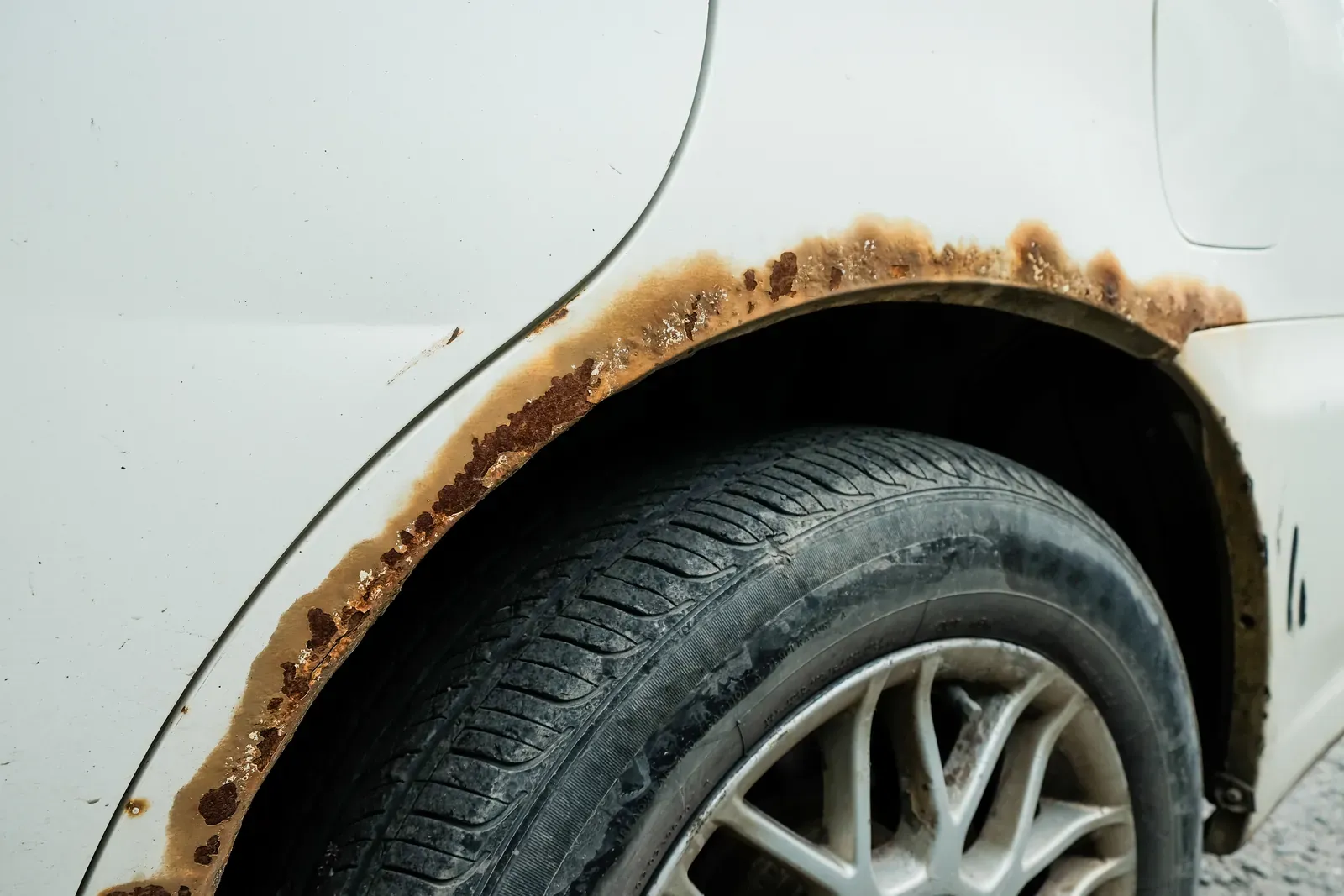
Why rust looks different on a Yorkville car
The cars around Bloor and Avenue are mostly garaged, mostly newer and many of them aluminum-skinned, which is why a body shop serving this neighbourhood sees rust in three specific forms instead of the rotted rockers common further out. The first is chip rust: a stone on the Don Valley Parkway breaks the paint on a steel lower door, a hood edge or a rear arch, salt gets into it, and by spring there is a bubble under the clear. The second is the car with no garage spot, parked on Hazelton or Scollard through the winter, where salt spray dries on the arches and sills every day and the underside never gets rinsed. The third is the older car: the collector’s coupe or the twenty-year-old sedan kept for sentiment, where the seam sealer has let go and moisture has been working the inside of the rocker for years. Each is repaired properly or not at all; grinding a bubble and painting over it buys one summer.
The salt cycle from the Bloor ramp to the 404
The parkway and the 404 are salted hard, and a car that commutes north from Yorkville drives through a brine mist twice a day from December to March. It settles on the lower doors, in the seam where the rear arch meets the quarter, behind the front wheel on the rocker, and inside the doors through the drain holes. Freeze-thaw in February and March makes it worse: water gets under a chip, expands as ice and lifts the paint further from the metal. The reason it shows in April is that the salt has done its work under cover all winter. A hand wash with the underside rinsed every couple of weeks, and a chip touched before Christmas, prevents most of it; once the paint has blistered, the metal beneath is already pitted and the only repair is to remove it. On a leased car the arch bubble is a charge at return if it is left; on a car you own it is the difference between a small refinish now and a cut-and-weld later.
Cutting it out, and what the warranty means
Real rust repair removes the corroded steel rather than covering it. The panel is stripped back to find the edge of the rot, which is always wider than the bubble. On a door or an arch the affected section is cut out and a new section welded in, a factory repair panel where one exists and a fabricated one where it does not, then the seams are sealed, epoxy primed, and the panel is refinished and blended into its neighbour. Inside the door or the rocker, a cavity wax is applied so the new steel is protected from the inside, where the salt got in the first time. Surface chip rust caught early is simpler: sanded to bright metal, treated, primed and refinished on the spot. The lifetime warranty on the refinish covers the paint; it does not cover new rust that comes through a new chip two winters on, which is why we show you the chip-touch routine before you leave. Send photos of every bubble, including the ones you think are small, and our estimator writes the estimate for the car rather than the spot.
Questions people ask
The dealer quoted a full arch section for one small blister above the rear wheel. Is that over-repair?
Not necessarily. Corrosion spreads under the paint from the point where it started, so the boundary of sound metal is always wider than the blister, and a repair that stops at the visible edge fails within a year or two. Whether that means a patch section or the full arch depends on what stripping the area reveals. We price what is actually there, which sometimes comes in under the dealer’s number and sometimes confirms it.
My car is aluminum-bodied. Can it rust?
Aluminum does not rust the way steel does, but it corrodes: a white, powdery bloom where the paint was chipped, or where a steel fastener sits against the aluminum. It is repaired by stripping the corrosion, treating the surface and refinishing. Steel structure under the aluminum skin, and steel subframes, rust as usual.
Will comprehensive coverage pay for the corrosion on my rocker?
No. Corrosion is wear, and no Ontario auto policy treats wear as an insured loss, so rust is a direct-pay repair. The exception is rust that traces back to collision damage from a claim that was repaired poorly or not at all, which belongs in a conversation with that insurance company. Where a bubble sits on a panel already being refinished for a claim, fixing it in the same visit at your own cost is usually the economical move.