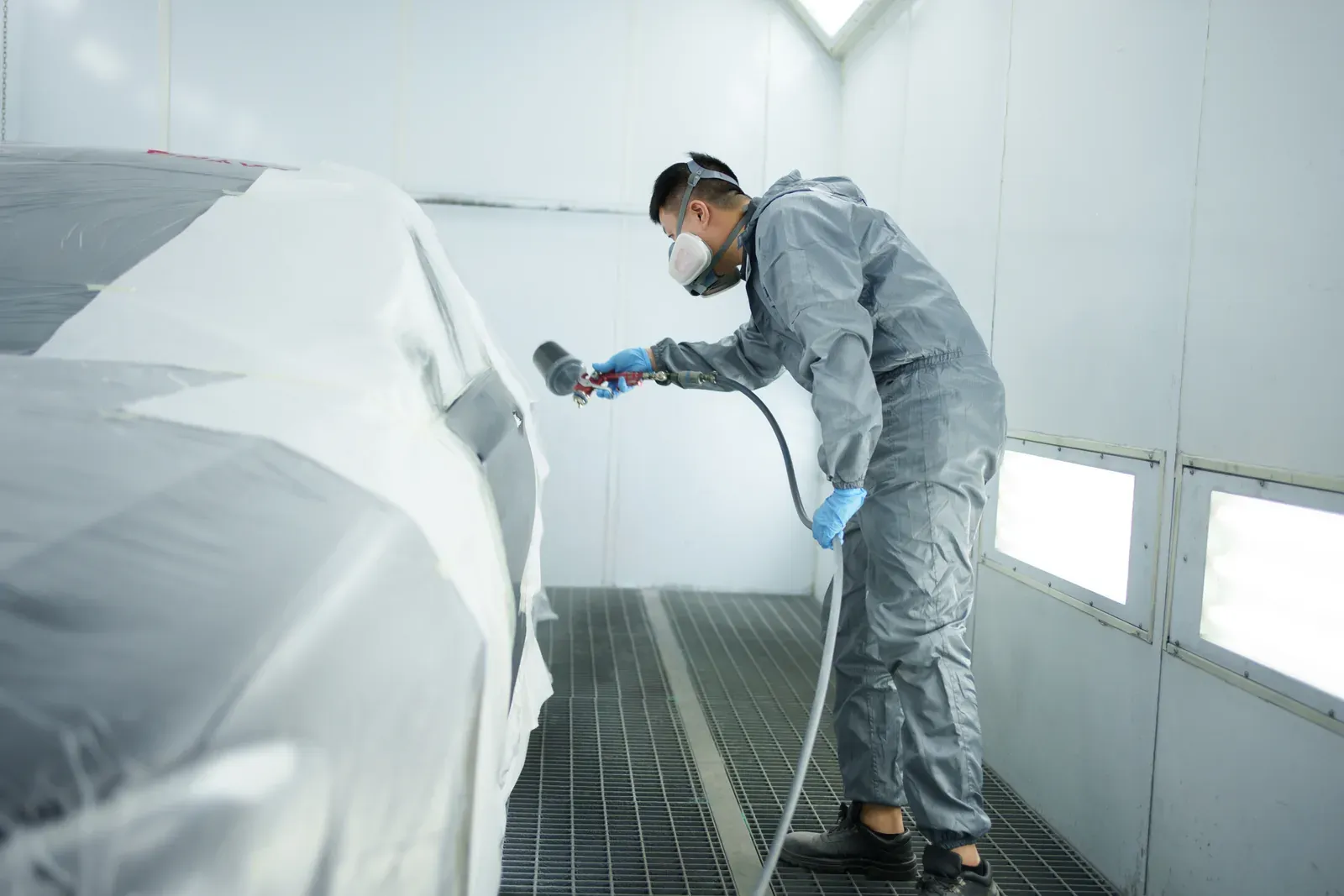
How a three-stage pearl gets matched
A pearl white is three coats doing three jobs: a white base for coverage, a translucent mica coat for the shimmer, and clear over both. The colour you see depends on how many passes of mica went on, from what distance, at what air pressure, and the factory itself varies. Start with the paint code from the door jamb, pull the variants the manufacturer has issued for that code, and spray each candidate on a test card with the same gun, the same number of coats and the same clear. Hold the cards against the car outside, at the angle a person looks at a door, not under the booth lights. Only then does the panel get masked. On a metallic black or a deep blue the mica step is gone but the flake orientation matters just as much, and it is set by gun distance and speed rather than by the formula.
That is the job on a pearl, and it is the reason a paint quote from a photo comes with the note that the final colour check happens at the car.
What Yorkville’s cars ask of a paint shop
The fleet around Hazelton and Cumberland skews toward finishes that punish a shortcut. Pearl and candy whites on German SUVs, satin and matte clears on performance coupes that cannot be polished, tri-coat reds, and electric luxury models painted in colours with a single factory variant that still shifts with the light. Most are leased, which means a lease inspector will stand at the fender in eighteen months with a paint-depth gauge, and a panel refinished without blending shows up as a step in the reading. Aluminum doors and hoods need their own prep, because the surface will not take filler and primer the way steel does. Add the neighbourhood’s share of cars that live outside on a Scollard driveway in winter, where salt spray and grit sandblast the lower doors, and a paint shop here spends its time on blending, on edge work, and on saying no to a spot repair that will not hold up.
Drop-off, cure, and what to do in the first month
The car comes up the parkway on a booked date once parts and materials are in hand, and the rental your coverage allows is waiting. Paint is baked in the booth, so it is dry to handle when the car leaves, but the clear keeps hardening for about a month. In that window: no automatic wash with brushes, no wax or ceramic coating, hand-wash only with a clean mitt, and avoid parking under the maples on Hazelton where sap and bird droppings sit on a soft surface. Bring the car back to Sheppard and Don Mills if anything looks off, because the refinish carries a lifetime warranty on the paint itself and a fault shows early. A matte or satin finish has its own rules, starting with no polishing, ever, and you leave with them written down.
- Colour matched by code and variant, then spray-out and daylight check
- Blending into adjacent panels as standard, not an extra
- Aluminum panels prepped with their own process
- Matte and satin clears refinished without polishing
- Lifetime warranty on the refinish
Questions people ask
My lease ends next year and one door was repainted somewhere else and looks slightly off. Can it be corrected?
Usually, yes. A door that reads a shade off is almost always a variant or a blend problem, not a bad colour code. We spray out against the car, refinish the door and blend into the fender and the rear door so the transition disappears. Photos in daylight, taken from a low angle, tell us whether it is a full redo or a blend.
The car is satin grey from the factory. Can that be painted at all?
Yes, but not the way a gloss car is. A satin clear is applied to a set film thickness and left alone, because any polishing puts a shiny patch in it. We refinish the whole panel rather than spot it, and we walk you through washing it afterward so it stays even.
Will the insurance company pay for blending the panels next to the damaged one?
On a metallic or a pearl, blending is the accepted method and it is written into the estimate as a line. Adjusters expect it. If one pushes back, our estimator explains why a butt-matched panel on this colour will not pass a daylight look, and the line usually stays.