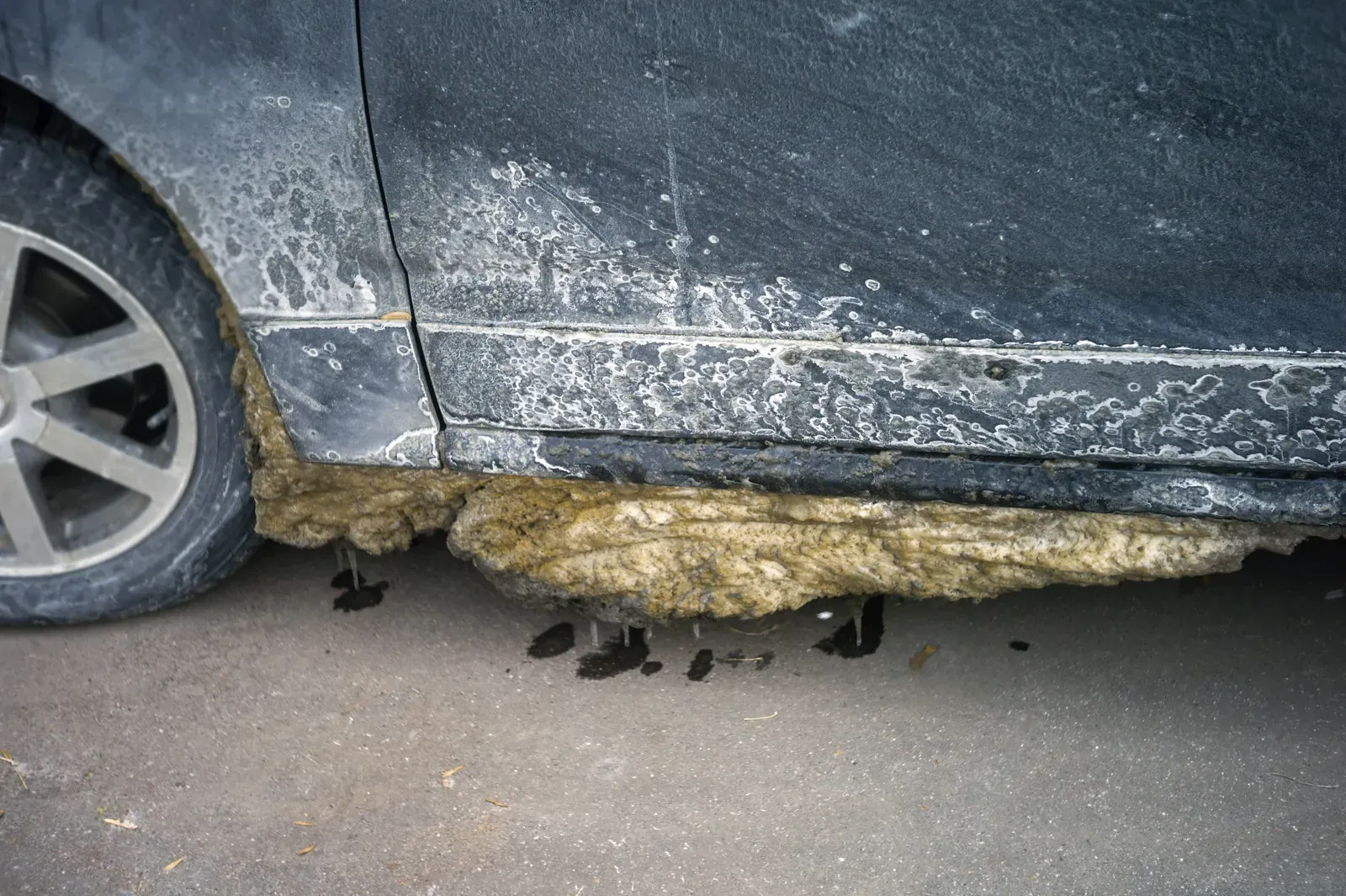
What the region actually puts on the road
Two things go down out there. Before a storm, crews spray a liquid brine so ice cannot bond to the asphalt. During and after it, rock salt goes on top. Brine is the one that matters most for your body panels, because it is already a solution — it wicks into seams, creeps behind trim and settles into cavities where no amount of highway speed will blow it back out.
Salt does not simply rinse away in April either. It is hygroscopic: the residue left in a rocker cavity draws moisture out of humid summer air and keeps a slow reaction going through July. That is why a car that looked fine in March can show bubbles by the following autumn without ever seeing another snowflake.
Add the geography. Sheppard, Finch, Don Mills, the 404 ramps and every plaza lot between them get treated heavily, and the spray thrown off a salted highway coats the lower half of a car within a few kilometres of driving.
The three places it starts on almost every car
Corrosion is not random. It begins where salt is thrown, where water sits, and where two pieces of metal are joined.
- Rocker panels — the long sills under the doors. They take direct spray off the front tires, they are built as a box with drains that plug with grit, and they rot from the inside out. By the time paint bubbles on the outside, the inside is well along.
- Wheel arches — the lips are pinched seams, often with a liner clipped against them. Grit sits in the gap, holds brine, and works through the coating at the fold.
- Doglegs — the short section where the rocker turns up into the rear quarter behind the back door. Water runs down and stops there, and the panel is doubled, so it holds moisture between layers.
Underneath, where nobody looks
Panel rust is the part you notice. The part that decides the car’s future is under it. Subframes, crossmembers, suspension mounting points, brake and fuel lines, exhaust hangers and the floor pan all live in the spray zone, and none of them are inspected during a normal service unless something is already wrong.
Surface scale on a subframe is normal on any GTA car past a few winters and is not, by itself, a problem. Flaking that comes away in layers, a mounting point that has swollen and lifted its seam, or a brake line that has gone pitted is a different conversation, and it is a safety one rather than a cosmetic one. Structural corrosion in those areas also shapes what happens after a collision, because a repair has to anchor to metal that is sound.
If your car is somewhere past its eighth winter, ask whoever has it on a hoist next to look along the rails and rockers with a light and tell you plainly what they see.
What “worth repairing” really asks
The question is never just how bad it looks. It is three questions, and they are answered in this order.
First: is the metal stained or is it gone? A brown patch that cleans back to solid steel is a paint repair. A patch that a screwdriver goes through, or that flexes under thumb pressure, is metal replacement. There is no filler answer to the second one — filler over rot hides it for one season and then telegraphs the whole shape back through the paint.
Second: is it structural? Cosmetic rot on an outer rocker skin is one job. Rot into the inner structure, a rail, or a suspension mounting area is another, and it is the one that decides whether the repair makes sense at all.
Third: what is your plan for the car? Cutting and welding a proper section into a vehicle you intend to keep for years is money spent once. On a car you plan to sell this spring, the honest answer is sometimes to stop the spread, tidy the edge and be straightforward with the buyer instead.
What a proper salt repair looks like
A repair that lasts removes the affected metal rather than covering it. The rotted section is cut out well past the visible edge, because corrosion always runs further under sound paint than it appears to. New metal is fitted and welded in, the welds are dressed, and every seam is sealed the way the factory sealed it.
Then the inside gets treated — cavity wax or an equivalent sprayed into the box section through the drain holes, because a rocker sealed beautifully on the outside and left bare inside will simply start again. Epoxy primer, colour and clear finish the outside, blended into the adjacent panels so the repair does not announce itself in daylight.
The version that comes back is the fast one: grind, fill, prime, spray. It looks perfect for a summer. It bubbles in the same spot the following March, usually a little wider than before.
Slowing it down between now and next winter
You cannot stop salt in this city, but you can stop feeding it.
- Wash the underbody, not just the paint, and do it during thaws rather than waiting for spring. A mid-winter rinse when it is above freezing is worth several spring ones.
- Poke out the drain holes along the bottom of the doors and rockers. They are usually blocked with grit, and a plugged drain turns a cavity into a bathtub.
- Touch up stone chips in autumn, not April. A chip on a rocker or arch lip that goes through to metal is an open door for the whole season.
- Deal with the first bubble while it is one bubble. The repair only gets bigger, and the cost of waiting is measured in how much metal has to come out.
- After body work, ask what went into the cavity behind the panel. If the answer is nothing, ask for it.
Questions people ask
How can a shop tell whether a bubble is surface rust or rot from behind?
By sanding it back — the metal answers fast. Clean steel with a shallow pit means surface rust, and primer and colour will hold. A sanding disc that breaks through, or metal that flexes under thumb pressure, means the corrosion came from inside the panel, and the fix is to cut that section out and weld new metal in.
Is rust under the car normal or is it a problem?
Light orange scale on a subframe or exhaust hanger is normal for any car that has seen a few GTA winters. Layered flaking you can pick off, a swollen seam, or pitting on brake and fuel lines is not — that belongs on a hoist with someone qualified looking at it, because it is a safety question rather than a looks question.
Does an underbody wash still help once salt is already in the seams?
It helps, because you are lowering the concentration of what is left rather than removing it entirely. The best time is a thaw in January or February, when the salt is fresh and still soluble, and a wand aimed up into the arches and along the rockers does more good than any amount of shine on the roof.
Why did rust appear as a supplement on my collision estimate?
Because a collision repair has to anchor to sound metal. Corrosion on its own is wear and customer-paid, but when a panel comes off and the metal at the edge of the damage turns out to be rotted, the repair area has to grow until it reaches solid steel — and that extra work belongs on the claim as a documented supplement.