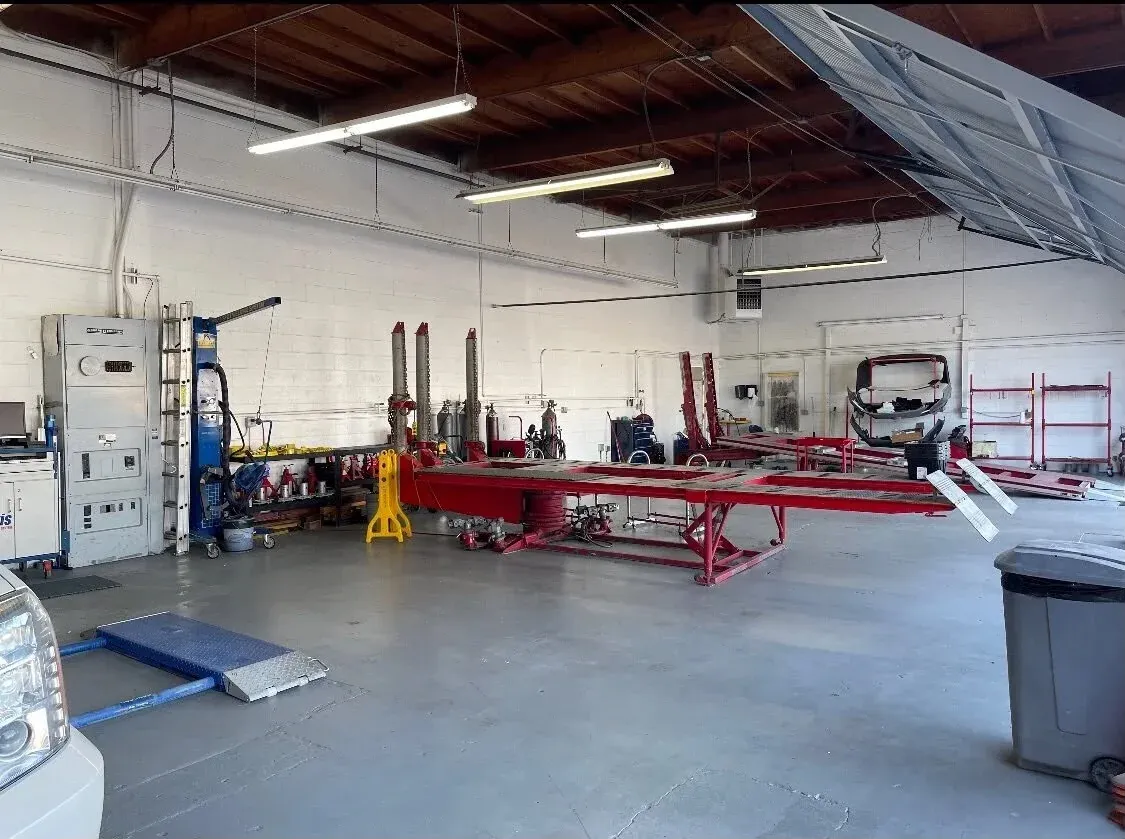
Where a Yorkville car picks up structural damage
Nobody bends a frame on Hazelton. It happens on the trips out: the Friday run up the Don Valley Parkway toward the 404 and cottage country, the airport dash west on the 401 from Avenue Road, the Bayview ramp where the merge onto the parkway is short and the traffic is fast. A rear-end at highway speed in the collectors, a spin on black ice at the Bloor ramp, a T-bone at Avenue and Davenport when the light was already red. The car may still roll, the doors may still shut, and the rails behind the bumper are a finger-width out of square. Signs that it is structural rather than cosmetic: a hood or trunk gap that changed width, a door that needs a lift to latch, tires that no longer sit centred in the arches, a steering wheel that is off-centre on a straight road. Any of those, and the car should be towed rather than driven, because a bent rail loads the suspension in ways it was never designed to carry.
Riveted and bonded, or pulled on the bench: what the structure is made of decides
Start with what the structure is made of, because under Cumberland that is the live question. The German and British SUVs and the electric sedans parked there carry aluminum-intensive structure, riveted and bonded at the factory; a bent aluminum rail is not pulled straight, it is replaced with an OEM section fixed the same way, following the manufacturer procedure line by line. The body-on-frame exceptions that valet the same forecourts — a G-Class, a Land Cruiser, an Escalade — have a separate ladder frame with its own measuring points. Almost everything else in the neighbourhood is a unibody, where the floor, rails, aprons and pillars are the structure, and the work starts on the bench: the car is anchored, dozens of control points are read electronically against the manufacturer’s dimensions, and the readout shows which rail moved, in which direction, by how much. Mild-steel sections are pulled back with hydraulic towers in small stages and re-measured after every pull; the high-strength and ultra-high-strength steels in modern pillars are heat-sensitive and are sectioned and replaced along factory cut lines rather than pulled. Suspension geometry is aligned afterward, and any radar or camera that was disturbed may require recalibration.
A leased car’s total-loss decision has three parties in it
A structural repair on a high-value car brings a conversation nobody enjoys: is it a total loss? In Ontario there is no fixed percentage. The insurance company compares the car’s actual cash value with the repair cost plus what the salvage would bring, and decides. On a newer luxury car the value is high enough that a serious hit is often still a repair; on an older one it may not be. Our estimator writes the estimate first, with the structural measurement to support it, so the decision is made on real numbers. If the car is at a Collision Reporting Centre or in a garage, we help arrange the tow and you tell the operator it is going to Crash Consultant at Sheppard and Don Mills. A rental runs for as long as your loss-of-use coverage allows — structural work is often two to four weeks depending on parts, so it is worth knowing your limit before the repair starts. Leased cars are handled with the lease company in the loop, since it owns the car.
Questions people ask
The car drives straight after the crash. Could it still have frame damage?
Yes. A bent rail behind the bumper does not always show in the steering, and the suspension can mask a few millimetres. The tell is in gaps, latching and tire position. Measuring on the bench is the only way to know, and it is done before the repair is written.
The car is leased. Who decides between repairing the structure and writing it off?
The insurance company makes the repair-or-total-loss call on the numbers, but the lease company owns the car, so it must approve the repair method and it will not accept shortcuts on structure. Your part is smaller than it looks: report the claim, choose the shop, and keep the lease company’s damage line informed. Our estimator sends the measurement report to both, which is usually what settles the method.
The insurance company says the car may be a write-off. Can I keep it and repair it anyway?
Sometimes. You can ask to retain the salvage; the settlement is reduced by its value and the car is branded, which affects resale and, on a leased car, is not your call to make. Talk to us before agreeing, because a second estimate on real measurements sometimes changes the outcome.