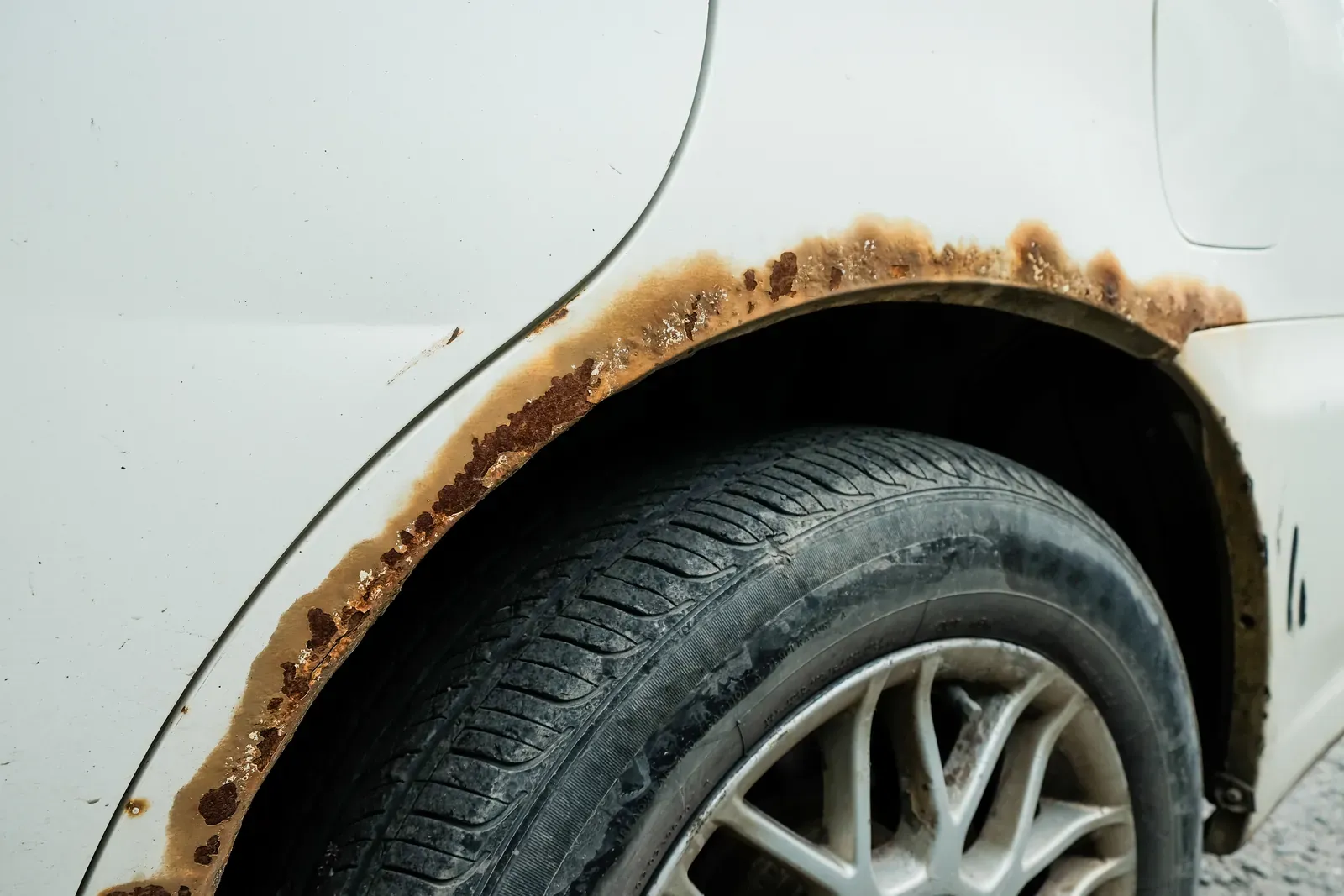
Steeles in February, and what the salt does by May
The salt on Steeles comes off the trucks. Six lanes get brined before the snow, the transports throw the slush up onto everything that follows them, and by the time a car has turned off at Kennedy the rockers, the wheel arches and the lower doors are coated in what will spend the winter eating the seams. Cars parked on the driveway apron or the street are worse off than the ones in the garage; the spray never washes off, and the freeze-thaw cycle in March pushes water into every stone chip along the lower body.
By May the signs are the bubbles on the rear arch, the soft spot at the bottom of the door, and the rocker that gives under a thumb behind the plastic cladding. On cars from the 2000s and early 2010s the spot welds along the rocker seam go first, and on the newer ones the arch lip rusts where the liner has worn through the paint.
The old sedan on the apron is the one rust decides
Milliken keeps its cars. A household with three generations and one double driveway does not sell the old sedan; it becomes the car the student takes to campus or the one that runs to Pacific Mall for groceries, and it sits on the apron because the newer cars get the garage. That car is the one rust decides. If the floor, the rails and the strut towers are sound, and the rot is confined to the rockers, the arches and the doglegs behind the rear doors, it is worth fixing, and it will pass a safety inspection for years afterward. If the rust has reached the rails or the subframe mounts, we say so before any money is spent.
Insurance does not pay for rust; it is wear, not an event. So the estimate is written for what the car is actually worth to the family, and the rust repair is often done at the same time as something else — the dent from the lot, the rocker that got pushed in — so the car is out of circulation once. If the car is about to change hands, a private sale needs a UVIP and a Safety Standards Certificate to license it, and rotten rockers fail the certificate.
A welded section outlives any amount of filler over a bubble
Rust that bubbles has already eaten the metal under it, so grinding the bubble and filling it just buys a season. The repair cuts the rust out to clean metal, welds in a fabricated patch or a replacement rocker or arch section, seam-seals the joins, primes with epoxy, undercoats the inside, and paints with the colour blended into the door and quarter so the rocker does not read newer than the car. The plastic cladding goes back on over a rocker that will hold a jack again.
After the repair is the time for rust-proofing, when the new metal is sealed and the rest of the underside is clean. It does not reverse anything, but it slows the next winter’s work on the seams that did not need attention this year, and on a car that lives on a Milliken driveway that is the difference between fixing the arches once and fixing them again in five years.
Questions people ask
The old sedan only does the Pacific Mall run now. Does driving it less slow the rust down?
No — it can speed it up. Short errands never warm the underbody enough to dry it, so the car that does ten-minute trips carries wet salt in its seams all winter, while the commuter car dries itself on the 404 every day. If the apron car is staying in the family, rinse the arches and rockers at a coin wash on mild days and give it a longer run now and then.
We are handing the apron car to our student for a year at campus. Fix the rust before or after?
Before, if metal is already exposed. Open steel does most of a winter’s damage in one salted season in a campus lot where nobody is checking it, and the repair afterwards is a section instead of a patch. If the spots are still bubbles under paint, photograph them and ask; some can safely wait for spring, and we will say which. Either way it is a cash job — rust is wear, and policies do not cover wear.
Does the plastic cladding along the rockers protect them or hide the problem?
Both. Cladding keeps stones and some spray off the paint, but grit and salt work in behind it and stay wet there, so the rocker can rot unseen until the cladding is unclipped. If your car wears cladding, have it popped off for a look every couple of springs — five minutes that catches the repair while it is still small.