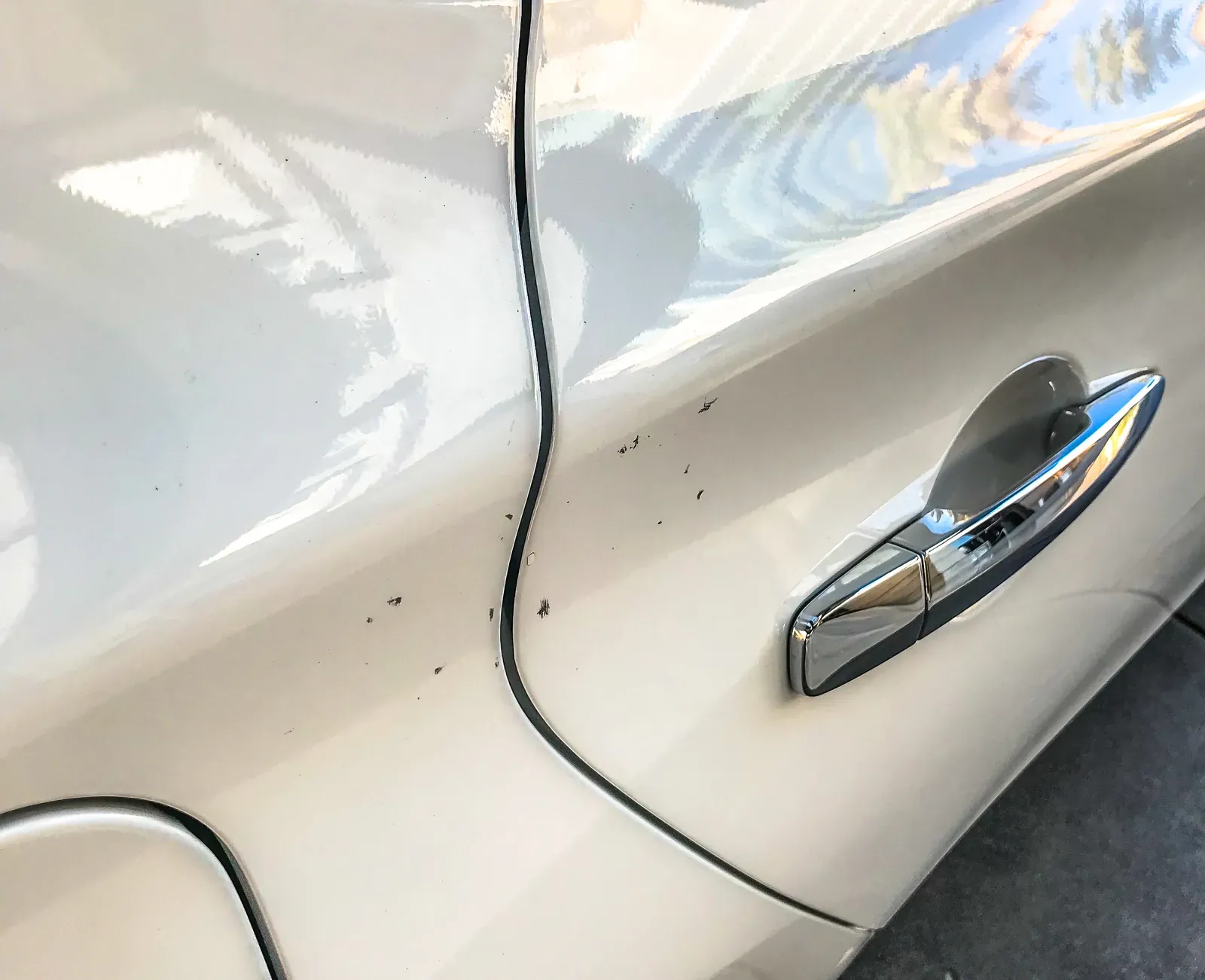
Dents that happen in the dark: the GO lot at six, the driveway at eleven
The Milliken GO lot fills in the dark. At six in the morning the rows are tight, the sightlines are car-height, and doors swing on hinges stiff with cold; the ding you find at six that evening happened twelve hours earlier and three cars away. At the Steeles plazas the drive-through queue shares its lane with the parking rows, so a car backing out of a stall meets a car inching forward for coffee — a slow hit, but square on the door skin, and deeper than it looks because neither driver saw it coming.
The double driveway finishes the job. Four cars parked nose to tail and side by side leave centimetres between door edges, and the last one home at eleven opens a door into the car it is blocking. None of these breaks paint most of the time, which is what makes them candidates for repair without repainting.
If the paint survived, the repair can skip the booth
The first question we ask of a dent is whether the paint survived. If the surface is unbroken and the dent is round or gently creased, it can usually be worked back from behind with rods, or pulled from the front with glue tabs, until the panel is flat and the factory finish is still on it. That is paintless dent repair, and it is the right answer for most door dings and hail. The panel keeps its original paint, which matters on a leased car and on anything pearl white.
A cart crease with a sharp bottom, a dent that crosses a body line, or a dent with cracked or scuffed paint over it needs the conventional route: the metal is worked as close to true as it will go, filled thin, primed and painted with a blend into the next panel. Aluminum hoods on the three-row SUVs Milliken families favour sit somewhere in between: aluminum is softer than steel but does not spring back and work-hardens if pushed too often, so the work is slower and a deep dent is likelier to end up needing filler and paint. We say which route applies when we see the photos, and the estimate is written for that route.
No note means your collision coverage; a note means DCPD
A ding with no one to blame — a cart, a door in an empty lot, no note — is a claim under the collision part of your own policy with the deductible applied, and on a single paintless dent the repair often costs about what the deductible would. Ask for the estimate before you decide; it is written the same day and it is yours either way. If the other driver left a note or was still there, the claim runs under DCPD and your own insurance company pays the share the other driver caused, as set by the Fault Determination Rules.
A hit-and-run in the Pacific Mall lot needs a police report before a claim can be opened, and the mall’s cameras sometimes settle who did it. Either way, send the photos and tell us which lot; our estimator reads them and says plainly whether this is a claim or a morning’s work.
Questions people ask
Can a door ding from the Pacific Mall lot be fixed without repainting?
Usually, as long as the paint is unbroken and the ding is not sitting on a hard body line. The panel is worked back from the inside or pulled from the front and the factory paint stays. Send a photo taken at an angle so the reflection shows the shape of the dent; that tells us more than a straight-on shot.
Hail caught the two cars that sleep on our driveway apron. Is that one claim or two?
Two — a claim runs per vehicle and policy, even in one household, and hail is a comprehensive claim that does not count as at-fault. Both cars can be photographed, estimated and booked together so the family is not down two vehicles at once; paintless repair handles most hail, panel by panel, and the deductible applies per car. If only one car is worth claiming, the estimate says so before you call anyone.
Do I need to book, or can I stop in on the way down Steeles?
Stop in if you are passing; someone will look at the dent. But the fastest route is three photos first, so the estimate is written before you make the drive and the visit is booked for a day the repair can actually happen. For a paintless repair that can be a short visit rather than a drop-off.