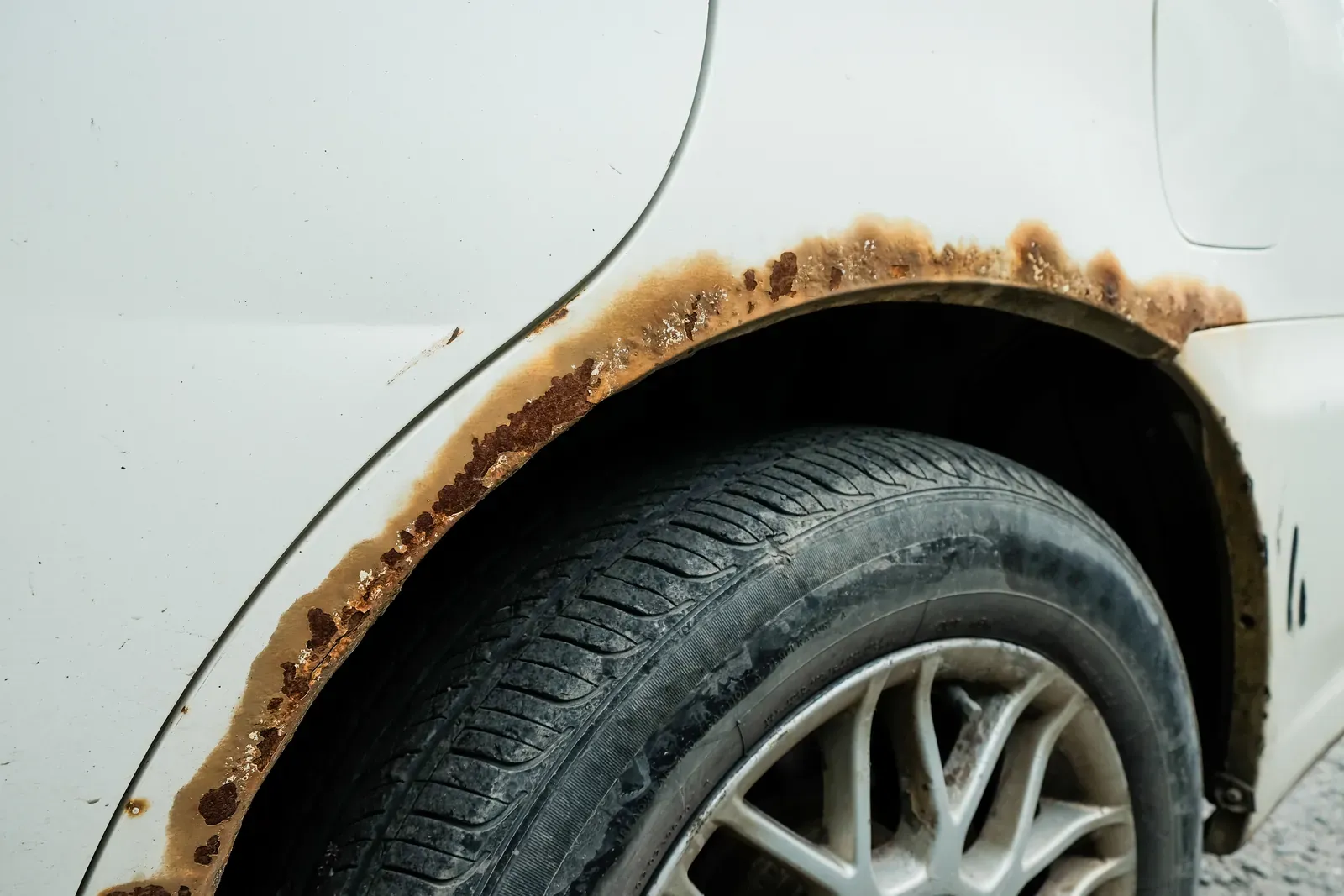
Salt that goes down the ramp and never comes back up
Toronto salts Yonge, Eglinton, Mount Pleasant and Bayview heavily from the first freeze until the last, and a Midtown car collects a coat of brine on every trip. Then it goes underground. A condo garage in February sits a few degrees above freezing with the air near saturation, and the slush that drips off the rockers and inside the wheel wells does not evaporate; it sits, and the car sits in it, until the next trip adds another layer. A car parked on a driveway on Chaplin Crescent at least dries out on a cold, bright day. A car on P3 under Redpath does not dry until April.
The result is rust that starts earlier and spreads faster than the same car would see in a suburb with a garage door. It is worst on cars that are driven a little, not a lot — the second car that leaves the garage twice a week wet and comes back wet — and on anything that arrived from the road-salt belt already carrying a chip.
Where it shows on a Midtown car
The lower rear of the front fender, where it meets the door — the dogleg — is usually first. Then the rear wheel arch lip, which bubbles from the inside out where the inner and outer panels are seamed together. Then the rocker panel beneath the doors, which is the part that sits closest to the wet slab. Bubbling paint is the surface symptom; by the time you see it, the metal behind has been thinning for a season or two. On Midtown’s older cars — the ten-year-old sedans on Merton, the compact SUVs that came with a Davisville rental’s parking spot — rockers can be soft enough to press a thumb into by the time the owner notices.
Doors, hoods and tailgates rust along their bottom seams for the same reason: water collects inside the folded edge and the drain holes are packed with the grit that came off Eglinton in the spring.
The repair that lasts starts by cutting the rust out
Sanding rust and painting over it is not a repair, and we do not offer it as one. The rusted metal is cut back to sound steel, a new section — a patch formed to the shape or a manufacturer repair panel for the arch or rocker — is welded in, the seams are sealed, the inside of the cavity is treated so the new steel does not go the way of the old, and the outside is primed, painted and blended into the panel around it. Done that way, the repair outlasts the metal beside it, and the paint carries a lifetime warranty.
Whether it is worth doing depends on the car. A rear arch on a well-kept eight-year-old car is worth fixing every time, because the alternative is watching it grow. A rocker rotted through on a car with a failing transmission may not be. Send photos of every bubbled spot — press gently on the worst one and photograph what happens — and our estimator will tell you honestly which side of the line the car is on. If you are keeping it, the drop-off works the way the rest of Midtown does: in on the way to work, out on the way home, with a rental if the job runs more than a day.
Questions people ask
Does parking underground really rust a car faster than parking outside?
In a Toronto winter, usually yes. Outdoor cars freeze and dry between trips; garage cars stay a few degrees above zero in damp air with salt on them, which is the condition steel corrodes in fastest. Rinsing the underside at a wash bay on a mild day, and keeping the garage floor under your car reasonably dry, slows it down noticeably.
Another shop quoted a full quarter panel for a small rust spot above the wheel. Is there a smaller repair?
Often, yes. The arch lip is available as a formed repair section, and rot confined to the lip can be cut out and new metal welded in without replacing the whole quarter — a big panel whose replacement drags in the door aperture, the glass and a lot of refinishing. The photos decide it: press gently around the spot, photograph what happens, and our estimator will tell you whether the smaller repair is sound or false economy. Rust itself is wear, so either version is a cash job rather than a claim.
The rust is only a small bubble. Can I wait until the lease is up in a year?
The bubble is the top of something larger. Under it the metal has already thinned, and a Midtown garage winter will roughly double the affected area by spring. On a lease, a rust repair done now and blended cleanly is a cosmetic non-event at return; a bubble left to grow becomes a chargeable defect. Send the photos and our estimator will say how urgent it actually is.