Curbside on Davisville and Merton
Streetside parking is the Midtown compromise: cheaper than a second garage spot, closer than the visitor level, and exposed to everything that passes. Davisville Avenue and Merton Street are narrow enough that a car door opened without a glance meets a passing mirror, and a mirror folded by a bus or a delivery van leaves a soft dent in the fender just behind it. On Merton, cyclists and parked cars share the same metre of road, and the dent is usually in the rear door where a handlebar or a pannier caught it. None of this is dramatic. It is a dent the size of a coffee lid with the paint intact, and it is exactly the kind of thing that can be fixed without paint at all.
The other steady source is the condo garage. A neighbour’s door swings into your quarter panel in the stall beside you; a bike rack or a stroller wheel knocks a crease into a rear door; a shopping cart left on a ramp rolls. Underground dents tend to be slightly deeper because the space is tight and there is nowhere for the impact to go.
Working the dent out from behind
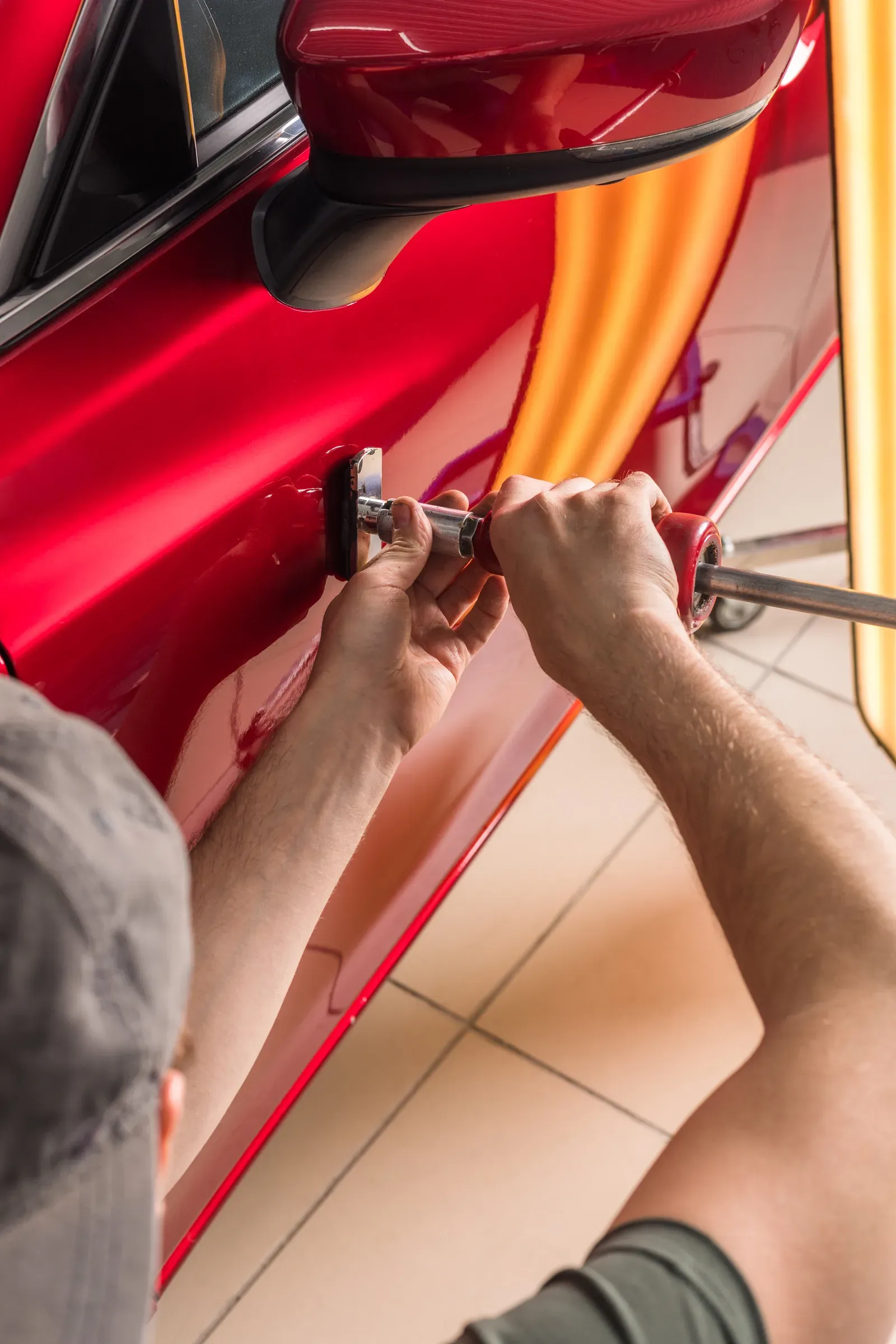
Paintless dent repair means reaching the back of the panel — through a window opening, a wheel well or a removed trim piece — and pushing the metal back to its original shape a few millimetres at a time, reading the reflection of a light board across the surface to see where it still sits low. Where the back of the panel cannot be reached, a tab is glued to the paint and the dent is pulled from the front, then the high spots are tapped down. Done well, there is no filler, no primer and no new paint, which means the factory finish is untouched and the repair leaves no record for a lease inspector or a future buyer to find.
It works when the paint has not cracked, the dent is not on a sharp body line and the metal has not been stretched. It does not work on a crease with the paint broken through, on a dent at the very edge of a panel, or on some aluminum hoods and doors that resist being reshaped. In those cases the panel is repaired conventionally and refinished, with the colour blended so the difference is invisible.
A single ding rarely justifies a claim; hail or a hit-and-run can
A single dent rarely justifies a claim. Once you subtract the deductible from what the repair costs, and weigh the claim record against the small amount left over, paying out of pocket is usually the better arithmetic — and a paintless repair is the least expensive kind of body work there is. Our estimator will put both numbers in the estimate so the decision is yours. The exception is when a dent comes with other damage from the same incident: a hit-and-run in the garage that dented a door and cracked the mirror, or hail that pocked the hood and roof at once. Then a claim through your own coverage makes sense, and we open and run it.
- Photos first; the estimate says which method fits
- Paintless repair where the paint is intact
- Conventional repair and blended refinish where it is not
- Drop-off on the way to work, pickup on the way home
Questions people ask
How can you tell from photos whether the dent can be fixed without paint?
Take the close-up with the light coming across the panel at an angle so the shape shows, and one from a step back so the panel edges and body lines are visible. Cracked paint, a sharp crease or a dent sitting right on a styling line tells our estimator a paintless repair will not hold; a smooth, shallow dent in the middle of a door almost always will.
Is a paintless repair as durable as a conventional one?
More so, in practice. The factory paint and corrosion protection are never disturbed, so there is nothing new to chip or fade. The metal has simply been returned to where it was pressed from. A conventional repair with filler and fresh paint is also durable, but it is a second finish on top of the first, which is why we use it only when the paint is already broken.
Can you fix a dent the same day if I drop the car in the morning?
A single small dent with reachable access is often done the same day, sometimes while you wait. Several dents, or one that needs trim removed for access, usually mean an overnight. The estimate will say which before you drive up Bayview.