What frame damage means on a Midtown car
Pickup trucks with a separate ladder frame are rare between Eglinton and St Clair. What lives in the garages under Yonge and Redpath is unibody: sedans, crossovers, hatchbacks and EVs where the floor, the rails, the pillars and the strut towers are one welded structure and the body panels are bolted or glued to it. Frame damage on that kind of car means the rails or the aprons have been pushed out of the positions the factory welded them to. The signs are subtle from outside — a hood gap wider on one side, a door that needs a shove to close, a steering wheel a few degrees off-centre on Bayview — and serious underneath, because crumple zones that are already partly used will not absorb the next hit the way they were designed to.
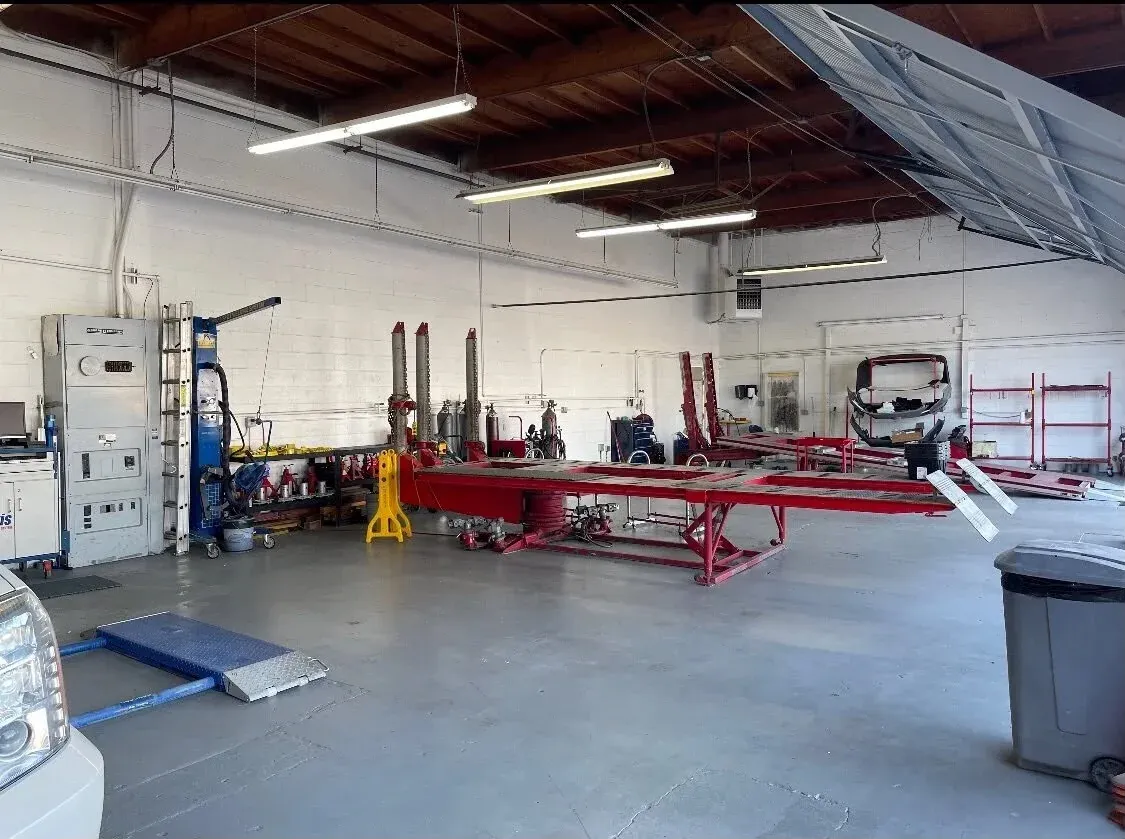
Straightening it is measuring first and pulling second. The car is anchored to a bench, a measuring system compares dozens of reference points to the manufacturer’s specifications, and hydraulic pulls are applied in the reverse of the direction the impact came from until every point reads within tolerance. Rails that have kinked rather than bent, and high-strength steels that cannot be re-formed without weakening, are sectioned and replaced along the lines the manufacturer’s repair procedure lays out.
Where Midtown structural hits come from
Mount Pleasant is the most common answer. The bends through the cemetery and the run south toward Moore Avenue are taken faster than the posted limit by drivers who know them, and a car that loses the line meets either the concrete or the car in the next lane at a speed where the front rail folds. Eglinton and Yonge, Eglinton and Mount Pleasant, and Bayview at Lawrence produce the intersection T-bone — a side impact that pushes the B-pillar and the rocker inward and, on a small car, moves the floor pan. Bayview through the Sunnybrook stretch and the ramp onto the 401 add the highway-speed rear-end that drives the trunk floor forward into the rear rails.
Garage damage does not usually reach the structure, with one exception: a car driven down the spiral ramp with the front bumper corner dragging the wall can push the rail tip and the radiator support back a centimetre, which is enough to matter.
Getting a car that will not drive out of a Midtown garage
A car with structural damage is often still sitting where the collision left it — on Mount Pleasant, in a Collision Reporting Centre lot, or back on P2 after someone limped it home. If the steering pulls, a wheel is out of line or anything is rubbing, do not drive it up Bayview; we coordinate a tow. Underground garages are a complication tow operators know well: low clearance, tight ramps, sometimes a flatbed that cannot get down and a wheel-lift that can. Tell the operator where the car is and that the destination is Sheppard and Don Mills, beside Fairview Mall, and we work out the rest with them.
From there the file runs the way any collision claim does: photo estimate, teardown, measured supplement with the printout from the bench attached, OEM structural parts requested, rental through your coverage from the day the car arrives. A structural repair is where the total-loss question sometimes comes up, and we tell you early if the numbers are heading that way rather than letting the adjuster surprise you.
Questions people ask
How do I know if the collision on Mount Pleasant bent the structure or just the panels?
You often cannot tell from outside. Uneven gaps around the hood or trunk, doors that bind, tires that wear on one edge and a steering wheel that is no longer straight are hints. The only real answer is measuring the car on the bench against the manufacturer’s reference points, which is why a front-corner hit gets measured before the estimate is finalized.
Is a car with a straightened unibody safe to drive afterward?
When the structure is returned to within factory tolerance, kinked sections are replaced rather than pulled and the manufacturer’s procedures for the steel involved are followed, yes. The measurements are printed and kept with the file so you and your insurance company can see them. A car that has been pulled roughly close and painted is a different story, and it is the reason to ask for the printout.
Will my insurance company write the car off instead of straightening it?
Only if the repair cost plus salvage value approaches the car’s actual cash value; Ontario has no fixed percentage. A structural pull on a newer car is usually well within the repairable range. When the estimate and the supplement start heading toward that line, our estimator says so early so you can weigh the options with time to think.