Two ways to build a vehicle
Body-on-frame is the older design and it survives where towing and payload matter. A ladder frame — two long rails with crossmembers between them — carries the drivetrain and suspension, and the body is bolted on top through rubber mounts. Most full-size pickups and a handful of large sport utilities are built this way. The frame can be straightened or, in some cases, replaced as a unit.
Unibody is everything else on the road today: cars, crossovers, minivans, most compact SUVs. There is no separate chassis. The floor pan, rails, pillars and roof are welded into a single shell that is simultaneously the passenger compartment, the mounting structure and the crash management system. Some vehicles use a hybrid layout, with a unibody centre section and bolted subframes carrying the suspension front and rear.
The distinction matters because it changes what damage means. Bend a ladder frame and you have bent a component. Bend a unibody rail and you have changed the shape of the vehicle itself.
The parts people mean when they say frame
On a unibody vehicle, an estimate that reads “structural” refers to specific welded assemblies, each designed to do a particular job in a collision. The front rails are folded steel boxes engineered to crush in a controlled sequence and absorb energy before it reaches the cabin. The aprons and strut towers carry suspension loads. The rocker panel ties the front and rear structure together along the side. The pillars and roof rails form the survival cell around the occupants.
Modern shells are not one material. Mild steel is used where energy should be absorbed, while ultra-high-strength and boron steels are used where the structure must not deform at all, and aluminum castings appear in more and more vehicles. Those materials look identical under paint and behave completely differently under heat and load — which is why repair decisions come from the manufacturer’s data, not from experience alone.
- Front and rear rails — the designed crush zones
- Aprons and strut towers — suspension mounting and load paths
- Rocker panels and floor pan — the longitudinal spine of the shell
- A, B and C pillars with the roof rails — the occupant cage
- Radiator support and core support — often bolted, sometimes welded
- Subframes and cradles — bolted assemblies that carry the drivetrain
How the damage is found
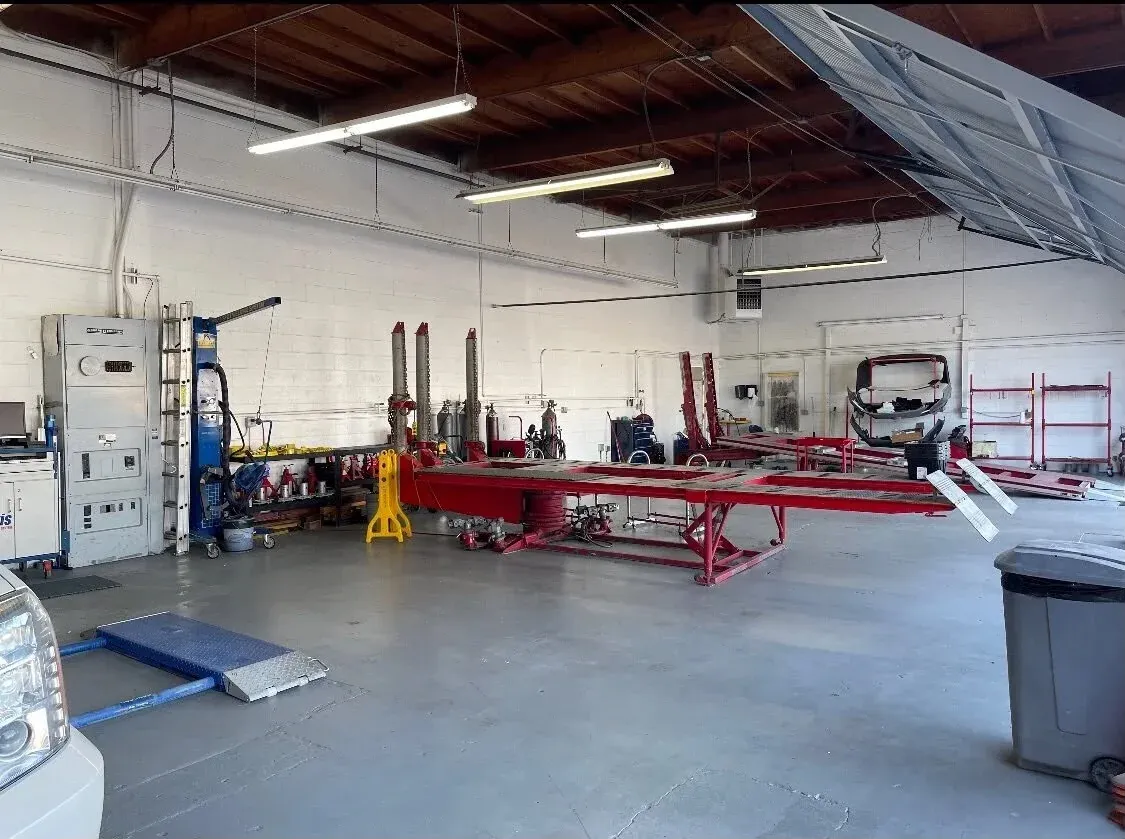
Structural damage is measured, never eyeballed. The vehicle is anchored to a bench and a measuring system — laser, ultrasonic or a computerised arm — reads a set of factory control points underneath, comparing each one against the manufacturer’s published dimensions in three axes. Deviations are reported in millimetres, and the tolerance is small.
The symptoms that send a vehicle to the bench are usually subtler than a visibly bent car. A door that suddenly needs a shove to latch, a gap that is wider at the top than the bottom, a steering wheel sitting off-centre on a straight road, uneven tire wear a few weeks after an impact, or a hood that will not sit level — these all point to something out of specification underneath.
Documentation is part of the job. Measurements are recorded before the pull and again afterward, which is what proves the vehicle is back within factory specification and what supports the repair if an insurance company or a future buyer asks.
Pulling, and the rules on sectioning
Straightening reverses the collision. The shell is clamped at the pinch welds or bolted to fixtures, and hydraulic towers apply controlled pull in the opposite direction to the force that caused the damage, in stages, with measurements taken between each one. Metal that went in last comes out first. A rushed single pull can straighten one dimension while pushing another out of tolerance.
What cannot be done is just as important. Many high-strength and boron steel components must not be heated to relieve stress, because heat destroys the properties that make them strong, and several must not be pulled at all — the manufacturer specifies replacement. Some parts may be sectioned, meaning a damaged portion is cut out and a new section welded in, but only at the locations the manufacturer permits, using the joint type and weld pattern it publishes.
A shop that follows those documents will sometimes tell you a rail must be replaced when it looks like it could be pulled. That is the procedure doing its job. Guessing on a structure designed to fold in a specific order is how a vehicle gets returned looking correct and behaving differently in the next collision.
After the structure is right
Straightening is the start of the sequence, not the end. Corrosion protection has to be restored anywhere welding or grinding took place: weld-through primer during assembly, seam sealer reapplied in the factory pattern, and cavity wax injected into closed sections so the inside of a repaired rail is protected as well as the outside. In a road-salt climate this step decides whether the repair lasts.
Then the mechanical work follows: a four-wheel alignment once the suspension mounting points are back where they belong, a check of the steering angle sensor, and a scan for stored fault codes. Where cameras or radar are mounted to structure that moved, recalibration may be required before the driver aids work as designed.
The vehicle gets road tested before anyone calls you, because some things only show up at speed on the 401 — a faint pull, a vibration that arrives at a particular speed, a wind noise from a door that no longer seals the way it did. If you want the shorter version of what structural damage means for your car, our answer page on frame damage covers it in a couple of minutes.
Questions people ask
Does a repaired unibody ever go back to being as strong as before?
When the shell is returned to factory dimensions, damaged high-strength components are replaced rather than pulled, welds follow the published pattern and corrosion protection is restored, the structure performs as designed. Every one of those steps is verifiable, and each should appear on the repair documentation.
Will structural repair show up on a vehicle history report?
It can, particularly where a claim was filed and the repair was significant. That is a reason to keep your measurement printouts and the final invoice — documented, in-specification structural work reads very differently to a buyer than an undocumented history entry.
My truck has a real frame. Is that easier to fix?
Different rather than easier. A ladder frame is heavier and more accessible, so pulls can be more direct, but the same rules apply about heat, published tolerances and which crossmembers may be repaired. Cab and box mounting points also have to be re-checked afterward.
Can you tell if there is structural damage from photos?
Photos show where the impact landed and how the panels and gaps reacted, which is often enough to say the vehicle should be measured. They cannot confirm dimensions. Anything the photos suggest is structural gets verified on the bench before the estimate is finalised.