The code on the door-jamb sticker
Open the driver’s door and look at the pillar. On most vehicles sold here there is a sticker with a build date, a tire pressure table and a short string of letters and numbers beside something marked C/TR, EXT or PNT. That string is the paint code. On some makes it lives under the hood, on a strut tower, in the glovebox or on the spare-tire well instead.
The code tells the mixing system which formula to pull: which toners, which flake, in what order and in what quantity. It is the first thing a painter needs and the last thing anyone should trust on its own. A code identifies a colour family. It does not describe the specific panel sitting in front of us.
When you send photos for an estimate, a clear shot of that whole sticker is worth more than a shot of the code alone. The build date and plant printed beside it are the clues that decide which version of the colour we start from.
- Driver’s door jamb or door edge — most Japanese and Korean vehicles
- Strut tower or the radiator support crossmember — many European vehicles
- Under the hood on the slam panel — several domestic trucks and vans
- Glovebox lid, trunk floor or spare-tire well — a handful of makes
- Photograph the entire sticker: build date and plant code matter later
One code, several variants
A manufacturer paints the same model at more than one plant, on more than one line, with material from more than one supplier, across a model year that can run long. Small differences creep in — a slightly coarser aluminum flake, a toner batch leaning a touch green, a robot laying film a fraction heavier. The factory signs off on all of it as the same colour.
Refinish paint companies track those differences and publish them as variants: alternate formulas for one code, usually labelled by year, region or assembly plant. A common silver may have a dozen of them. Popular pearl whites can have more. Picking between the variants is where a match is won or lost, and it is why two shops working from the identical code can hand back two different-looking fenders.
A variant is not a fudge or a shortcut. It is a documented recipe for the colour as your car was really painted, which is rarely the colour on the master sample.
Chips first, then a spray-out card
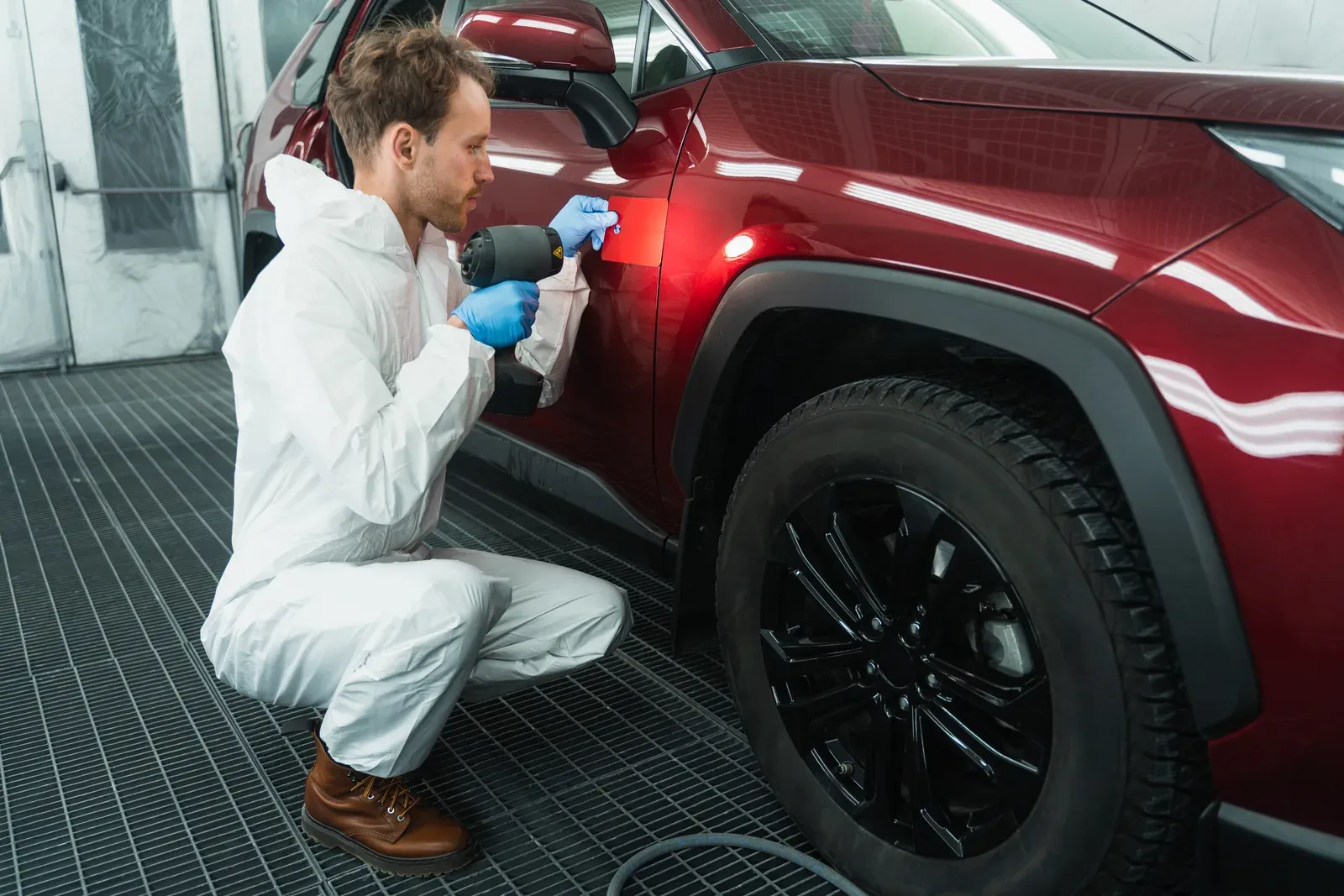
Every variant exists as a sprayed chip in a fan deck. The painter washes and dries a clean area of the panel beside the repair, then lays chips against it and works down to two or three candidates. Wax, road film and old polish all distort the reading, so the surface is cleaned first — comparing against a dirty door is a guaranteed argument at pickup.
The shortlisted formula is then mixed and sprayed on a test card, called a spray-out. It goes on with the same gun, the same air pressure, the same number of coats and the same clear that will go on your vehicle. Metallic and pearl colours change with how they are laid down, so a card sprayed differently from the panel proves nothing at all. The card is flashed, cleared and cured before anyone judges it.
If the card is off, we adjust the formula or move to another variant and spray a second card. A card takes minutes. A refinished quarter panel that has to come back takes a day.
Corrected light, and three angles
The comparison happens under daylight-balanced tubes in a light booth, or outdoors in open shade on a bright day. Two colours can agree under one light source and disagree under another — a shop fluorescent and a sodium street lamp each tell their own story. Controlled light is the reference. The parking lot is the audience.
The card gets held flat against the panel and read at three angles. Face is straight on, where pigment reads strongest. Flop is the shallow angle you see walking up to the car, where metallic flake either sparkles or goes dark and where most mismatches surface. The mid-tone sits between. A card that agrees at all three is a match; one that only agrees face-on will look wrong from the sidewalk forever.
- Face — viewed square to the panel, pigment dominant
- Mid-tone — roughly forty-five degrees, the everyday view
- Flop — a shallow raking angle, where flake orientation shows
- Both wet and cured, since some colours shift as solvent leaves
Matching the car you own now, not the one that left the plant
Paint ages. Ultraviolet light works on pigment, horizontal surfaces take the worst of it, and the hood of a ten-year-old vehicle is no longer the shade it was built as. Reds and dark blues drift the fastest. Silvers and greys hold on longest. The target is never the factory master. It is your panel, in its current condition, on the day we spray.
Sometimes the honest move is to machine-polish the neighbouring panel before painting, lifting oxidation and pulling the old finish back toward where the fresh material will land. Sometimes the gap is simply wider than mixing can close, and the answer is to carry colour a controlled distance into the adjacent panel so the transition happens gradually rather than at a hard edge on a body line.
That decision is made before spraying, not after, because it changes what has to come off the car — a mirror, a handle, a trim strip, sometimes a door seal.
What colour work looks like on your repair
Our estimator puts the colour plan in the estimate at the start: the code, the panels being refinished, and any blending the match will need. If a variant reads off on the card, it is caught on the card. Nothing gets discovered halfway through a bake cycle.
When you pick the vehicle up, look at it outdoors, from several steps back, then crouch slightly and sight down the side. That shallow view is how everyone else sees your car. Refinish work here carries a lifetime warranty on paint, which matters most for what shows up in year three, not for what you can see on day one.
Questions people ask
Can you match paint without the code?
Usually, yes. If the sticker is missing or painted over, the vehicle identification number often points the paint system to the original colour, and a chip comparison on a cleaned panel narrows it from there. It takes longer and leans more heavily on the spray-out card.
Is a factory touch-up pen the same colour as my car?
It is the same code, mixed to the master formula, not to your vehicle’s variant, and it is brushed rather than sprayed. On a stone chip the size of a pinhead nobody notices. Across a scratch the length of a door it reads as a stripe.
Why do tri-coat and pearl whites cost more to match?
They are sprayed in three stages: a ground coat, a translucent mid-coat holding the pearl, then clear. The final colour depends on how many mid-coats went on, so the number of passes has to be established on a test card and repeated exactly on the panel.
My car is old and faded. Will one panel stand out?
Not if the plan accounts for it. Polishing the adjacent panels and fading the new colour into them handles most fade. Where a roof or hood has gone chalky, refinishing that whole surface is a better answer than trying to disguise it.