Intact paint is the fork in the road
Before anyone talks about method, there is one question: is the paint still intact? Sheet metal that has been deformed but not cut, cracked or stretched can usually be persuaded back to its original shape with the factory finish still on it. Once the paint is broken, or the metal has been stretched thin, the repair changes category entirely and refinishing becomes part of it.
The second question is access. Can a tool reach the back of the panel, or is there a reinforcement, a foam block, a window regulator or a sealed cavity behind it? Access decides whether the metal is pushed from behind or pulled from the front.
The goal at every rung of the ladder is the same: correct shape, correct gaps, and corrosion protection restored. The right method is the smallest one that achieves all three.
Paintless dent removal
Paintless work is the top of the ladder and the least invasive thing a body shop can do. Metal rods are worked in behind the panel through an existing opening — a window channel, a tail lamp cavity, a drain hole — and the dent is massaged out from the centre outward under a striped reflection board that shows the technician exactly how the surface is moving. Done well, there is no filler, no primer, no colour to match and no cure time. The original factory paint stays exactly where it is.
It is ideal for hail dimples across a roof and hood, a shopping-cart dent in a door, a windrow scrape that pushed a rocker in without cutting it, and the classic parking-lot ding from the vehicle next to you.
- Paint must be unbroken — no cracks, no chips at the low point
- Best on smooth, gently rounded dents rather than sharp creases
- Needs access behind the panel, or the next method on this list
- Aluminum panels take longer: the softer metal has less memory and does not spring back
- Dents on a body line or at a panel edge are the difficult ones, not the big ones
Glue pulling, when there is no way in from behind
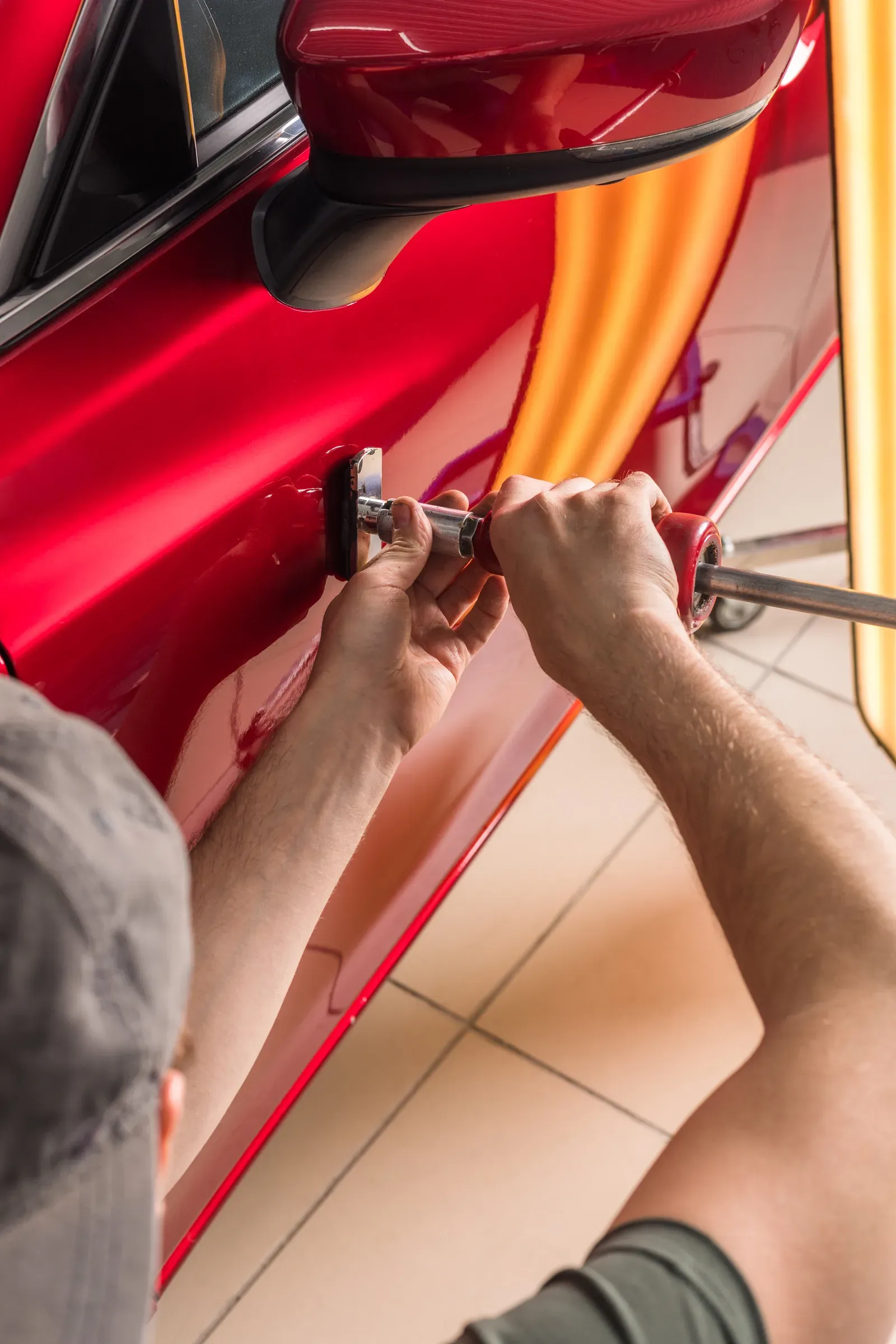
Plenty of modern panels are effectively sealed. Roofs have foam-backed reinforcements, quarter panels have inner structure, doors have intrusion beams in the way. Glue pulling solves that from the outside: plastic tabs are hot-glued to the surface over the low spot, a slide hammer or a bridge puller draws them out in small steps, and the glue releases with alcohol afterward leaving the paint untouched.
It is often used alongside rod work rather than instead of it — pull the deepest part out with tabs, then refine the surrounding surface with rods. Tapping down the high spots with a knockdown tool is part of the same process, since metal that comes out too far has to be settled back.
The same caveat applies as with rods: the finish has to be sound. Glue tabs on failing clear coat will lift the clear, which turns a small dent into a refinished panel.
When the paint is already broken
If the collision cut the paint, the calculus changes — the panel is being refinished no matter what, so the metalwork can be more direct. On steel, a stud welder tacks pins to the low area, a slide hammer pulls them out, and the pins are ground off. Deeper damage gets worked with a hammer and dolly from behind where access allows, bringing the panel back to within a fraction of a millimetre of its original contour.
Only then does filler enter the picture, and its job is narrow: a thin skim to correct the last imperfections, block-sanded flat, never a substitute for straightening. Over that goes primer, a guide coat to reveal any remaining waves, more block sanding, then colour and clear with a blend into the panel next door.
Panels made of aluminum follow a different path — different tools, a separate work area to avoid steel dust contamination, and heat used carefully — but the sequence of straighten, fill sparingly, prime, refinish holds.
Replacement, and why it is sometimes the cheaper honest answer
Some damage cannot be repaired to a standard anyone should accept. A sharp crease that runs across a body line has stretched the metal, and stretched metal will not return to its original length. A tear, a puncture, or rust perforation at the low point means the corrosion barrier is gone. Damage that crosses a welded seam or reaches a structural reinforcement is not a panel problem any more.
Bolt-on panels — fenders, doors, hoods, trunk lids — come off and go on in hours, which frequently makes replacement faster and less costly than many hours of metalwork. Welded panels such as quarter panels are a bigger operation: the factory welds are drilled out, the new panel is fitted and welded following the manufacturer’s procedure, seam sealer and cavity wax are reapplied, and only then does refinishing begin.
Where safety structure is involved, we push for original equipment parts, because fit and crash behaviour are designed together. Our estimator writes out which panels are being repaired and which are being replaced before the work starts, so the estimate reads as a plan rather than a total.
One last thing worth knowing about the ladder: moving down a rung is common and moving up one almost never happens. A dent that looks like a straightforward push from behind can reveal a hairline crack in the paint once the panel is cleaned and lit properly, and at that point the repair moves into refinishing. That is why a paintless quote given from a photo carries a caveat, and why the vehicle gets looked at in person before anyone commits to a method.
Questions people ask
How do I know if my dent qualifies for paintless repair?
Look at the lowest point of the dent under bright light. If the paint there is unbroken with no cracking or chipping, and the dent is rounded rather than sharply creased, it is a candidate. Send a close photo and one along the panel at a shallow angle.
Is body filler a sign of a cheap repair?
No, but too much of it is. Filler used as a thin skim over properly straightened metal is standard practice on every quality refinish. Filler used to bridge a dent that was never pulled out is the problem, and it eventually cracks or shows as a shadow.
Does hail damage always need paint?
Often not. Hail typically leaves shallow, rounded dimples with the finish intact, which is exactly what paintless work handles best. Where a stone has cracked the paint or dented a sharp edge, those specific spots get refinished while the rest are pushed out.
My door dent is right on the crease line. Why is that harder?
Body lines are formed by stretching metal over a tight radius, so the steel there is already worked and much stiffer than the flat around it. Moving it back takes more force in smaller increments, and getting the line perfectly straight again is the difficult part.