Blending is how the repair disappears
Painting a fender and stopping at the fender’s edge puts two different sprays of the same colour side by side, with a sharp line between them exactly where the eye is best at comparing. Blending removes that comparison. The painter sprays the new fender fully, then carries the colour a short way onto the door, thinning each pass so the new colour fades to nothing over the old, and finally clears both panels edge to edge. The transition is now a gradual shift across an unbroken surface, which the eye reads as one colour.
It is the difference between a repair you can find and one you cannot. Walk down any row in a mall parking lot and the doors that were painted without a blend are the ones that look a shade off in the afternoon sun. That is the standard behind “you won’t remember which door it was”, and there is no way to reach it on a metallic or pearl colour without blending.
The word itself confuses people, because “blend” sounds like mixing colours. It is closer to feathering. The colour is the same in the gun throughout; what changes is how much of it lands on each part of the neighbouring panel, so the new finish thins out gradually into the old one.
Why a perfect match still needs it
The paint code on your door jamb names a colour, not a single formula. Across a production run the factory adjusts the mix, the application and the bake, so the same code exists in several slightly different variants. Then the car spends years outside, and the paint shifts a little more. The shop matches to what is on the car now, using variant chips and spray-out cards under corrected light, and the match can be extremely close. Close is not identical.
Metallic and pearl paints add another variable. The colour you see depends on how the aluminum flakes or mica particles lay in the film, and that depends on the gun, the pressure, the distance, the temperature in the booth, and the painter’s hand. Two panels sprayed on two days by the same painter with the same can will not lay the flake identically. Side by side at a hard edge, that shows as a lighter or darker panel. Blended across the edge, it does not show at all.
The page on whether new paint will match the old goes deeper into how the match itself is built. Blending is what makes the match good enough in practice, not just on a card held up in the booth.
What gets blended, and what it costs in time
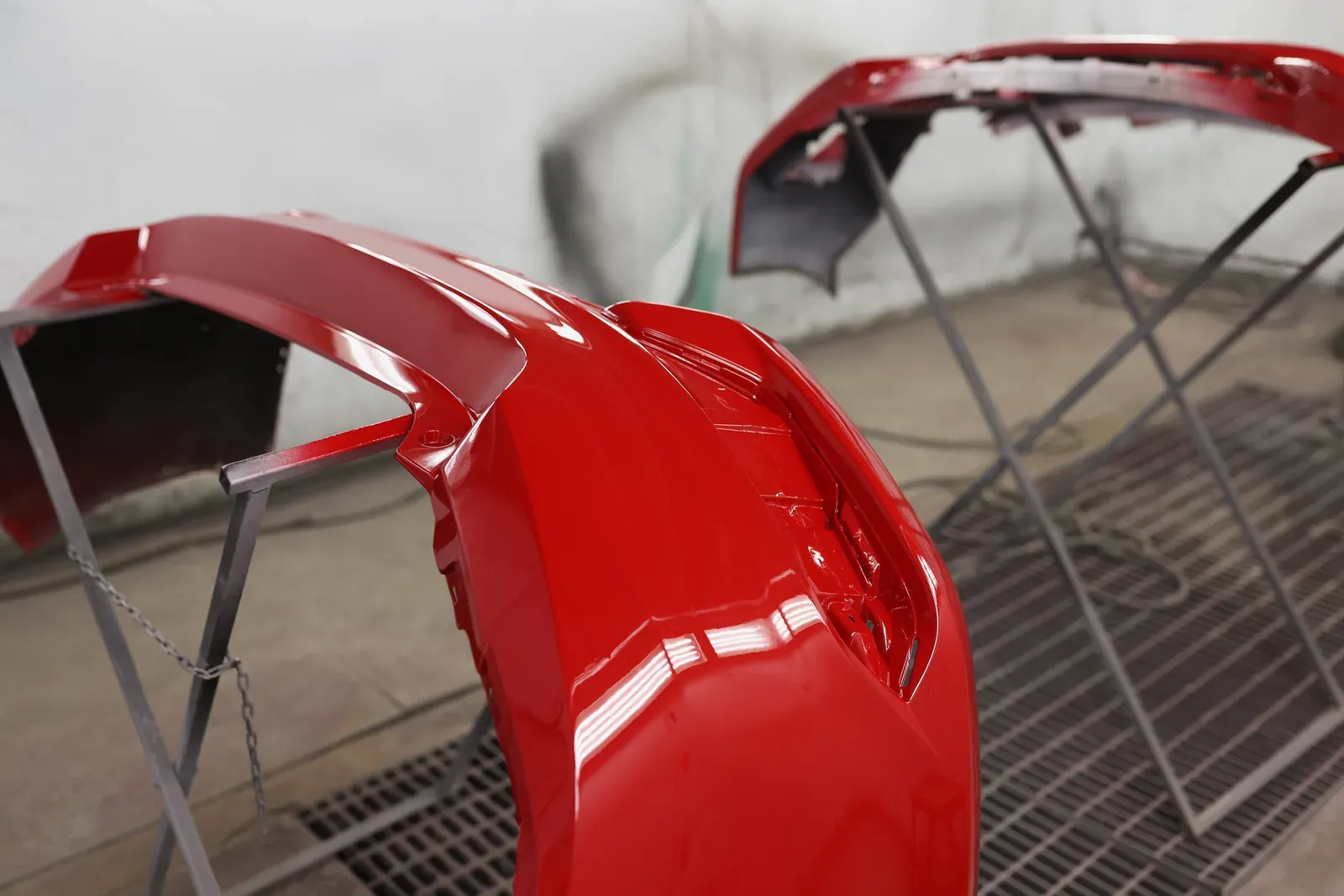
The rule is simple: blend into whatever panel sits next to the repair in the same line of sight. A front fender blends into the door. A rear door blends into the front door and the quarter panel. A hood on a metallic colour blends into both fenders. Bumper covers are their own case: the plastic cover is usually painted complete as a part, and on metallics and pearls the adjacent fender or quarter is often blended as well, so the plastic’s slightly different texture does not read as a colour step at the seam.
Blending means the adjacent panel is sanded, masked, sprayed and cleared along with the repaired one. It takes more material and more booth time, and it appears on the estimate as a blend line for that panel. Insurance companies in Ontario understand blending and generally allow it on metallic and pearl colours; where an adjuster questions it, we show the spray-out card and explain why the alternative is a visible repair. It is not padding. It is the cost of making the repair invisible.
- Fender repair: blend into the door, sometimes the hood on a light metallic.
- Door repair: blend into the panels ahead and behind.
- Quarter panel repair: blend into the rear door, and often along the roof edge or the sail panel.
- Solid, non-metallic colours: blending is sometimes unnecessary, decided from the spray-out card.
What you should see when the car comes back
No edge. Stand at the corner of the car and sight down the side in daylight, then again under the parking-garage lights, and the colour should run continuously across the repaired panel and its neighbours. Look at the flake in a metallic from a few angles. Look at the clear coat for a uniform texture across the whole side rather than a glossier patch. If you can find where the paint changes, the blend was not done or was not done well.
Blending is part of every paint repair we do on a metallic or pearl colour, and it is covered by the same lifetime warranty as the rest of the refinish, because the blended panel is a painted panel. The auto painting page explains the booth, the process and what the warranty covers. If you are curious about the technique in more depth, the guide on panel blending goes through it panel by panel, with the estimate lines you will see for each.
One last note for anyone comparing quotes. A quote that is noticeably lower than the others on a metallic colour has often left the blend out. Ask. The answer tells you a lot about what the finished car will look like in the Fairview Mall lot at four in the afternoon.
Questions people ask
Does blending mean my whole car gets repainted?
No. Only the repaired panel and the panels immediately beside it are sprayed. The rest of the car is masked and untouched.
Can a solid colour be painted without blending?
Sometimes. A plain white or black may match panel to panel from a spray-out card, and the painter decides from that card. Metallics and pearls almost always need the blend.
Why does my estimate show a blend on a panel that was not damaged?
Because that panel receives colour to hide the transition. The line pays for the sanding, masking, spraying and clearing of that undamaged panel; it is what keeps the repair invisible.
Does a blended panel need to be cleared as well?
Yes. The clear coat goes over the whole blended area edge to edge, which is why the neighbouring panel is prepared and masked in full rather than just the corner that receives colour.