Dry, hard, and cured are three different things
Ask when paint is dry and you will get three honest answers depending on which stage someone means, and they are hours, days and weeks apart. Confusing them is how a good refinish gets ruined in a driveway.
Dry to the touch means the solvent at the surface has flashed off and the film is no longer wet. Hard means the coating has enough mechanical strength to be handled, masked, reassembled and driven. Cured means the chemical reaction inside the film has run essentially to completion and the coating has reached its final hardness, chemical resistance and gloss.
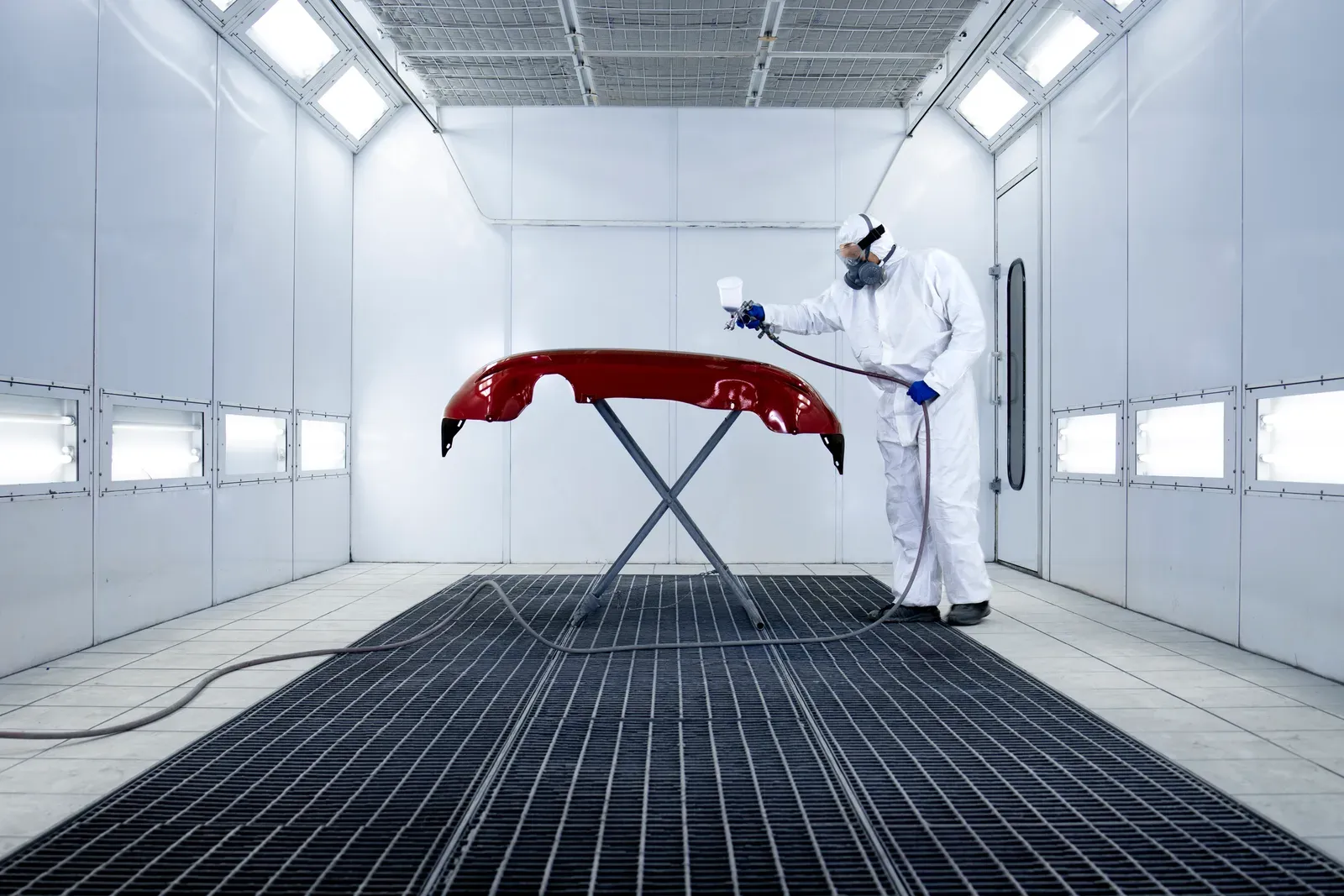
Modern refinish clears are two-part systems: the clear and a hardener that begin cross-linking the moment they are mixed. Heat speeds that reaction up, cold slows it down, and nothing stops it. The booth accelerates the early part of the reaction. The rest happens in your driveway over the following weeks.
Flash time between coats
Inside the booth, each coat has to release most of its solvent before the next one goes on. That interval is the flash time, and it usually runs a handful of minutes per coat depending on the product, the booth temperature and the humidity. Rushing it traps solvent under the following coat, and trapped solvent finds its way out later as tiny pinholes, dieback in the gloss or a hazy patch that appears days after the car went home.
A painter judges flash by look and by feel at the masking edge, not by a stopwatch alone. It is one of the quiet reasons a refinish cannot simply be sped up on request: the chemistry sets the pace and the booth schedule is built around it.
Products are also chosen for conditions. Reducers and hardeners come in speeds — fast, medium, slow — matched to booth temperature and humidity so the film levels out properly instead of drying before it flows. Using a fast reducer in a warm booth leaves texture in the surface; using a slow one in the cold leaves solvent trapped. That choice is made before the gun is filled, and it is part of why the same colour can be sprayed differently in February than in August.
The bake cycle
When the last coat of clear has flashed, the booth switches to bake. Filtered air is heated and circulated over the vehicle for a set period, driving the cross-linking reaction forward far faster than shop-temperature air would. There is then a cool-down before anyone touches the panel, because moving a hot, still-soft film is how fingerprints and rack marks end up permanently in a fender.
After the bake the finish is hard enough for the real work to resume: unmasking, reassembly, trim and emblems, glass and lamps, alignment of gaps, and any polishing needed to level dust nibs. The vehicle can be washed carefully, driven in rain, and parked outside. What it cannot do yet is take anything sealed onto its surface.
The weeks after you pick it up
Solvent keeps leaving the film after the bake, and the coating keeps shrinking, hardening and tightening for weeks. During that window the paint needs to breathe. Anything that seals the surface — wax, polymer sealant, a ceramic coating, even a fitted car cover pressed against a hood — traps solvent and can leave dull spots or a soft finish that never reaches full gloss.
It is also mechanically softer than mature paint, so it marks more easily. This is where automatic washes do their damage: brushes that a two-year-old finish shrugs off will put a haze of fine scratches into three-week-old clear.
- No wax, sealant or ceramic coating until the shop tells you the paint has cured
- No automatic car wash, especially brush washes — hand wash gently instead
- No pressure washer close to fresh edges, gaps or masking lines
- Wash with lukewarm water, pH-neutral soap and a soft mitt, in the shade
- Remove bird droppings, sap and bug splatter immediately; fresh clear etches easily
- Skip car covers, magnetic signs, suction mounts and adhesive decals for now
- Avoid parking under trees, near sprinklers, or on gravel that throws stones
Cold, damp and the Toronto calendar
Temperature drives the whole reaction. Paint sprayed and baked in a controlled booth is not affected by the weather outside, but everything before and after it is: a vehicle brought in at minus fifteen has to come up to temperature before body filler, primer or sealer behave properly, and panels that go outside straight into a January night keep hardening more slowly than they would in July.
That is one reason winter jobs in the GTA can carry an extra day, and why the care window after pickup is worth stretching a little in cold months. It is also why we would rather keep a vehicle an extra night than hand it back with a finish that has not finished.
If you are unsure how far along your paint is, ask at pickup and ask again before the first wax. The answer depends on the product used, the panels sprayed and the season, and our estimator will give you a straight date rather than a rule of thumb.
What happens between the bake and the handover
The bake ends and the vehicle does not go straight to the front lot. Fresh clear picks up airborne dust as nibs — specks that feel like grit under a fingertip — and levelling them is a separate operation: each one is denibbed with very fine abrasive, then the area is compounded and polished until the gloss reads uniform with the panels around it. On a dark colour this can take longer than the spraying did.
Reassembly follows, and it is where fit is won. Lamps, grilles, mouldings, emblems and clips go back with the gaps set deliberately, panel to panel, so the repaired side matches the side that was never touched. Anything that had to come off for a blend — a handle, a mirror cap, a weatherstrip — goes back on last so nothing presses into soft paint.
Then the vehicle is washed, the interior is cleaned of any masking residue, and it sits until the finish is stable enough to hand over. Waiting a few extra hours at this stage is cheaper for everyone than polishing a fingerprint out of a fender next week.
Questions people ask
Can I drive the car in rain right after picking it up?
Yes. Rain does nothing to baked clear coat. What matters is what sits on the surface afterward — road film, tree sap or droppings left on soft paint. Rinse the car gently when you get the chance and dry it with microfibre.
When can I wax or apply a ceramic coating?
Not until the shop confirms the finish has cured, which is weeks rather than days and depends on the product and the season. Applying too early seals solvent in and can leave dull patches that require the panel to be polished or resprayed.
Why does my new paint still feel slightly soft?
Because it is. Cross-linking continues long after the film looks and behaves like finished paint, and full hardness arrives at the end of that process. Treat the panel gently for the first few weeks and it will reach the same durability as factory finish.
Does a heat lamp or infrared cure paint faster than a booth?
Infrared is used for spot repairs and small panels and it does accelerate the same reaction, but it heats a limited area. A full downdraft booth cycle heats the whole vehicle evenly, which is what a multi-panel refinish needs to cure consistently.