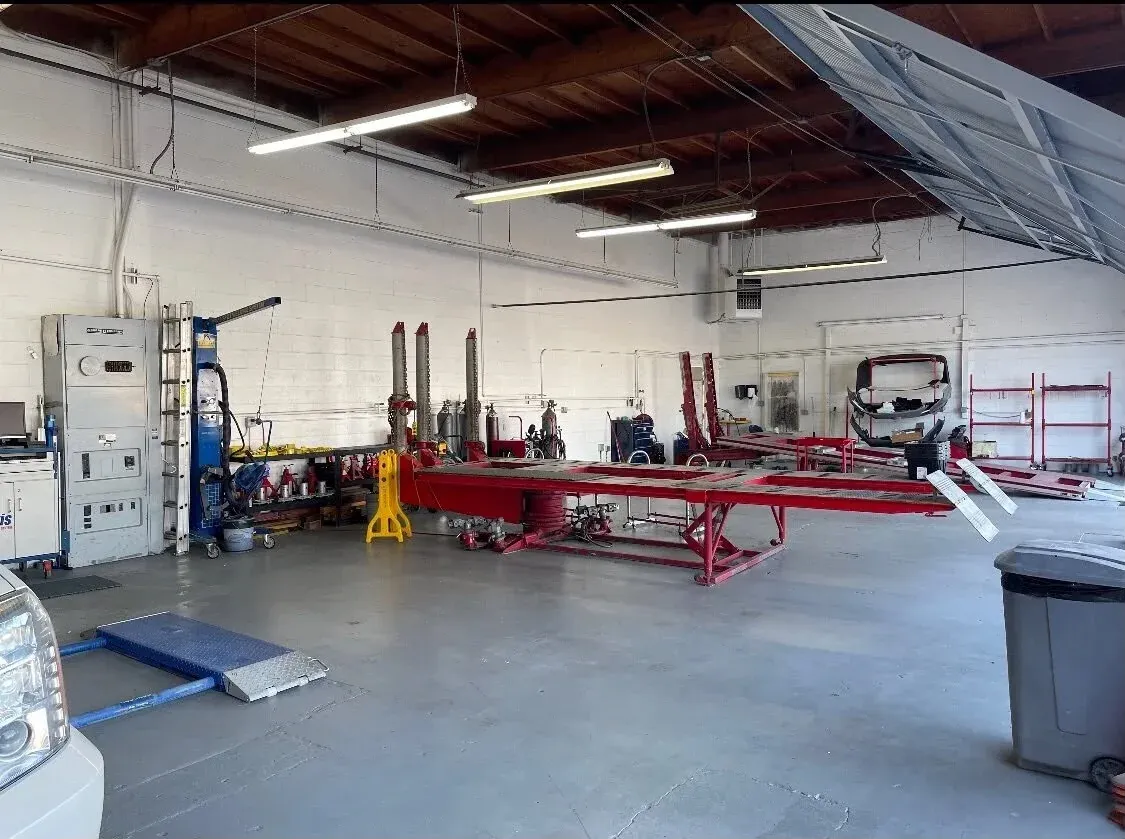
From the 404 shoulder to our bay without a highway ride
A car with suspected structural damage should not be driven, and around this corner it does not have to be. The weave where the 404 south splits for the 401 and the DVP, the collectors at Leslie, the left-turn lanes at Sheppard and Don Mills: all of them are a few minutes from our door by flatbed. Ontario’s towing rules put the destination in your hands, not the operator’s, so tell the driver Crash Consultant at Sheppard and Don Mills, or call from the scene and we coordinate the tow ourselves. The same applies to a car sitting in the compound at the Collision Reporting Centre or stuck in a building’s garage with a wheel pushed back into the wheel well.
The hits that bend structure here are predictable. Highway-speed sideswipes in the weave load the rocker and the rear rail on one side. The T-bone at the intersection, six lanes across with a mall entrance on the corner, pushes the B-pillar and the floor. A front-corner impact in the ramp queue can shorten a front rail without leaving much on the outside. And every March a few come from a pothole on Don Mills south of Sheppard hard enough to bend a control arm and nudge the mount it bolts to.
Measure, pull, measure again
Structural work here follows one sequence and it does not skip steps. The car goes on the bench and its control points are measured against the manufacturer’s data, producing a printed map of what moved and by how much. The pull happens in controlled increments with the metal brought back rather than yanked, and the same points are measured again. Both sets of readings go in your file and to your insurance company, so the repair is proven rather than described. Only after the geometry is right do panels, paint, and calibration of any driver-assist sensors follow, because a perfect refinish on a crooked structure is decoration.
The car often tells you something moved before anyone measures it. Doors that need a shove to latch. A hood gap wider on one side than the other. A steering wheel that sits off-centre after the alignment shop has done its best. Tires wearing on one shoulder a few weeks after a hit that seemed minor. New wind noise at 100 km/h on the 404. A unibody carries the suspension geometry, the crash-energy paths and the airbag timing; millimetres matter, and nobody sees millimetres by eye.
- Baseline measurement against factory data before any repair decision
- Controlled pulls with before-and-after readings kept in your file
- Panels, refinish and sensor calibration only after the structure is right
- Alignment and a road test on the 404 ramp before the keys come back
When repair stops making sense, and who decides
Sometimes the measurements argue against the repair. Rails crumpled past what can be restored to specification, or a repair cost climbing toward the car’s actual cash value, are things we tell you at the start, not after the parts have arrived. Ontario has no fixed write-off percentage; the insurance company weighs actual cash value against repair cost plus salvage, and you are entitled to see that math and to question the value they put on the car. Under DCPD, if you were not at fault the file is with your own insurance company either way, and we prefer OEM parts wherever the repair touches a safety structure.
While the measurement and the decision happen, a rental through your coverage keeps you moving, timed from the day the car arrives on the flatbed. Updates come from the person doing the work, and if the conversation about total loss and salvage is easier in Mandarin, we have it in Mandarin.
Questions people ask
The car pulls to the right since the accident but the body looks fine. Could that be structural?
It could. A pull that an alignment does not fix, or that comes back within days, usually means a mounting point has moved, and mounting points live in the structure. The only way to know is measurement against factory data. We measure first and tell you exactly what moved, if anything, before any repair is priced.
Can a bent unibody really be made safe again, or should I want the write-off?
A unibody pulled back to specification on a bench, with the readings to prove it, is a car restored to the geometry it was designed with. That is a normal, documented repair. What you should want is honesty about which side of the line your car is on, and we give you that before the work starts, along with the before-and-after numbers.
Will my insurance company accept your measurements?
Yes. Before-and-after readings against the manufacturer’s specification are exactly what an adjuster wants in the file, and they go to your insurance company with the estimate and any supplement. They also matter years later: a documented structural repair answers a buyer’s questions cleanly if you ever sell the car.