Unionville GO by morning, the Civic Centre by night
The GO lot fills front to back: the rows nearest the platform go first, the stalls are standard width, and everyone parking there is watching a train, not a door. Morning dings land on front doors at handle height. Evening damage is different — the reverse out of a stall happens in the dark against a lot that emptied unevenly, and it leaves shallow crescents low on quarters and rear doors. At the Markham Civic Centre the pattern is event-shaped: a full lot emptying all at once after a show or a ceremony, doors and liftgates swinging in every second stall.
Main Street adds the roadside version — a passenger door opened into a mirror at the curb, a tailgate met by a parallel parker working by feel. At Toogood Pond the overflow parks half on the grass verge, and a swung kayak or a bike pedal off a rack adds the odd tailgate dent to the mix. And once or twice a summer a thunderstorm drops enough hail to stipple a hood, which looks catastrophic and is usually the easiest dent work there is, because hail almost never breaks paint.
If the paint held, the dent comes out without a respray
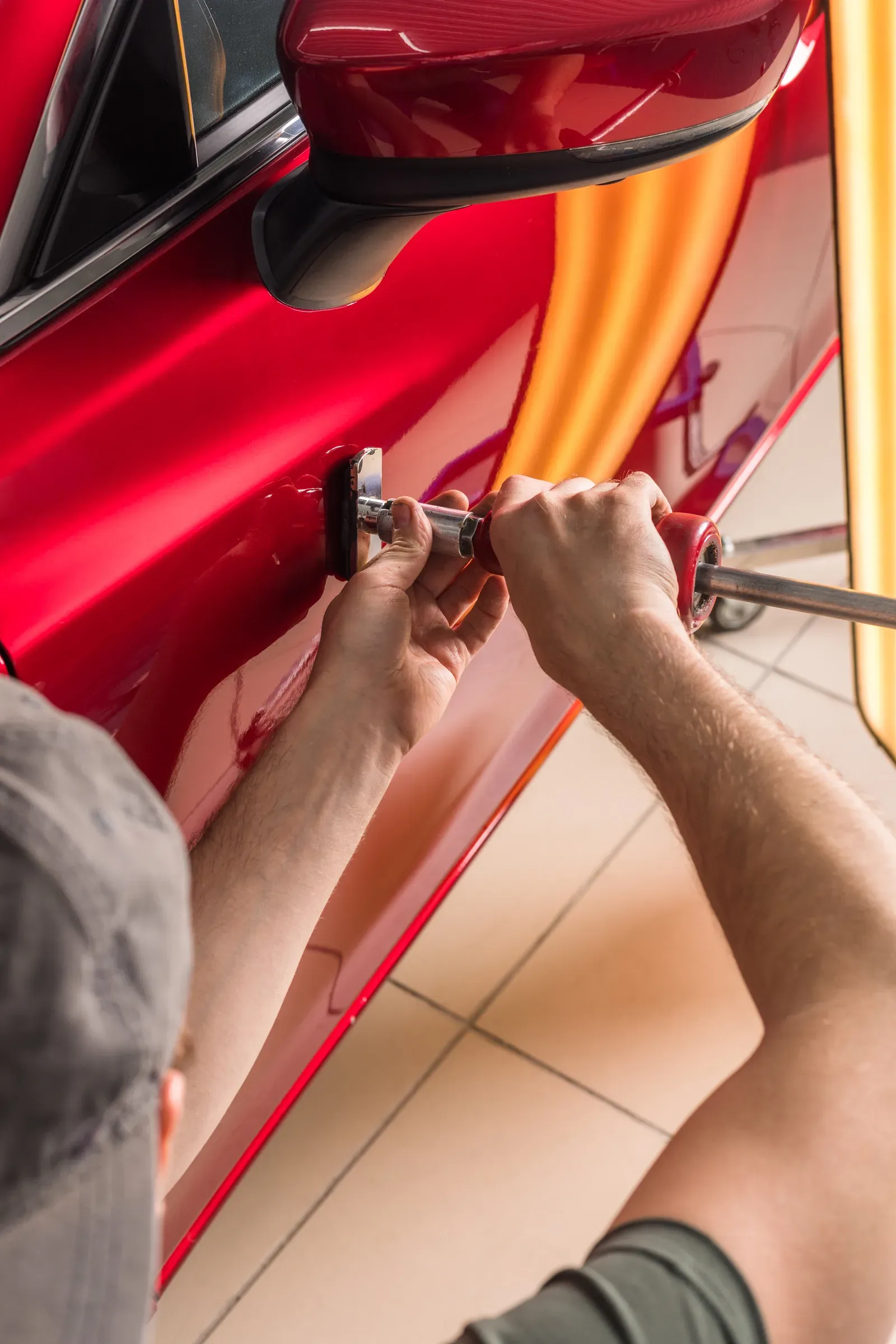
A dent with unbroken paint can usually be worked back from behind until the panel reads straight, keeping the factory finish — hours of work rather than days. Cracked paint, a stretched crease or a dent riding a sharp body line means conventional repair instead: fill, prime, paint to the code and blend into the next panel. Aluminum hoods and doors, common on the leased vehicles north of Carlton, can be worked without paint too, but slowly — aluminum has little spring-back and hardens as it is worked, so the passes are smaller and the patience is larger.
- Unbroken paint: pushed back from behind, factory finish kept
- Cracked or stretched: conventional repair with refinish and blend
- Aluminum: workable without paint, with more patience than steel
- The written estimate names the method before the car moves
A deductible, a leased car, and which dents are worth a claim
A single door ding often prices near a typical deductible, and a claim that saves you nothing still sits on your record — so for the GO-lot ding, the arithmetic usually says pay for it yourself, and notify your insurance company of a collision either way. Hail is the opposite case: it falls under comprehensive coverage, carries no fault, and a stippled hood and roof price well past most deductibles, so it is usually worth filing.
Leases change the urgency more than the method. A crease that could wait five years on an owned car costs real money at a return inspection, and paintless repair is the return-friendly fix where it applies, because the factory paint stays untouched. Send photos with a reflection across the dent — the shape tells us the method — and the written estimate comes back with both numbers, claim and cash, so the decision is made before the car ever leaves Unionville.
Questions people ask
The dent is on a leased SUV that goes back in six months. Paintless or conventional for the inspection?
Paintless, wherever the paint is unbroken — the factory finish stays, so there is nothing for an inspector to measure or question. If the paint is cracked the choice is made for you, and a properly blended refinish beats a chargeback. Send photos and we will tell you which side the dent is on.
I came back from the train to a crease low on the rear door, and the centre of it looks shiny. Does that change anything?
Probably. A shiny or flattened centre often means the metal stretched or the clear coat crazed as it folded, and stretched metal will not settle back with rods alone. That crease is likely a conventional repair with refinish rather than a paintless job — a close photo with a reflection across it usually settles the question before you book anything.
A door caught my car at a Civic Centre event and the driver left a note. Do we settle privately or call the insurance companies?
Either can work, but notify your own insurance company promptly regardless — the policy expects to hear about a collision even when you intend to pay privately. If it runs as a claim and the other car is identified and insured in Ontario, your own company pays the not-at-fault damage under DCPD. If the repair prices near your deductible, a private arrangement is often simpler for everyone.