A pearl white has variants, and the lease inspector has a gauge
Unionville’s lease turnover keeps its driveways in the colours that are hardest to repaint: pearl white with mica that shifts as the light moves, deep metallic greys, a candy red that took three coats at the factory. One paint code can hide half a dozen factory variants, so matching the code alone gets you a fender that looks right head-on and wrong from the neighbour’s driveway. And because so many of these cars go back to a lease company, the repaint will eventually be judged by someone paid to find it.
That is why the match is proved before the car is sprayed. The code from the door jamb narrows the family; the variants are sprayed out on cards and held against the actual panel in daylight rather than under booth lamps; the winner is blended into the panels on either side of the repair so there is no hard line for the eye to catch. A door repair becomes a door plus a feathered fender edge and quarter edge — more masking, not more damage.
Booth days: what the car is doing while you are without it
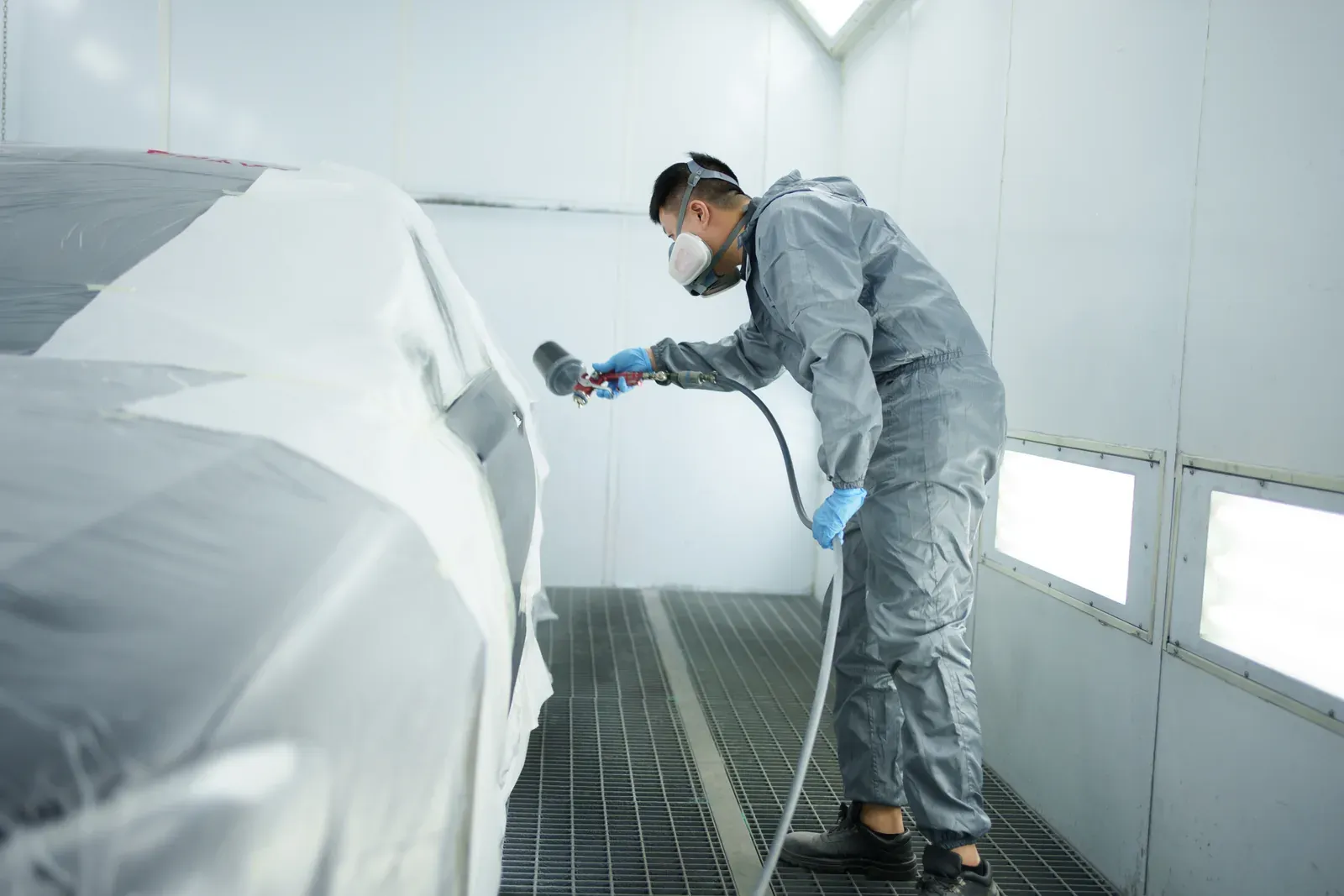
The panel is stripped to sound material, filled, blocked flat, and the old paint around the repair feathered so the new coat has an edge to melt into. Primer and sealer go on and are sanded again; then base coat in as many passes as the colour needs, the mid-coat if it is a three-stage, and clear over everything, baked to cure. Badges, mouldings and handles come off rather than being taped around wherever the panel allows, because a tape line at a badge is where a repaint gives itself away first.
One or two panels usually means a few days: prep, booth and bake, then reassembly, polish and a check in daylight before you see it. All of it is covered by a lifetime warranty on the paint and refinish for as long as you own the car — peeling, fading and clear-coat failure on our work. A stone chip from the 404 next winter is not a warranty item; the fender still matching the door in five summers is exactly what the warranty is for.
Plastic takes colour differently, and the estimate plans for it
Bumper covers get their own line of thinking. A cover is usually painted complete, as a part, and on a metallic or a pearl the fender or quarter beside it is often blended — plastic takes the same colour slightly differently than steel, and the texture difference can read as a colour step at the panel gap. That blending is planned on the estimate from the start, and it is the difference between a corner that disappears and one you notice every time you load the trunk.
Logistics are the easy part. The car comes down Highway 7 to the 404 on a workday morning, we are just off the Sheppard exit beside Fairview Mall, and Don Mills subway station shares the block if you need to keep moving without the car. When the refinish is part of a claim, the rental through your own coverage is arranged ahead of the drop-off; winter stretches bookings a little, because every car ahead of yours cures on the same schedule.
Questions people ask
Why does the estimate show refinish time on panels nothing touched?
That is blending. The repaired panel is painted, and a light coat is carried into the panel beside it so the colour transition happens gradually across a body line instead of abruptly at a panel edge. On pearls, metallics and three-stage colours it is the only reliable way to make a repair invisible; skipping it is how two-tone doors happen.
A panel on my leased car has already been repainted once. Will a second repaint be a problem at lease return?
A proper repaint measures thicker than factory paint but is not itself a chargeback — inspectors look for visible mismatch, texture and overspray. If the first job shows, redoing it properly before the return is usually cheaper than the penalty. Send photos and we will tell you which side of that line it sits on.
How soon after painting can I wash the car?
A gentle hand rinse is fine after about a week; avoid pressure washers, automatic brushes and any wax or sealant for roughly a month while the clear finishes hardening. Sap and bird droppings should come off promptly with water, since fresh clear is softer than cured clear and marks more easily.