Where Newmarket parks, and what it costs the doors
Upper Canada Mall is the obvious one. Between the November weekends and Boxing Day the lot at Yonge and Davis is full to the far edges, and the dents that come out of it are the standard mall kind: a door edge from the next stall, a cart that rolled downhill, a bumper corner from a reverse that started before the mirror check. The big-box lots along Yonge toward Green Lane and the plazas at Davis and Leslie do the same on a smaller scale.
Main Street is different, and worse for quarter panels. The angled parking on the historic strip means every departure is a blind reverse into a moving lane, and the car in the next stall is centimetres from your rear door as you swing. We see rear-quarter creases from Main Street that have nothing to do with speed and everything to do with geometry. The GO station lot on Davis, the Magna Centre lot at hockey time and the Fairy Lake lots on a summer Saturday add the rest: tight spaces, early mornings and drivers backing out in every direction. Winter adds the windrow — a compacted ridge at every driveway mouth that a car noses over blind, into a neighbour who had no time to react.
Paint intact means rods and patience; paint cracked means the booth
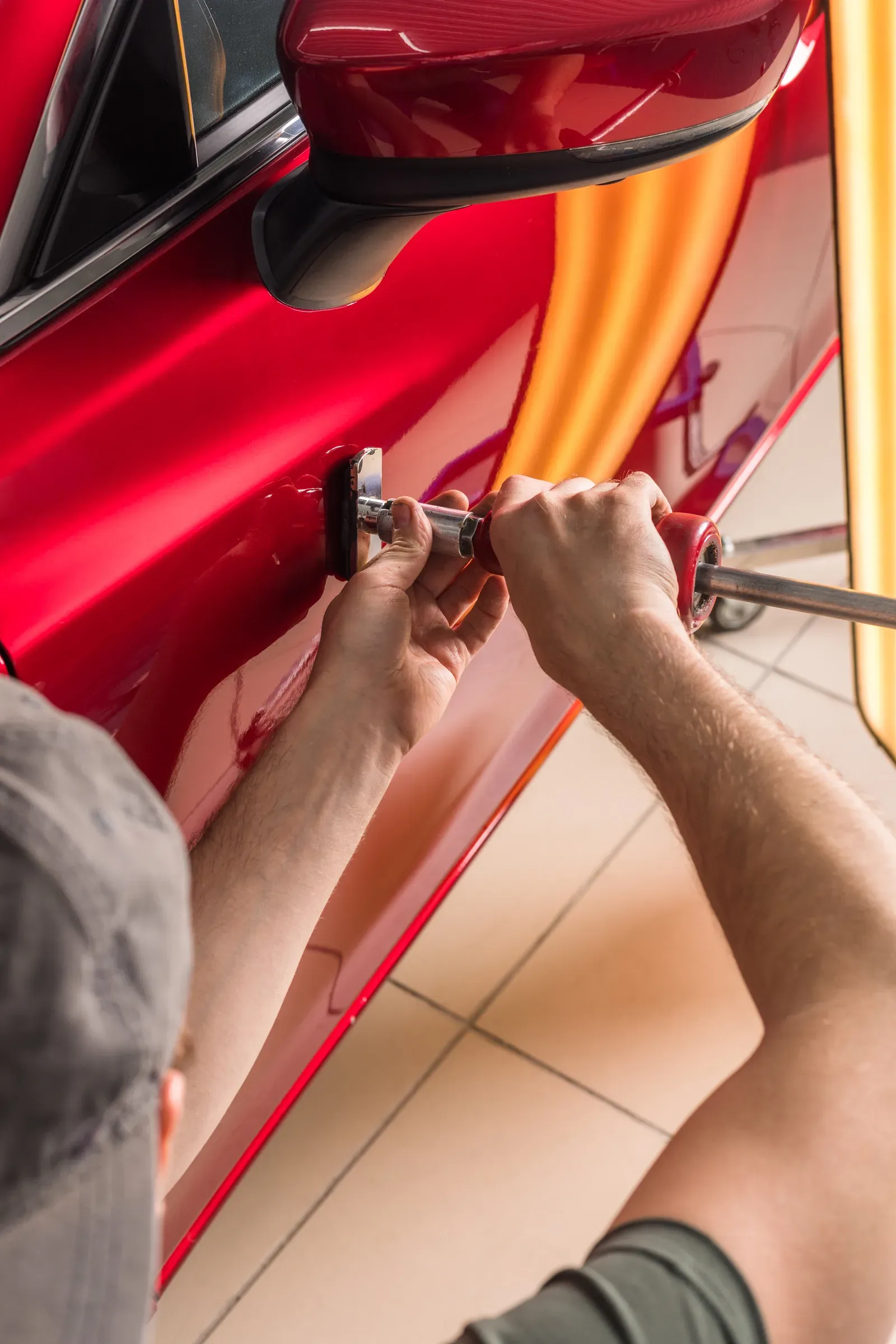
The first question about any dent is whether the paint survived. If it did — a smooth ding on a door or quarter with no crack in the finish — the dent can often be worked out from behind with rods and tabs, with no filler and no paint. The factory finish stays, which is what a lease inspector or a private buyer will later care about. Our estimator can usually tell from a photo taken at a low angle whether that route is open.
A crease with cracked paint, a dent on a body line, or one where the metal has stretched needs the conventional route: the panel is worked back to shape, high spots brought down, then primed, colour-matched to your code and blended into the neighbouring surface. When a dent sits over a door’s intrusion beam or has broken the panel’s strength, a replacement skin is the better repair and we will say so plainly rather than write the bigger job.
- Paintless repair where the finish is intact — no filler, no repaint
- Conventional repair and refinish where the paint is cracked or the metal stretched
- Replacement recommended only when it is genuinely the better outcome
The deductible call, made in Newmarket before you drive
A single mall ding often prices near a typical deductible, and claiming it gains you nothing. A creased quarter from Main Street plus a scraped bumper corner is a different number. Our estimator writes the estimate from photos first so you can compare it against your deductible from your kitchen table, and if a claim makes sense we open it and deal with the adjuster from here. One incident per claim is the rule; unrelated dings from three different lots cannot ride on one file, but they can be priced together as an out-of-pocket job and cleared in one visit.
Because the drive is about 28 to 40 minutes, single-panel dent work is booked so the car goes straight into a bay on arrival. Paintless repairs can sometimes be done while you wait; refinished panels are usually two to three working days, with the rental through your coverage if the job is a claim.
Questions people ask
A cart hit my door at Upper Canada Mall. Is that a claim?
Usually not worth one. A single cart dent with intact paint is often a paintless repair that lands below or near a typical deductible, so claiming it puts a claim on your record for little return. Send a photo taken at a low angle; our estimator will tell you whether the paint survived and what the out-of-pocket number is.
Can a dent from Main Street’s angled parking be fixed without painting?
If the finish did not crack, often yes. Rear-quarter creases from a blind reverse tend to be shallow and long, which is workable from behind when there is access. If the crease sits on a body line or the paint has split, the panel needs conventional repair and a blended refinish.
Can I get several old dings fixed on the same trip down the 404?
Yes, and it is the sensible way to use the drive. Unrelated dents cannot go through one insurance claim, but they can be priced together as a single out-of-pocket job. Send photos of each one and you get one written number, one drop-off, and one pickup.