Where the dents come from: lots, not roads
The Shops at Don Mills is an outdoor mall, and its parking is a set of open rows between the streets, laid out for people walking between stores rather than for people manoeuvring cars. Doors open into the next stall, carts drift downhill toward the Lawrence side, and a car parked there for a long dinner comes back with a crease in the door or a soft dent in the rear quarter that nobody left a note for. The plazas along Lawrence between Don Mills and Leslie, and the strip at Leslie and Lawrence, are older and tighter, with curb stops that catch a bumper corner and cart corrals that are never quite where the carts are.
Edwards Gardens on a warm weekend adds a lot full of visitors and wedding parties who do not know the layout, and the underground garages of the towers along Don Mills add the other kind of dent: the low, long one from a pillar or a ramp wall. What all of these have in common is that the paint is usually intact. That is the fact that decides how the dent is fixed.
Without repainting, and when that is not possible
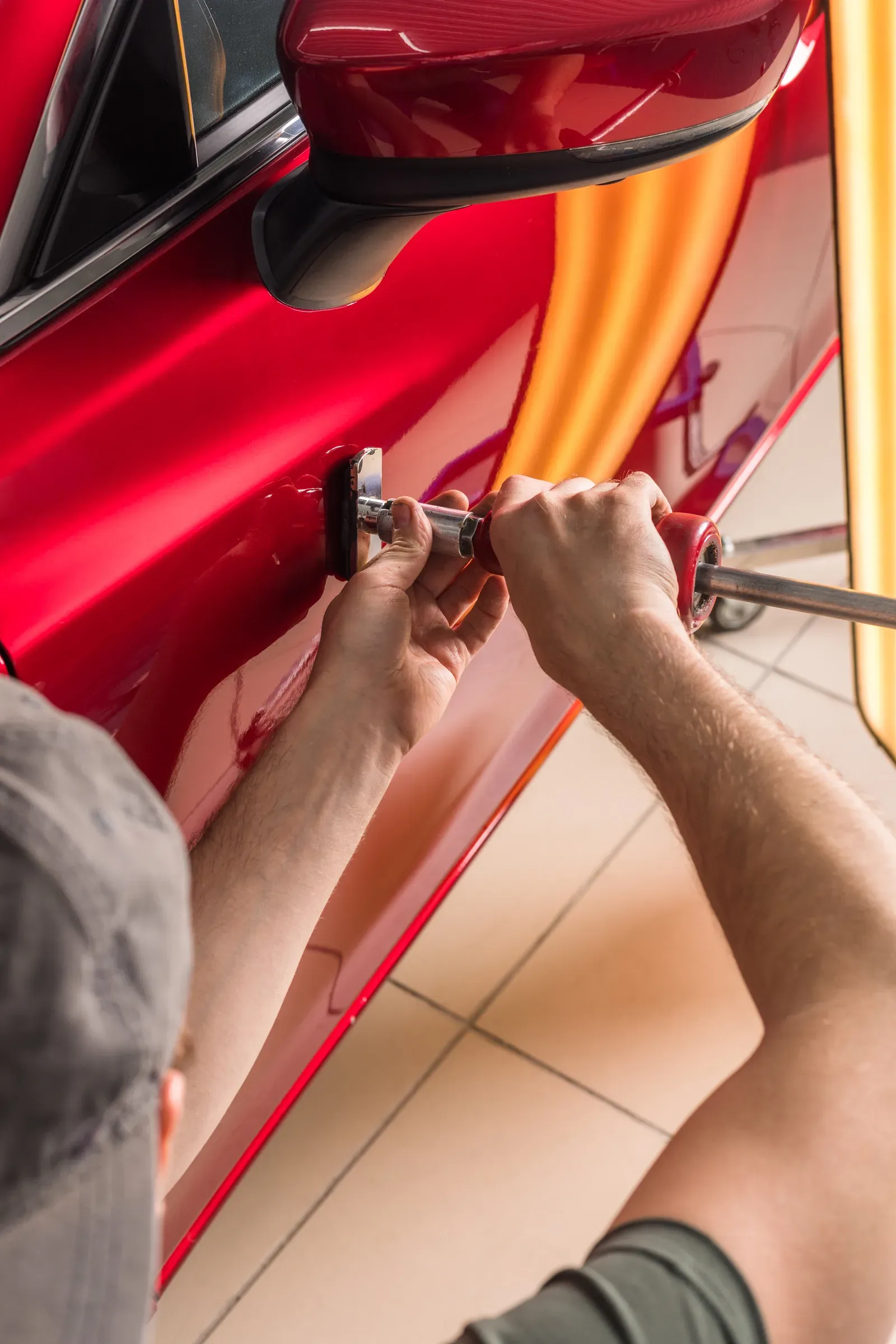
If the paint has not cracked, the dent can very often be worked out from behind the panel with paintless dent removal. The technician reaches the back of the panel through a window opening or a removed trim piece, and pushes the metal back to shape a fraction at a time under a striped light that shows every remaining low spot. No filler, no primer, no paint, and the factory finish stays as it was. Door dings, cart dents and hail are the natural cases. A smooth dent the size of a hand on a flat part of a door is a good candidate; a sharp crease on a body line, or a dent with an edge behind it that no tool can reach, is not.
When the paint has broken, or the metal has stretched, the repair becomes conventional: the dent is pulled or hammered out, a thin skim of filler levels what remains, the area is primed, and the panel is refinished and blended into its neighbours. Our estimator can usually tell which route a dent needs from three photos, one straight on and two at an angle so the light shows the shape.
Most lot dents are cash repairs; hail and identified drivers are claims
A single lot dent sits near the line where a claim stops making sense. If the repair cost is close to your collision deductible, paying out of pocket keeps a claim off your record and avoids the conversation with the adjuster. If the damage is larger, or someone else’s car did it and they stayed to exchange information, a claim through your own insurance company under DCPD costs you nothing when you were not at fault. A hit-and-run in the lot generally falls under your collision coverage and needs a police report.
We give you the number from the photos and let you decide; the estimate is written the same business day either way. For hail, which reaches Don Mills a few afternoons every summer, comprehensive coverage applies, and paintless removal is usually the whole repair.
- Paintless removal where the paint is intact, with the factory finish kept
- Conventional repair and blended refinish where the paint has cracked
- Honest advice on claiming versus paying, based on the photo estimate
- A few minutes up Don Mills Road, with the bus back down
Questions people ask
A shopping cart at the Shops at Don Mills left a round dent in my door. Will it need paint?
Probably not. A cart dent is usually a soft, round low spot on a flat part of the door with the paint unbroken, which is exactly what paintless removal is for. Send a photo taken at an angle under daylight and our estimator will confirm; if there is a chip or crack in the paint at the centre of the dent, the answer changes.
The ramp wall in our building’s garage put a long, low dent along the side. Is that a dent job or body work?
It depends where it sits. The door and quarter above the trim line can often be worked back without paint; the rocker below is stiffer, double-skinned near the jack points, and a dent pressed into it usually needs conventional repair and refinishing. A photo taken from a low angle down the side of the car shows which panels carry the dent, and the estimate splits it panel by panel.
Can a dent on the roof from hail be fixed without repainting the whole roof?
Usually, yes. Hail leaves shallow, round dents with the paint intact, and paintless removal takes them out one by one from beneath the roof skin. Roof hail falls under comprehensive coverage rather than collision. Only when a hailstone has cracked the paint, or the dents are so dense the metal has stretched, does the roof need refinishing.