Ravine roads in February
Don Mills is bordered by ravines, and the roads that cross them are the ones that bend cars. Lawrence Avenue drops through the valley past Edwards Gardens on a curve that stays shaded and icy after the rest of the road has dried. Leslie runs the length of Sunnybrook Park on a grade with the same problem. The DVP ramps at Wynford are banked and always a little slower than they look. A slide on black ice on any of these ends against a curb, and a curb strike at the front wheel is exactly the kind of impact that bends a lower control arm, shoves a strut tower out of position, or kinks a front rail without leaving much of a mark on the paint.
Spring finishes what winter started. The freeze-thaw potholes that open along Don Mills Road and the Lawrence plazas from February through April hit hard enough at speed to bend a wheel and, on a bad one, move a subframe. The tell-tale is the same either way: the steering wheel is no longer centred, the car pulls, a door has started to catch on its latch, or a panel gap has changed width from one end to the other.
Measuring before pulling
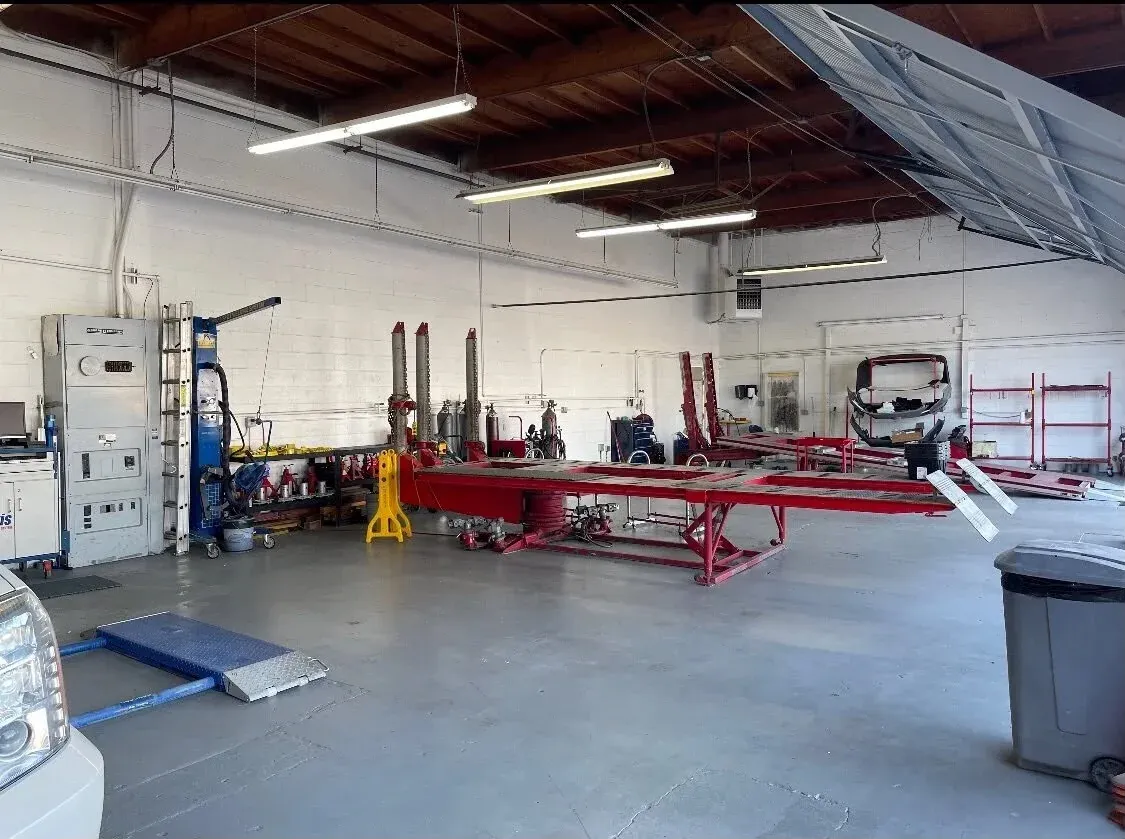
Almost every car in Don Mills is a unibody: there is no separate frame, and the body shell itself carries the suspension and absorbs the crash. Straightening it starts with measurement. The car goes on the bench, reference points on the underbody are located, and their positions are compared to the manufacturer’s specifications in three dimensions. Millimetres matter here, because a rail that is a few millimetres out changes the way the suspension sits, the way the doors close, and the way the car behaves in the next collision.
Once the map of what moved is clear, the bench applies controlled pulls with chains and hydraulic towers in the opposite direction to the impact, a little at a time, with measurements taken between pulls. Where the metal is torn or has been folded past the point where it will return, the section is cut out and a new piece is welded in, following the manufacturer’s procedure for that car. Then the suspension is inspected, the alignment is set, and only after that do the panels and paint go back on.
The claim, the tow, and the total-loss question
A car with a bent structure should not be driven up Don Mills Road. We arrange the tow; under Ontario’s rules you name the destination, and the operator brings it to Sheppard and Don Mills, whether from a Lawrence curb, a Wynford ramp or a Collision Reporting Centre lot. If another driver caused the slide, the claim runs under DCPD through your own insurance company. If you slid on your own, it is a collision claim with your deductible.
Structural repair is where the total-loss question comes up. There is no fixed percentage in Ontario; the insurance company compares the repair cost to the car’s actual cash value with salvage taken into account. Our estimator writes the estimate from the teardown, sends the adjuster the measurements, and argues the case in either direction honestly, because a car that is measured and welded to specification is as straight as it was, and a car that should be written off should be.
- Tow coordinated to Sheppard and Don Mills, with you naming the destination
- Three-dimensional measurement against factory specifications before any pull
- Sectioning and welding to the manufacturer’s procedure where metal will not return
- Alignment and suspension inspection before the car is refinished
Questions people ask
I slid into a curb on the Lawrence hill by Edwards Gardens and the car pulls left. Is that frame damage or just alignment?
Sometimes alignment, often more. A curb strike hard enough to pull the steering usually bends a control arm or a tie rod, and it can shove the strut tower or the rail behind the wheel. An alignment shop can only tell you the wheel will not adjust into range; the bench tells you why. Send photos of the wheel and the fender gap and we will start there.
Can a unibody really be straightened, or is it never the same again?
It can. The bench pulls the shell back to the manufacturer’s reference points and the measurements are printed, so the result is not an opinion. Where metal has been folded past recovery it is replaced by sectioning, welded the way the manufacturer specifies. Done that way, the car is as straight as it left the factory. Done by eye, it is not, which is why we measure.
The pothole on Don Mills Road bent my wheel and now the door catches. Can I claim that?
Pothole damage is a collision claim under your own policy, with your deductible, since no other driver is involved. You can also file a claim with the City for road damage, which is a separate process with its own rules and no guarantee. The door catching is the more important sign: it means something behind the wheel has moved, and the car should be measured before it is driven far.