Report it at the gate, while the operator can still see the car under the arm
The strongest report is the one made before you leave the lane. Once you pull away, the lot operator has a car somewhere in the city with a dent, and nothing tying it to their equipment. So stop clear of the exit if you can, put the hazards on, and press the help button on the pay station. Say plainly that the barrier dropped onto the car, give the time and your plate, and ask for the attendant’s name or a reference number.
Ask in the same conversation for the gate camera footage to be saved. Many paid lots and garages have cameras on their entry and exit lanes, and those systems often record over themselves after a while. A request on the day, followed by an email that evening, gives the operator a reason to pull the clip before it is gone.
Then gather the paper trail. Keep the entry ticket, the payment receipt or the app confirmation, because they place you at that gate at that minute. Photograph the gate from a distance so its number or lane label shows, then the arm itself, then the car. If another driver was ahead of you and the arm came down as you followed them through, say so in your report rather than leaving it for the operator to discover on video.
How it happened decides whether it is the operator’s problem or a claim on your policy
An arm that lowered onto a car sitting still under it, after you had paid or the gate had opened for you, points toward the lot’s equipment. A car that rolled into an arm already down is a collision with a fixed object, and that sits with the driver. Most real cases fall somewhere between, which is why the footage and your receipt matter more than anything you say at the gate.
Start with the operator. Send your photos, the time, the gate number and the reference you were given, and ask how they handle damage from their equipment. Many lots have a claims process for exactly this; some will deny it outright. If they refuse or stall, your own policy is the fallback. Your insurance company decides whether a dropping barrier counts as a falling object under comprehensive or as a collision, and the deductible applies either way.
In a condo garage, the corporation’s gate and its insurance belong to the building, not to you. Report it to the property manager in writing with the same photos, and keep a copy. If the gate has a history of closing on cars, other residents have probably complained too, and that record helps.
Where a barrier arm lands, and what that does to the metal and glass
Barrier arms are long and light, but they come down with leverage, and they almost always hit the same places. On a sedan it is the roof just behind the windshield or the back edge of the hood. On a taller SUV it is the front of the roof or the top of the windshield frame. The usual result is a straight crease across the panel, sometimes with a scuff where the arm’s rubber edge rubbed the clear coat.
Glass is the other thing to check. An arm landing on the top of the windshield can start a crack at the edge, and on a car with a panoramic or sunroof glass panel, the impact can chip or crack the glass itself. A cracked windshield is replaced, and on a car with a lane-keeping camera mounted behind it, recalibration may be required once the new glass is in.
Run your hand along the crease in daylight rather than under the lot’s lights. If the paint is unbroken and there are no cracks radiating from the dent, it is likely a dent-only repair. If the paint has split along the fold, the panel will need refinishing as well.
Getting a roof crease out without repainting the roof
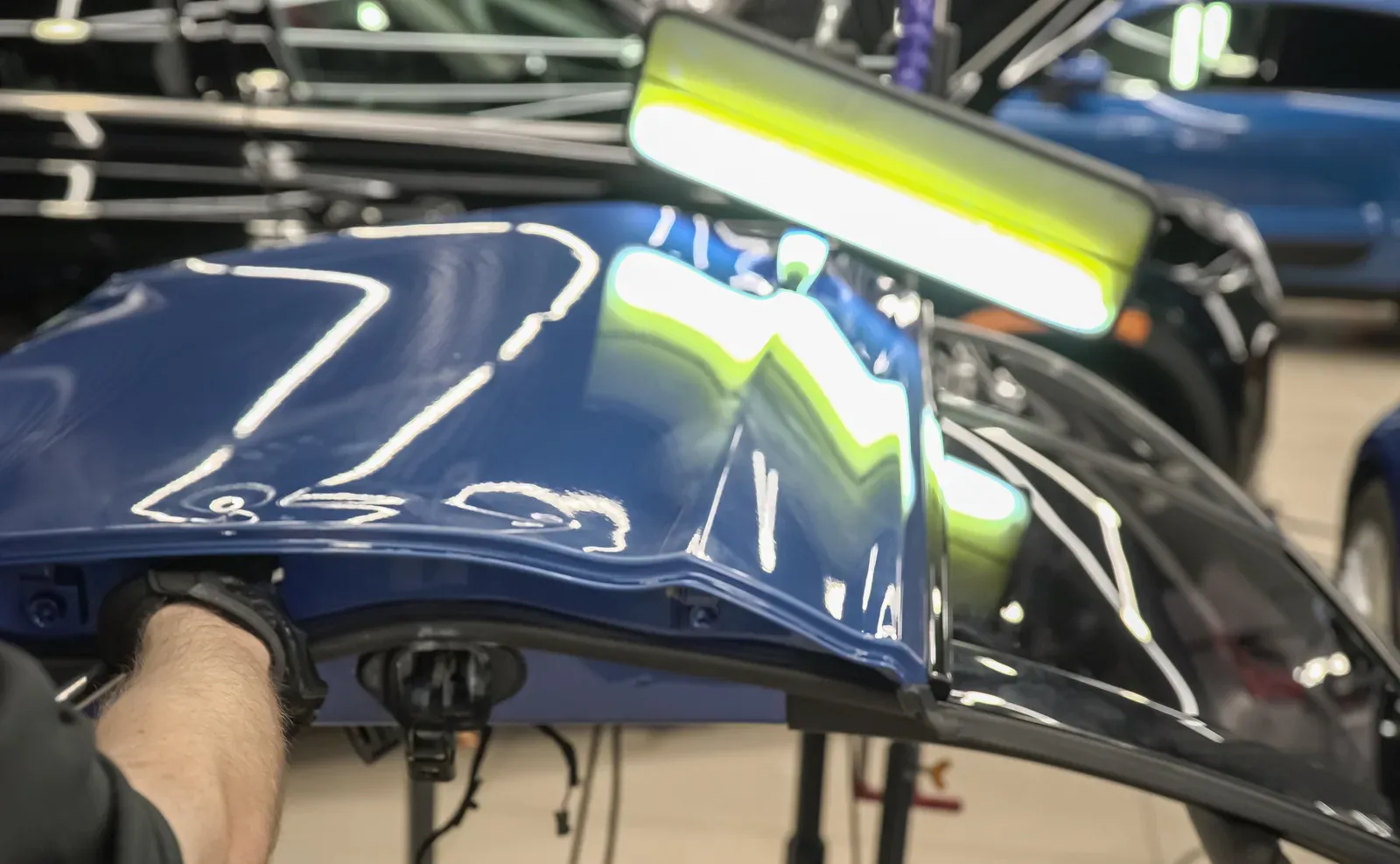
Roofs are where paintless dent removal earns its place, because refinishing a whole roof is a large job for a small mark. When the paint has not cracked, our technician works the crease out from underneath with rods and a light board, reading the reflection across the panel to see the metal level out. Access to a roof usually means lowering the rear of the headliner or working through the dome-light or sunroof opening, done carefully so the interior goes back without a mark.
A sharp, short crease is harder than a long soft one, and a crease right on a roof rail or a hood’s front edge sometimes cannot be brought back fully without paint. We tell you that from the photos, before the car comes in, so you know which repair you are deciding on. If the panel does need paint, it is colour-matched and blended so the roof does not read as a different shade from the pillars beside it.
For the claim, the estimate is the document the lot operator or your insurance company will want. Send three clear photos of the crease, in daylight, with one showing the whole roof or hood so the size is clear, and our estimator writes it up the same business day. If the operator agrees to pay, the shop invoice is what they will ask for.
Questions people ask
The attendant says the sign warns that gates can close on cars. Does that end my claim?
Not necessarily. A sign is the operator’s first line of defence, but it does not settle whether their gate closed on a car it had just let through. Send your receipt, the time and the gate number anyway, and ask for the footage to be reviewed. If they still refuse, your own coverage is the next step.
I followed the car ahead through without paying first. Is that my fault?
Probably, at least in the operator’s eyes. Most barrier gates are built to close after each vehicle, and tailgating through is the classic way to get hit. That damage would normally fall under your own collision coverage. It is still worth photographing the gate and getting the estimate before you decide whether a claim makes sense.
The arm only scuffed the clear coat on the hood. Does that need a body shop?
Often not. A rubber-edge scuff that sits on top of the clear can usually be polished out. If a faint line remains after polishing, or you can see a shallow dent under the scuff, send a photo and we will say which it is.