Drive to a safe exit if the car allows it, and leave the object where it lies
The right move after the bang is usually to keep going, gently, to the next exit. A shoulder on the 401 collectors or the 404 between Highway 7 and the 401 is a dangerous place to stand, and the object you hit is already behind you. Watch the dash on the way: a temperature needle climbing, an oil-pressure light, a steering pull or a tire-pressure warning all mean the car should stop at the first safe spot rather than the convenient one.
Do not walk back for the ladder or the tread. If it is still in a live lane and other drivers are going to hit it, call 911 and tell them where it is; the OPP patrols the 400-series highways and wants hazards off the road. On the DVP and the Gardiner, Toronto Police handle it. Either way, give the direction of travel and the nearest exit or overpass, because that is how a crew finds it.
If a dash camera was running, save the clip before the loop records over it. A few seconds showing the object falling from a vehicle ahead, or lying in the lane, settles more questions than any written description.
With nobody to name, the adjuster places the claim from your description
When no one can be identified, the claim stays on your own policy, and how you describe it decides where it lands. As a rule of thumb, an object that falls or flies into the car, such as part of a load blown off a truck, is usually a comprehensive loss, while driving into or over something already lying in the lane is usually treated as collision. The insurance company makes the final call, so tell the adjuster what you saw, in order, and let it place the claim. Your deductible applies either way, and you confirm the amount before work begins.
If you did see where it came from, that changes the file. A pickup that shed a ladder, a flatbed that dropped lumber, a trailer that threw a tread: the plate, the company name on the door and the time are worth more than anything else you could gather. Report it to police so there is a record of the vehicle. Your insurance company then has an identified party to work with, and the rating can change.
Call your insurance company that day or the next, well inside the week a standard Ontario policy allows for notice, and ask whether it wants a police or Collision Reporting Centre report for this kind of loss. Some do for any highway claim. A report made the same day is far easier than reconstructing one a week later.
Photographs to take once the car is off the highway
Shoot the car before you clean it, from far to near, and include underneath. The debris story is told in marks a wash removes.
- A wide shot of the front or side showing where the strike landed, with the plate in frame.
- Close shots of any rubber smears, wood splinters, metal transfer or a strap caught in the grille.
- The ground under the engine bay after a few minutes parked, to show any green, orange, red or brown drip.
- The underside as far as you can see: hanging plastic, a dented pan, a loose heat shield.
- The dashboard with every warning light that came on, and the trip odometer.
- A screenshot of your map history or a note of the exit you took, with the time.
The expensive damage sits behind the grille and under the engine
Many debris strikes look small from the front and large from the hoist. Low objects like a tread, a muffler or a strap slide under the bumper cover, so the visible cover may only carry a scuff while the engine splash shield is torn, the lower radiator support is bent, and the air-conditioning condenser, the first thing behind the grille, has a crease that will slowly leak refrigerant. Behind that sits the radiator, and on turbocharged cars an intercooler and its hoses.
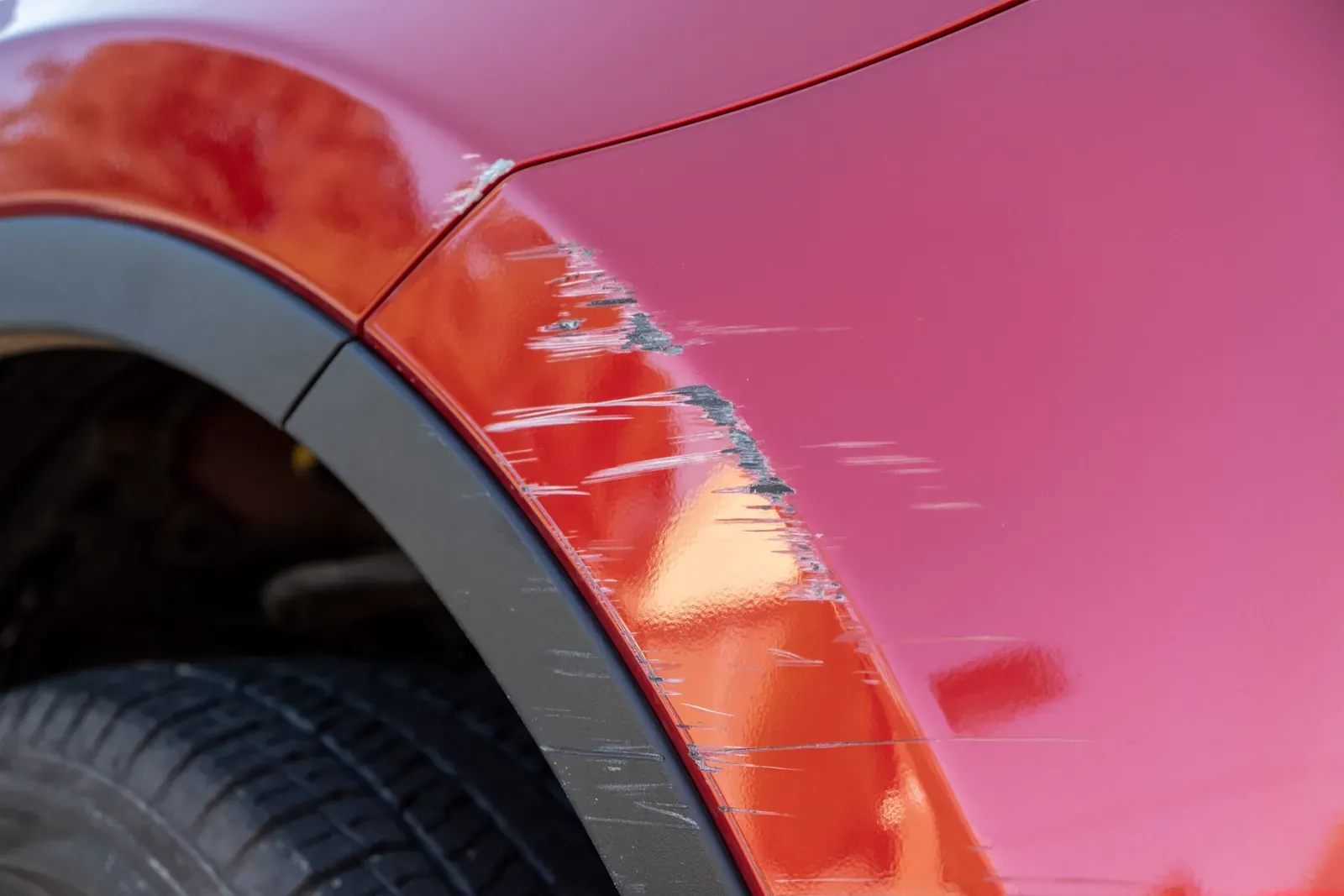
Further back, the parts to check are the oil pan, the transmission cooler lines, brake and fuel lines along the floor, the exhaust and its hangers, and the rocker panels. A truck tire tread that breaks up at speed can also whip into a front door or rear arch and leave a long dent with black rubber in it.
Driver-aid hardware lives in the strike zone. Front radar often sits behind the grille emblem or in the lower bumper, and parking sensors sit in the cover. A module knocked out of aim may show as adaptive cruise turning itself off or a sensor-blocked message. Recalibration may be required once parts are replaced, and that goes on the estimate rather than surprising you at pickup.
How we inspect a debris-strike car
Three photos get the first estimate started: the front, the damage up close and one wide shot, plus a note of which lights came on. Our estimator writes it the same business day. When the car arrives it goes up on the hoist with the under-shield off, because a debris estimate written from the front bumper alone is usually short. Parts found once it is apart are photographed and sent to your adjuster as a supplement, and we carry that back-and-forth for you.
A coolant or oil leak is a reason to tow rather than drive, and we can help set that up to wherever you want the car to go. Mechanical items such as an oil pan or a transmission line are marked separately, and the body-work lines stay distinct from them. We deal with whichever insurance company you have, in English or Mandarin, and any rental comes through your own policy’s coverage.
Questions people ask
I drove over a tire tread and now there is a drip under the front. Can I drive to the shop?
Check the colour and the gauges. Clear water from the air conditioning is normal. Green or orange coolant, brown oil or red transmission fluid means stop and arrange a tow, because an engine run low on any of those can turn a body repair into a much larger one.
A ladder came off a pickup ahead of me on the 401 and I got the plate. Does that help?
A great deal. Report it to police with the plate and description, and give both to your insurance company. An identified vehicle gives your insurance company someone to deal with and can change how the claim is rated, compared with debris from nowhere.
Nothing looks broken but adaptive cruise keeps switching off since the strike. Related?
Very possibly. A radar module behind the grille or lower cover can be knocked out of aim by a strike that barely marks the paint. A scan and inspection of the mount will tell you, and recalibration may be needed once the cause is fixed.