From the harbour to Stevenson Road
The south end supplies the summer scratches. The launch and the lots around the harbour and Lakeview Park are gravel at the edges, and gravel plus a turning trailer equals a curved scrape down a rear quarter, often with a shallow dent underneath it. Low posts, hitch tongues and the corner of a car-topper account for most of the rest between May and October, and any nick that reached bare metal starts browning within a few wet weeks on a car that lives outside.
Through the middle of the city it is grit. The transports running Stevenson Road and Park Road throw stone and road sand at everything behind them, and a season of that leaves the lower doors and rocker faces of a following vehicle finely scored rather than obviously scratched. In the older north end the streets are narrow and the hedges are old; squeeze over for an oncoming pickup and the passenger side comes home wearing hairline scoring from the door handle back. And in the plaza lots along King and Taunton, the mark that turns up is usually somebody else’s paint transferred onto your bumper corner in a stripe.
How far in the mark went
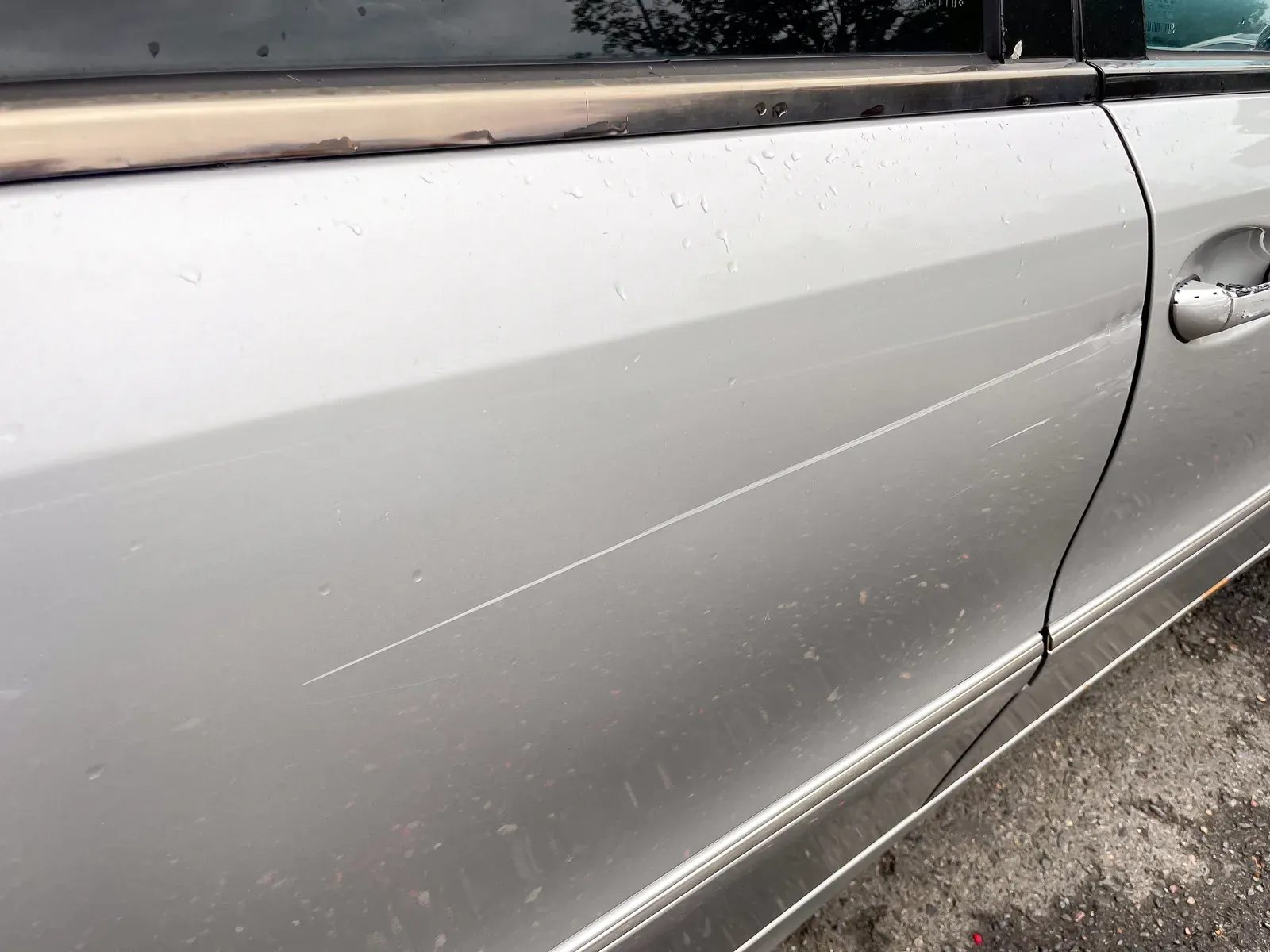
Depth is the whole question, and a fingernail drawn slowly across the mark answers most of it. Gliding over without catching, on a line that only shows in direct sun, means the damage stopped in the clear coat — a compound and a machine polisher take it out in under an hour with no paint involved. If it catches and the line reads lighter than the panel around it, the clear is gone and colour has been cut into, and no amount of polishing puts colour back — that is a refinish. If you can see grey primer or bright metal, the clock is running, because bare steel low on the body sits in salt spray from November and turns a paint repair into a cut-and-weld repair by spring.
Refinishing means sanding the area flat, priming where the metal is exposed, spraying a colour tinted to your car rather than to the code, and fading it into the adjacent panel so no edge exists. A scrape that crosses from a quarter panel onto a bumper cover is two materials, steel and flexible plastic, prepared with different products and painted in the same pass. Paint transferred from another vehicle is the happy case: most of it polishes off entirely, and what is left underneath is usually far less than it looked.
- Clear-coat marks polished out, no spraying and usually no more than an hour
- Colour-deep lines refinished and faded into the panel beside them
- Exposed primer and metal sealed before the first salt run of the winter
- Transferred paint from another car usually comes off completely
Fitting it into a trip you were already making
A lot of Oshawa works west of Oshawa. If you commute along the 401 toward Scarborough, North York or Markham, our exit is already on your route, which changes the arithmetic entirely for a polish: pull off at the 404, hand over the keys, spend the time in Fairview Mall next door, and collect the car on the way back through. People who take the train from Oshawa GO on Bloor Street sometimes do it in reverse, leaving the car on a Saturday and picking it up the following weekend.
A refinish is different, because booth time and cure time are not negotiable and the car stays a few days. That gets booked for a week you can spare it, with a rental through your coverage if the damage is going through a claim. Whether it should is a question of who caused it. A key line cut across three panels in a public lot is vandalism, which is comprehensive coverage with no fault recorded against you — report it to police online or at a station, not a collision reporting centre, and it is usually worth claiming. A scrape you put on your own trailer or a post is collision coverage with your deductible, and usually is not. Our estimator writes the estimate either way, so the decision is made with a number rather than a guess.
Questions people ask
The lower doors on my car look dull and scoured after a winter behind trucks on Stevenson Road. Is that fixable?
Usually, and often without paint. Road sand thrown by transports scores the clear coat in thousands of shallow passes rather than one deep cut, so a machine polish restores the gloss on most of it. Where seasons of grit have worn through to colour or primer — typically the rocker faces and the bottoms of the doors — those areas are refinished and blended upward into sound paint. Photos taken low along the side in daylight tell us which of the two you are looking at.
A hedge on a narrow street put fine lines down the whole side of my car. Polish or paint?
Usually polish, and it is one of the most satisfying jobs we do. Hedge and branch marks tend to be many shallow lines in the clear coat rather than a few deep ones, so machine polishing removes most or all of them at once. The exception is where a heavier branch dug in — sight down the length of each line in low sun, and any line that reads lighter than the paint around it has cut into colour and needs paint even if the rest do not.
The scrape is on the plastic bumper cover, not on metal. Does that change the repair?
It changes the preparation, not the outcome. Flexible plastic needs an adhesion promoter and a paint mixed with a flex additive, or the finish cracks the first time the cover takes a knock. The upside is that plastic does not rust, so a deep scrape there is not urgent the way bare steel on a rocker is. The downside is that a gouge deep enough to raise a furrow of plastic needs sanding and filling before any colour goes near it.